
For most UTV owners, synthetic rope is safer and more practical for winch recovery. It is lighter, easier to handle, and stores less recoil energy than steel cable, reducing injury risk. Steel cable remains suitable for heavy utility work where abrasion and heat are frequent concerns.
Many discussions about synthetic rope versus steel cable overlook critical recovery details. This guide examines how each material performs under load, identifies key risks, and explains how the right choice can simplify challenging recoveries.
A practical breakdown for UTV owners who handle their own recoveries, from trail situations to utility applications.
Safety Comparison: Recoil, Snapback, and Injury Risk
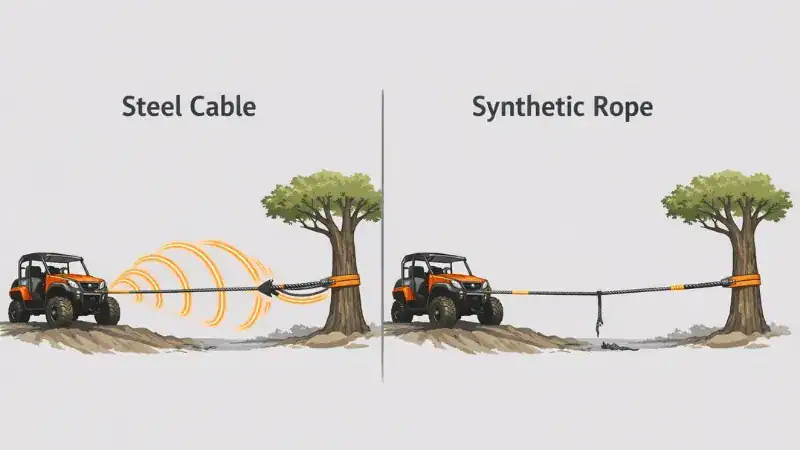
Safety is the primary concern when comparing synthetic rope and steel cable for UTV winches. The main risk is recoil energy, which determines how forcefully a line reacts if it breaks under load.
Steel cable stores significant energy when under tension. If it breaks, it can snap back forcefully, posing a serious injury risk to anyone near the line of pull.
For example, during a solo mud recovery on a narrow trail, a UTV operator may have limited space to avoid the winch line. If a steel cable breaks under load, the snapback can move unpredictably toward the vehicle or operator. In contrast, a broken synthetic rope typically falls to the ground, significantly reducing the risk of serious injury in confined spaces.
Reducing snapback risk depends not only on rope material, but also on where the operator stands — which is heavily influenced by winch remote choice during recovery.
Synthetic rope acts differently:
- Stores far less recoil energy than steel cable under load
- When synthetic rope fails, it usually drops instead of snapping back.
- This distinction is most critical when someone is near the winch line during a slow, loaded pull.
Synthetic rope does not eliminate all risk. Proper technique, maintaining a safe distance, and using winch line dampers are essential regardless of the rope type.
The primary safety difference between synthetic rope and steel cable is the amount of recoil energy stored. While this makes synthetic rope appear safer, proper recovery technique remains essential with either material.
Performance Differences Under Real UTV Recovery Conditions
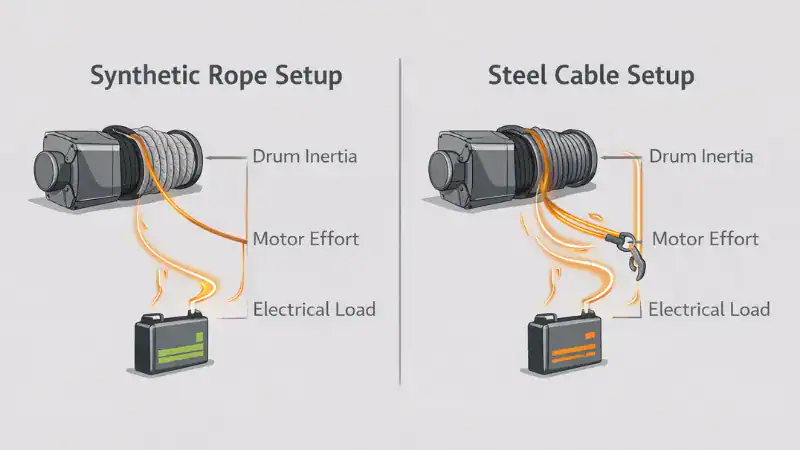
In actual UTV recoveries, performance depends on control, consistency, and compatibility with your electrical system, not just maximum pull rating.
Synthetic rope is lighter, placing less weight on the winch drum. This results in:
- More consistent line speed under load
- Better control during short, staged pulls
- Reduced strain on UTV batteries and stators
Steel cable adds more weight to the drum, which can reduce line speed and increase power draw during extended pulls on UTV electrical systems.
Environmental performance also varies between the two materials:
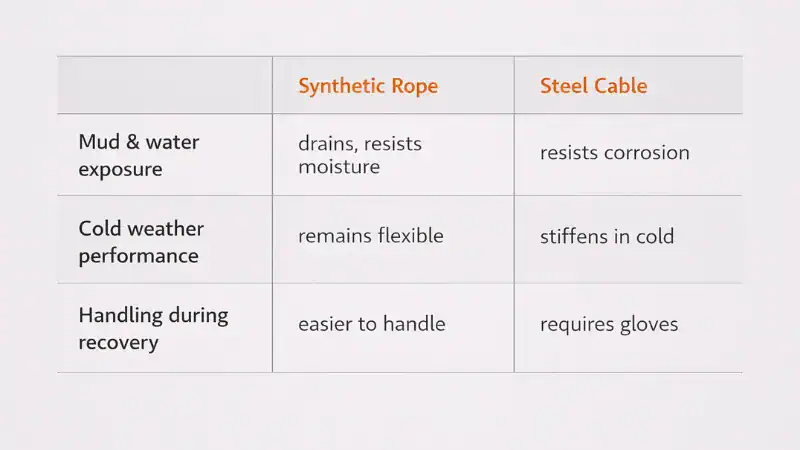
- Mud and water: Synthetic rope does not corrode. Steel cable can rust internally after repeated exposure to water.
- Cold conditions: Synthetic rope stays flexible, while steel cable gets stiff and harder to handle.
- Handling during recovery: Synthetic rope is easier to handle, move, and rewind onto the drum, helping to reduce operator fatigue.
Steel cable’s main advantage is abrasion resistance. However, for most trail and recreational recoveries, control and predictability are more important, making synthetic rope the preferred option.
Synthetic rope reduces weight on the winch drum and lessens strain on the electrical system, resulting in better line control, consistent performance, and greater efficiency. In contrast, steel cable adds weight, which can slow line speed and increase power draw from UTV batteries and stators.
How well a winch manages electrical load and heat varies widely by manufacturer, which is why engineering differences between winch brands matter as much as rope choice.
Durability and Maintenance: Abrasion, Heat, and Longevity
Durability depends more on proper use and maintenance than on the material itself. Both synthetic rope and steel cable can fail prematurely if not used correctly.
Where the steel cable holds up well?
Steel cable tends to perform reliably in situations that involve:
- frequent contact with sharp edges or rocks
- Repeated abrasion during hard recoveries
- Higher heat exposure, especially during long pulls
This durability is why steel cable remains common in heavy-duty and industrial applications.
Where steel cable becomes a liability?
Despite its strength, steel cable is vulnerable to issues that develop over time:
- corrosion after repeated exposure to water or mud
- internal strand damage that’s difficult to spot during casual inspection
- fraying that turns handling into a safety concern, even with gloves
These issues often develop gradually and can be overlooked until they pose a significant risk.
Why do many riders prefer synthetic rope?
Synthetic rope provides several advantages for routine UTV recovery:
- No corrosion risk, even in wet environments
- Damage is easier to see during routine checks.
- Handling is safer and more forgiving during setup and recovery.
For most recreational and utility UTV applications, these benefits make recovery safer and more predictable.
Limitations to Keep in Mind
Synthetic rope performs well in most UTV recoveries, but it has limitations that are important in practical use:
- Abrasion shortens its lifespan quickly when the rope is dragged across rocks or sharp edges.
- Continuous friction on the drum or fairlead can generate heat more quickly than many operators expect.
- long-term exposure to sunlight slowly degrades the fibers over time
Steel cable offers greater abrasion resistance, while synthetic rope is easier to inspect and safer to handle. Steel cable can corrode internally and develop sharp frays over time. Synthetic rope is more sensitive to abrasion and heat but does not rust.
Maintenance is essential for both types of winch line to ensure longevity. This includes cleaning synthetic rope, inspecting steel cable for broken strands, avoiding power spooling under load, and replacing damaged lines. With proper care, both materials can last and avoid most failures.
Fairlead Compatibility: Hawse vs Roller
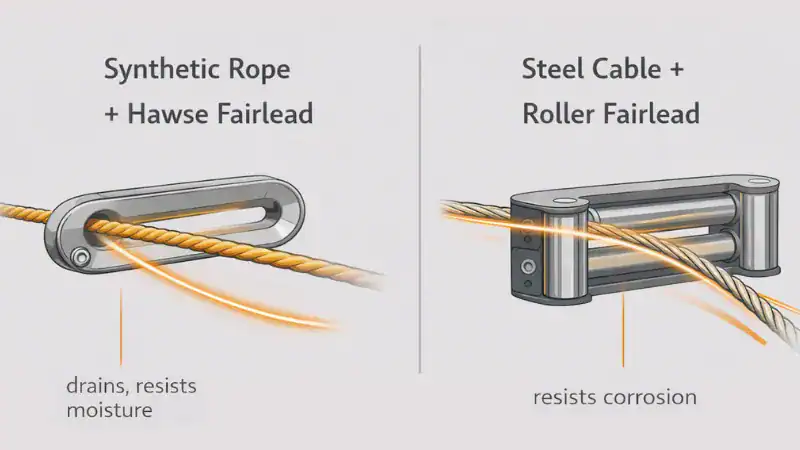
Fairlead compatibility is a critical safety factor that is often overlooked. Using the incorrect fairlead can accelerate wear and increase the risk of failure.
The rules are simple:
- Synthetic rope → Hawse fairlead
- Steel cable → Roller fairlead
A hawse fairlead provides a smooth surface that protects synthetic rope from abrasion. Roller fairleads are designed for steel cable but can pinch or damage synthetic rope.
Selecting the correct fairlead is essential for winch safety. Use a smooth hawse fairlead with synthetic rope and a roller fairlead with steel cable. The wrong fairlead can accelerate wear and increase the likelihood of line failure during recovery.
Common risks of mismatched setups include:
- Accelerated rope wear
- Heat buildup at contact points
- Uneven spooling and binding
Proper fairlead alignment is equally important, as severe pull angles increase friction and stress on the line, regardless of material.
Selecting a fairlead is not merely an accessory choice; it is a critical component of the load path that protects both the winch line and the operator during recovery.
When Steel Cable Still Makes Sense on a UTV
Steel cable is best suited for UTVs primarily used in heavy utility work, such as environments with constant abrasion, sharp edges, or repeated long pulls that generate heat.
Steel cable requires more experience and stricter safety procedures, making it less suitable for general trail or recreational recovery.
Steel cable may be the better option when:
- Abrasion is constant and unavoidable.
- Heat buildup from repeated long pulls is expected.
- The UTV is primarily used for work, not for trail recovery.
Examples include farm operations, construction sites, and snow plowing, where the line frequently contacts hard edges.
However, steel cable requires:
- Proper roller fairlead setup
- Use of winch line dampers
- Strict stand-off positioning
- Frequent inspection for corrosion and fraying
At ATVNotes, we consider steel cable a specialized tool rather than a general upgrade for recreational UTV use.
Which Winch Line Is Best for Most UTV Owners?
That’s right—synthetic rope is the best overall choice.
It is better suited for:
- Trail riding
- Solo recovery
- Mud and snow conditions
- Recreational and mixed-use UTVs
As suggested above, steel cable is better reserved for:
- Heavy utility work
- Abrasion-heavy environments
- Operators trained in strict recovery safety
When selecting a winch line, consider winch capacity, electrical limitations, and your recovery technique. In most cases, a properly sized winch with synthetic rope offers better control and safety than a heavier setup with steel cable.
Common Mistakes with Synthetic Rope and Steel Cable
Most winch line failures result from user error rather than material weakness. Synthetic rope and steel cable fail for different reasons, but both become hazardous when basic recovery rules are not followed.
Many of these rope-related failures are preventable with proper technique, positioning, and pacing, all of which are covered in our UTV recovery safety fundamentals.
Common mistakes with synthetic rope:
- Power spooling under heavy load, which causes heat damage to the drum
- Dragging a rope across sharp edges without protection
- Using roller fairleads instead of smooth hawse fairleads
- Skipping regular inspections for abrasion and glazing
Common mistakes with steel cable:
- Ignoring corrosion after water or mud exposure
- Handling a frayed cable without gloves
- Winching without a line damper
- Standing inside the line of pull during recovery
The most significant mistake with either material is improper recovery positioning. Standing too close to a tensioned winch line or failing to move bystanders away greatly increases the risk of injury.
From a recovery training perspective, proper technique prevents most failures. Using a damper, maintaining a safe distance, pacing pulls, and regularly inspecting winch lines are more important than the type of rope used.
Synthetic Rope vs Steel Cable — Quick Comparison
The following table highlights the real-world differences between synthetic rope and steel cable on UTV winches, focusing on actual recovery performance rather than specifications alone.
| Feature | Synthetic Rope | Steel Cable |
| Failure Behavior | Drops with low recoil | Snaps back violently |
| Weight on Winch Drum | Light | Heavy |
| Handling Safety | Safer, easier to grip | Hazardous when frayed |
| Abrasion Resistance | Moderate | High |
| Corrosion Risk | None | High over time |
| Best Use Case | Trail, solo, mixed use | Heavy utility, abrasive work |
For most UTV owners, synthetic rope provides a safer and more user-friendly recovery experience. Steel cable is preferable in specialized work situations where abrasion resistance outweighs safety considerations.
FAQs on UTV Winch Line Options
Can I replace the steel cable on my UTV winch with a synthetic rope?
Yes. Most UTV winches can be converted from steel cable to synthetic rope. You will also need to install a hawse fairlead. Ensure the rope size matches your winch and spool it carefully before use.
Does synthetic rope wear out faster than steel cable?
Not necessarily. Synthetic rope is more sensitive to abrasion and heat, while steel cable is more prone to rust and fraying over time. With regular inspection and proper use, both types can be long-lasting.
Do I still need a winch line damper with synthetic rope?
Yes. Even though synthetic rope is safer, a winch line damper should still be used. A damper absorbs energy and provides additional protection if the line or anchor fails during recovery.
What winch rope is best for mud and snow recovery?
Synthetic rope is best for mud and snow recovery. It does not rust, remains flexible in cold weather, and is easier to handle when wet. These qualities make it ideal for typical UTV trail and winter recovery scenarios.
Final Verdict
For most UTV winch applications, synthetic rope is the best overall choice. It is lighter, safer, and easier to control during recoveries, particularly in mud, snow, and rough terrain.
Steel cable remains a good option for utility UTVs operating in environments with significant abrasion or heat. However, it requires stricter safety procedures, the correct fairlead, and careful operator positioning to manage snapback risk.
The main point is clear – selecting a winch line is primarily about safety, not just strength. A properly sized winch with synthetic rope and sound recovery technique offers the best combination of control, reliability, and injury prevention.
Rope choice affects safety and control, but winch capacity, duty cycle, and electrical limits ultimately determine recovery success — all of which are covered in our complete UTV winch guide.
Continue exploring related topics:
- Understanding UTV winch electrical limits and overheating risks
- How snatch blocks reduce load and improve winch recovery safety
- Essential winch accessories that improve recovery safety and control

ATVNotes is an off-road resource focused on ATV and UTV winching, recovery systems, safety gear, tires, batteries, and essential off-road equipment. Content is produced by the ATVNotes Expert Team and written from the perspective of a practical off-road recovery advisor, emphasizing real-world performance, system compatibility, and safety-first practices across trail riding, utility use, and off-road exploration.