
What Is an ATV/UTV Winch Recovery System?
Most riders think of a winch as a powered spool mounted to the front bumper.
But actually, that’s only part of the story.
Most winch failures I see in trail riding aren’t motor failures — they’re mounting or electrical issues.
A true ATV or UTV winch recovery system is not a single component — it’s a coordinated chain of mechanical force, electrical supply, structural support, and rated recovery hardware working together under tension. When one part of that chain is weak, the entire system feels weak, no matter how strong the motor is.
In real trail conditions, you don’t just test a winch. You test the system behind it.
An ATV/UTV winch recovery system is a vehicle-mounted pulling system that combines a winch motor, gear train, rope or cable, electrical supply, mounting structure, and rated recovery hardware to extract a vehicle under controlled tension.
That last phrase — controlled tension — is what separates a recovery system from a simple pulling device.
When a machine is buried in mud or resting on its frame rails, the force required to move it doesn’t just travel through the rope. It travels through the drum, into the mounting plate, across the frame, and back through the electrical system that feeds the motor. Every component shares that load.
If the battery sags under current demand, the motor slows.
If the mounting plate flexes, bolts begin to loosen over time.
If the recovery point isn’t rated, it becomes the failure point.
Thus, a reliable setup accounts for all of those.
At its core, every ATV or UTV winch recovery system includes three interdependent layers:
Mechanical drive components, which generate and multiply pulling force:
- Winch motor
- Gear train (planetary or worm)
- Drum and rope/cable
- Fairlead guiding the line path
Electrical supply components, which deliver high current under load:
- Battery
- Solenoid or sealed contactor
- Heavy-gauge wiring and ground path
Structural and recovery hardware, which transfers and manages force:
- Model-specific mounting plate
- Rated recovery points
- Snatch block (for mechanical advantage when needed)
As is pointed out earlier, none of these operates independently. On the contrary, they are to work simultaneously to make the recovery system operational and successful. For example, the motor may be rated for thousands of pounds, but if the voltage drops or the mounting plate flexes, performance immediately declines.
Therefore, the experienced riders learn that recovery reliability isn’t about buying the biggest winch available. It’s about building a balanced system in which electrical delivery, mechanical leverage, and structural strength support one another.
In the sections that follow, we’ll break down how each part of the system influences the others — and how to build a setup that performs consistently in mud, snow, steep terrain, or work applications.
If you’re still evaluating equipment options, you can also explore our detailed guide on the best ATV winches to see how different models fit into a complete recovery system.
How ATV and UTV Winches Differ in Design, Capacity, and Use
Although ATV and UTV winches look similar at first glance, their real differences appear in load demands, mounting structure, and electrical support. Vehicle weight, intended terrain, and recovery frequency all influence which winch type performs best. Understanding these differences prevents undersizing or unnecessary upgrades. The following sections break down how motor design, gearing, rope choice, waterproofing, and OEM integration affect real-world performance.
ATV vs UTV Winches — What’s Actually Different?
At first glance, ATV and UTV winches look similar. In practice, the differences are tied to vehicle weight, electrical capacity, and mounting structure, not branding.
ATVs typically weigh between 500–800 lbs (wet weight), while many UTVs exceed 1,200–2,000 lbs before cargo. That difference directly affects:
- Required winch capacity
- Amp draw under load
- Mounting plate strength
- Frame stress distribution
A 2,500–3,500 lb winch is common for ATVs. UTVs can do with 3,500 lbs winches nut often require 4,500–6,000 lbs to handle added weight and resistance.
The electrical system also matters. UTVs generally have larger batteries and higher-output charging systems, allowing them to support heavier winches more comfortably.
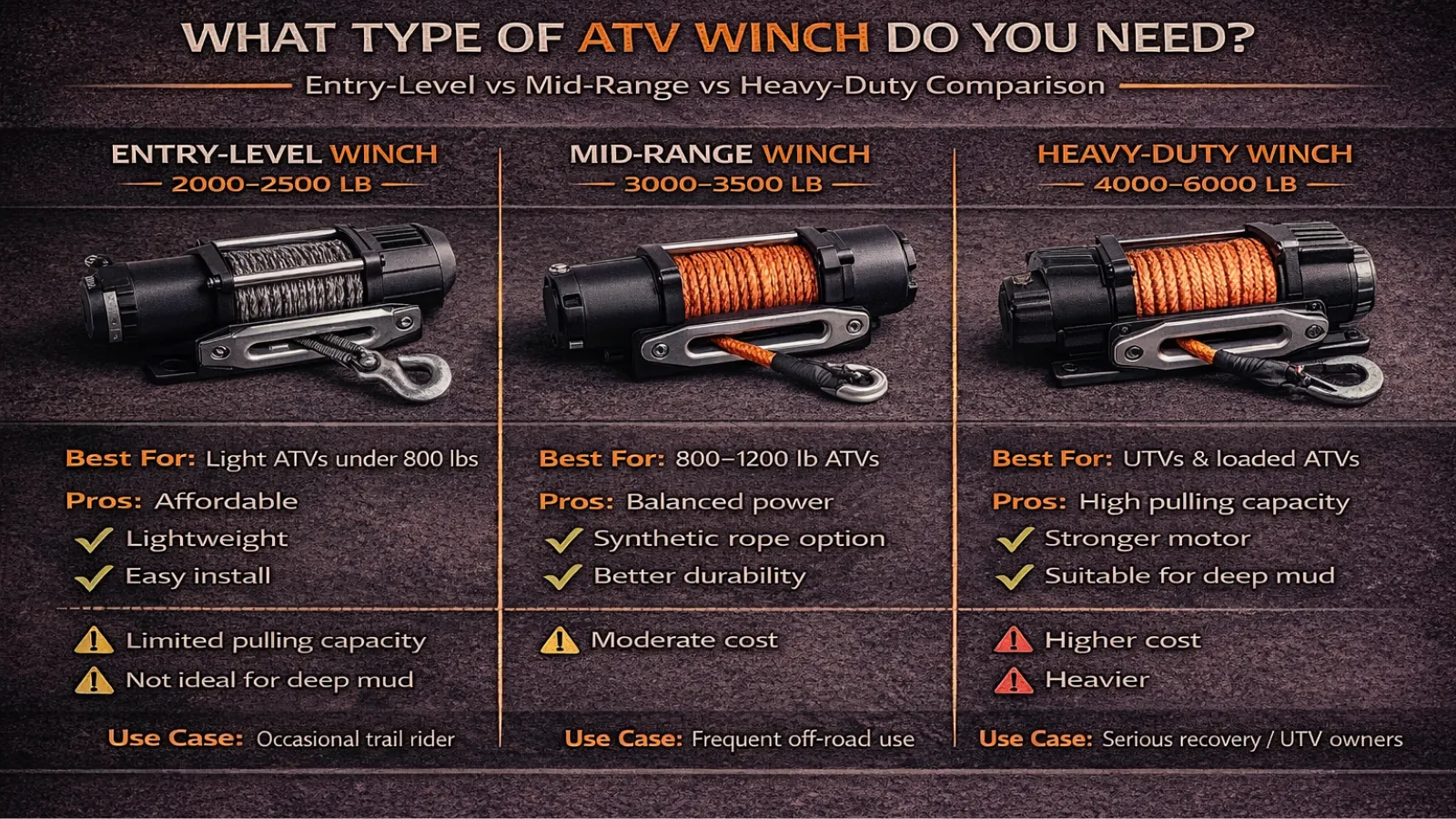
Physically, UTV mounting plates are usually larger and reinforced differently, since recovery loads are higher and bumper designs vary more widely.
The winch itself may look similar, but the vehicle integration changes everything.
To understand the off-road recovery system you need to go through a breakdown of sizing and compatibility differences.
Motor Types – Permanent Magnet vs Series Wound
The motor is the heart of the winch. In ATV/UTV applications, two types are common:
- Permanent magnet motors
- Series-wound motors
Permanent magnet motors are lighter and more common in smaller ATV winches. They are efficient for intermittent use but can generate more heat under sustained heavy loads.
Series-wound motors are typically found in higher-capacity winches. They produce stronger torque under load and handle heat better, making them more suitable for heavier UTV recoveries.
The key difference isn’t just torque — it’s duty cycle.
Duty cycle refers to how long a winch can operate under load before overheating. Heavier vehicles and deep mud recoveries increase heat buildup inside the motor housing.
For occasional trail recovery, either motor type may be sufficient. For frequent heavy pulls or work tasks, heat resistance becomes more important than raw rated capacity.
The motor choice should match how often and how hard you expect to pull.
Gear Systems – Planetary vs Worm Gear
Once the motor spins, the gear train multiplies torque before it reaches the drum.
Most ATV/UTV winches use planetary gear systems. These are compact, efficient, and allow faster line speeds. They’re well-suited to recreational trail riding where speed and compact size matter.
Worm gear systems, less common in ATVs but found in some heavy-duty applications, provide inherent self-locking properties. This means they resist back-driving under load — but they tend to operate slower and generate more heat during sustained pulls.
The trade-offs:
- Planetary: Faster, lighter, more common.
- Worm gear: Slower, strong holding ability, more heat under extended load.
For most ATV and UTV riders, planetary systems provide the best balance of torque, speed, and packaging.
Gear type affects how efficiently torque is transferred — but mounting strength, line condition, and electrical supply often influence recovery success more than gear design alone.
Synthetic Rope vs Steel Cable
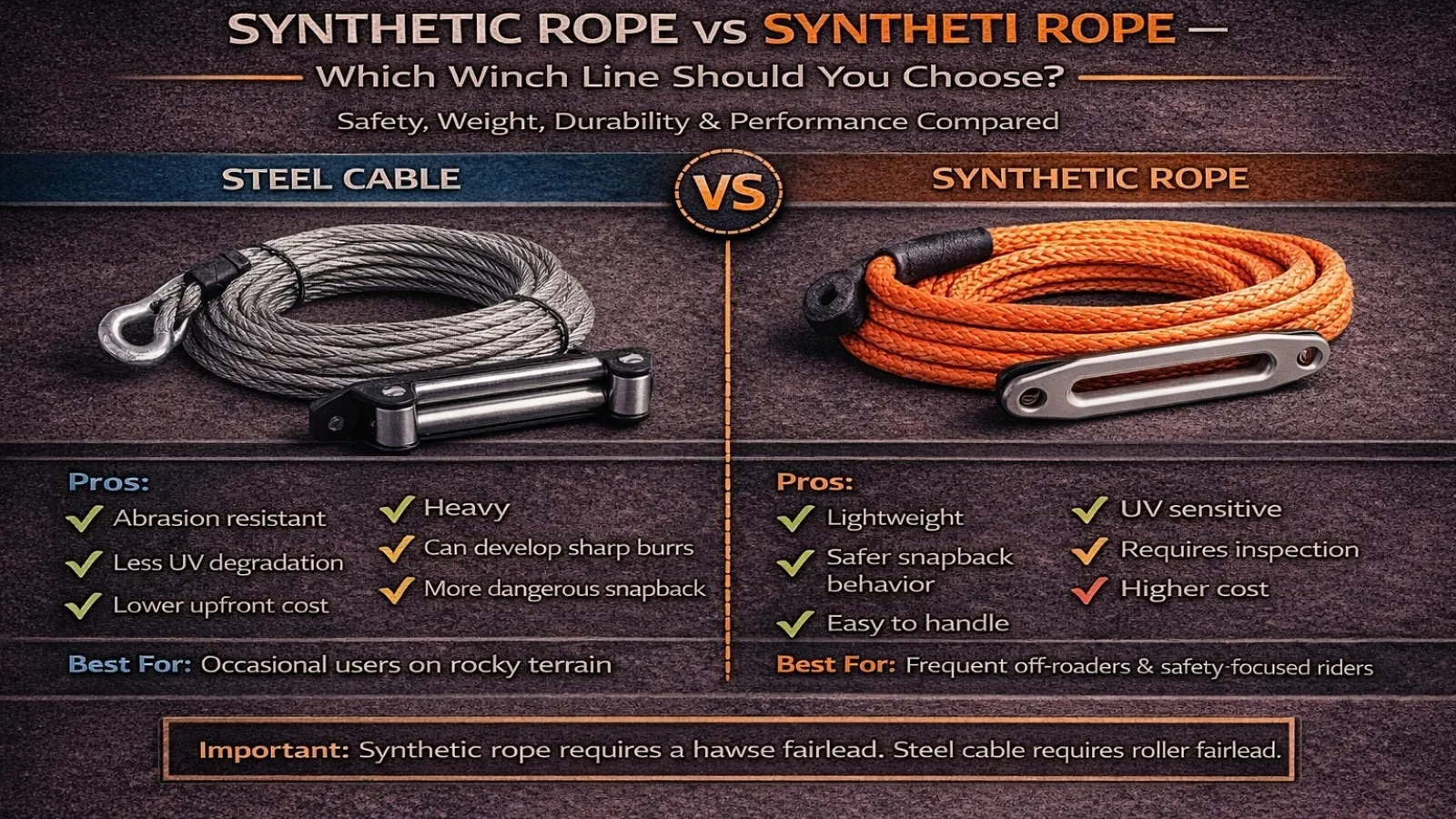
Both options perform the same basic function — transferring pulling force from drum to anchor — but they behave differently under stress.
| Feature | Synthetic Rope | Steel Cable |
| Weight | Lighter | Heavier |
| Safety if snapped | Lower recoil energy | Higher recoil energy |
| Handling | Easier with gloves | Can develop burrs |
| Abrasion resistance | Moderate | High |
Synthetic rope is lighter and easier to handle, making it popular for trail riders. Steel cable, on the other hand, is more abrasion-resistant but heavier and stores more energy under tension.
Fairlead compatibility matters here. Synthetic rope typically pairs with a hawse fairlead, while steel cable often uses roller fairleads.
For a deeper comparison of durability and maintenance, Synthetic Rope vs Steel Cable debate can get you the right option for you.
Waterproof Ratings Explained (IP Ratings)
Winches operate in mud, water crossings, and wet climates. Waterproofing isn’t marketing fluff — it affects long-term reliability.
Most sealed winches use IP (Ingress Protection) ratings, such as IP67 or IP68.
- The first digit refers to dust protection.
- The second digit refers to water resistance.
An IP67-rated winch can typically withstand temporary immersion in water. However, no winch is truly immune to long-term exposure to moisture.
Water intrusion most often affects:
- Solenoid contacts
- Motor housing
- Bearings
Riders who frequently encounter mud holes, swamp trails, or creek crossings often choose winches designed for wet and muddy riding conditions, since sealed components help prevent water damage to the motor and electrical system.
OEM vs Aftermarket Winches
OEM (Original Equipment Manufacturer) winches are designed to integrate directly with specific vehicle models. They often offer clean fitment and plug-and-play compatibility.
Aftermarket winches offer a broader selection of capacities, motor types, rope materials, and price ranges.
The main considerations are:
- Mount compatibility
- Electrical connection type
- Warranty support
- Intended usage level
While OEM options simplify installation, aftermarket options offer better flexibility for riders who need specific capacity or performance features.
Reliability depends more on system matching and installation quality than simply OEM vs aftermarket labeling.
Brand reputation can also influence reliability and long-term performance. If you’re curious about how different manufacturers approach winch engineering and durability, it’s worth exploring who actually builds the most trusted UTV winches and how their designs differ.
How Key Winch Features Affect Real-World Recovery Performance
Not every winch feature matters equally in every situation. Instead of focusing on brand names or marketing claims, it’s more useful to understand how specific design features affect recovery outcomes.
The table below summarizes how major winch components influence performance under different conditions:
| Feature | What It Affects | When It Matters Most |
| Motor Type (Permanent Magnet vs Series Wound) | Heat tolerance, sustained pulling strength | Frequent heavy pulls, mud recovery, and work use |
| Gear System (Planetary vs Worm) | Line speed vs torque efficiency | Trail riding vs slow controlled extraction |
| Rope Type (Synthetic vs Steel) | Weight, safety margin, abrasion resistance | Water crossings, deep mud, frequent handling |
| Waterproof Rating (IP67/IP68) | Long-term reliability in wet conditions | Mud riding, snow, submerged crossings |
| Rated Capacity | Recovery margin under load | Larger UTVs, incline recoveries |
| Control Type (Wired vs Wireless) | Operator positioning and safety | Solo recovery situations |
The key insight is this: no single feature determines winch performance. Recovery success depends on how these elements work together under load.
Understanding feature impact prevents overbuilding in low-demand situations — and prevents undersizing in high-resistance terrain.
How to Size an ATV or UTV Winch Correctly for Real-World Recovery
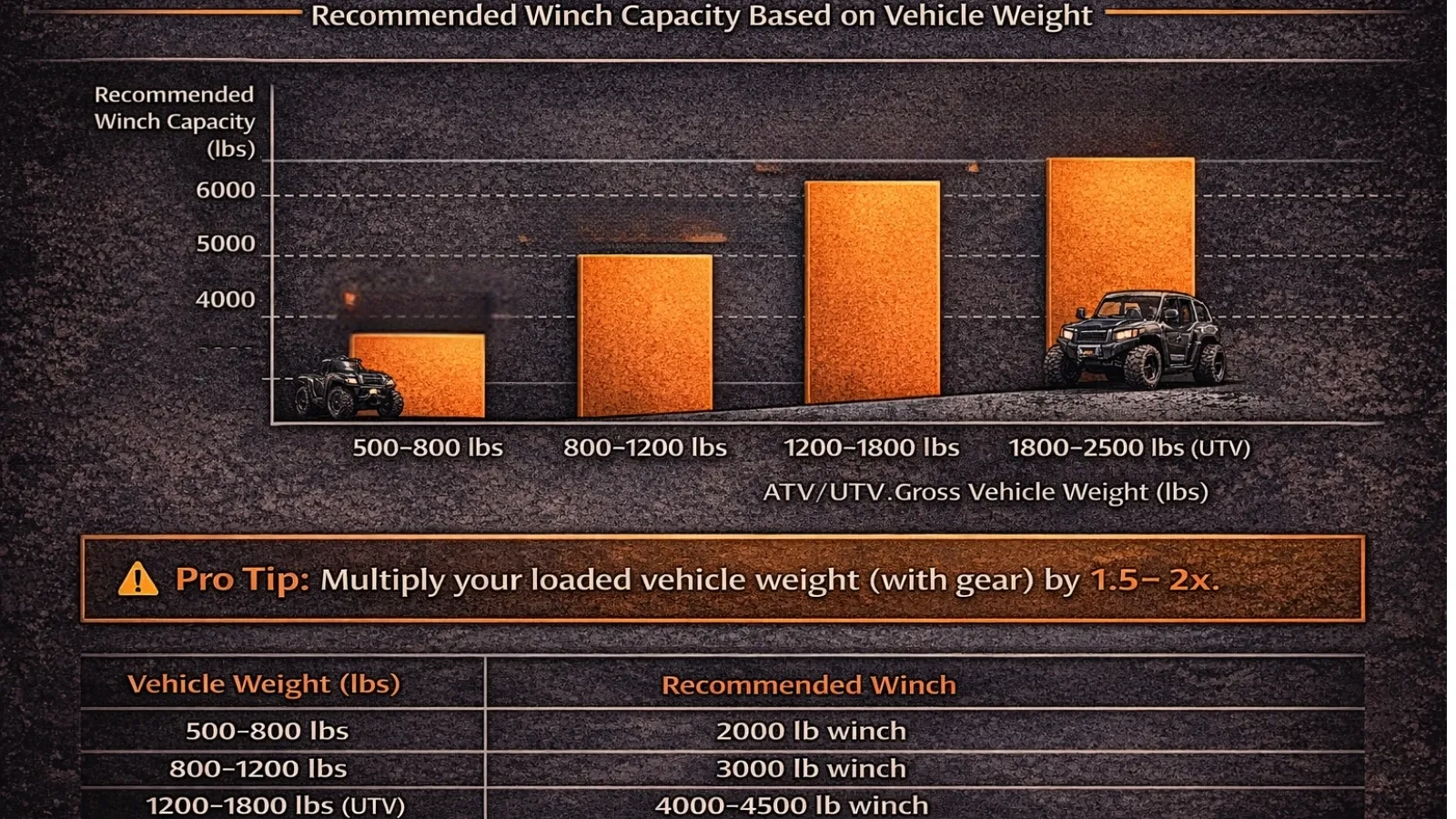
Winch capacity is not just about matching a number to vehicle weight. Terrain resistance, drum wraps, incline angle, and electrical stability all influence pulling performance. While the 1.5× vehicle weight rule provides a useful baseline, real recovery conditions often require deeper evaluation. The following sections explain how sizing works in practical scenarios, including line pull ratings, mechanical advantage, and electrical demand.
What Size Winch Do You Really Need?
The most commonly cited guideline for ATV and UTV winches is simple:
Choose a winch rated at a minimum of 1.5 times your vehicle’s fully loaded (wet) weight.
“Wet weight” includes fuel, fluids, installed accessories, winch mount, racks, plow frames, and typical cargo.
Why 1.5 times?
Because real-world recoveries are rarely equal to static vehicle weight. A stuck machine experiences resistance from:
- Tire suction in mud
- Packed snow resistance
- Incline gravity load
- Obstructed tire rotation
- Embedded rocks or roots
That extra margin keeps the winch from operating constantly at or near stall load, where heat buildup and amp draw increase sharply.
For example:
- A 650 lb ATV used for trail riding will typically perform well with a 2,500 lb winch.
- The same ATV used for deep-mud riding may benefit from 3,000–3,500 lbs of added reserve.
Oversizing, however, has trade-offs. Larger winches:
- Add front-end weight
- Increase electrical demand
- Require stronger mounting support
Capacity is about balance — not simply maximizing the number printed on the housing. No capacity rule eliminates the need for proper rigging.
For deeper calculation logic and terrain multipliers, refer to the Winch Capacity Sizing Guide.
ATV Winch Sizing Guide
Most recreational ATVs fall between 500–800 lbs wet weight. Using the 1.5x rule gives a theoretical minimum of 750–1,200 lbs, but winches are typically sold in practical increments:
- 2,000 lbs
- 2,500 lbs
- 3,000 lbs
- 3,500 lbs
For light-duty trail riding, a 2,500 lb winch is often sufficient. It provides comfortable overhead without excessive weight. However, for machines weighing between 500 and 900 pounds, a 3500-lb ATV winch is the most common upgrade among trail riders. (You can see how the top models compare in this guide on top-rated 3500 lb ATV winches meant for safe off-road recovery.)
However, riding style changes the equation.
If you frequently:
- Ride through clay-heavy mud
- Cross deep water ruts
- Pull other riders
- Use your ATV for plowing
You are increasing the frequency and intensity of load cycles. In those cases, moving to 3,000–3,500 lbs offers:
- Lower motor strain
- Reduced electrical spikes
- Greater recovery margin
The goal is not brute force — it is sustained reliability.
Winch capacity should always match the ATV’s working weight and the type of terrain you ride in. Our detailed guide on how to determine the correct ATV winch capacity walks through the common sizing rules riders use to choose between 2,000, 2,500, 3,000, and 3,500 lb winches.
For a more practical breakdown based on terrain, riding style, and real-world recovery situations, see our guide on choose the right ATV winch based on real-world use.
UTV Winch Sizing Guide
UTVs introduce larger variables.
Base weight alone may range from 1,200 to over 2,000 lbs. Add:
- Passengers
- Bed cargo
- Larger tire diameter
- Accessories (roof, bumpers, plow systems)
A lightly equipped 1,400 lb UTV typically requires at least 4,000–4,500 lbs of winch capacity. Heavier working UTVs may justify 5,000–6,000 lbs.
Unlike ATVs, UTVs often benefit from:
- Stronger frame rails
- Higher-output charging systems
- Larger batteries
This allows them to support heavier winches more effectively — but mounting strength and recovery point rating must still match capacity.
A 6,000-lb winch attached to a weak bumper mount is not a 6,000-lb recovery system.
For detailed working vs recreational scenarios, see the UTV Winch Sizing Guide.
Understanding Line Pull Ratings
Winch ratings are measured under controlled laboratory conditions — specifically at the first wrap of rope on the drum.
At the first wrap:
- Drum diameter is the smallest
- Torque multiplication is greatest
- The rated pulling capacity is the highest
As rope layers accumulate on the drum, the drum’s effective diameter increases. This reduces mechanical leverage and lowers available pulling force.
In practical terms:
- First wrap = maximum pulling power
- Mid wraps = moderate reduction
- Final wraps = noticeable reduction
This is why experienced riders often spool out extra line before heavy pulls.
Winches are rated at the first layer of rope on the drum. As more layers build up, pulling power decreases because the drum diameter increases.
There is also a critical difference between rolling load and dead load.
A rolling load assumes:
- Tires rotate freely
- Surface resistance is low
A dead load occurs when:
- Tires are buried
- Axles are hung on obstacles
- Suction or incline increases resistance
A 1,200 lb UTV stuck to the frame in mud can behave like a significantly heavier dead load.
Understanding line pull ratings helps explain why:
- A properly sized winch can still struggle
- Spooling out more line increases pulling force
- Mechanical advantage becomes valuable
Capacity ratings are not exaggerations — they are simply measured under ideal conditions.
Why the 1.5× Rule Isn’t Always Enough – Real-World Example
The 1.5× rule is a useful baseline — but it assumes relatively controlled conditions.
Consider a practical scenario:
A 1,400 lb UTV becomes buried in clay mud on a slight incline. On paper, a 4,500 lb winch appears more than sufficient. But several factors change the equation:
- Mud suction increases resistance beyond rolling load.
- The incline adds gravitational pull.
- The winch drum is on its third wrap, reducing mechanical leverage.
Under these conditions, the effective resistance can temporarily exceed the simplified 1.5× estimate.
This doesn’t mean the winch is undersized. It means recovery conditions matter.
In this scenario, two adjustments improve performance without changing the winch:
- Spooling out additional line to regain first-wrap pulling power
- Switching to a double-line pull to emphasize load reduction
Capacity rules provide a margin — but real-world recovery depends on load management and mechanical advantage.
Single-Line vs Double-Line Pull
A single-line pull connects the winch line directly to the anchor point.
A double-line pull uses a snatch block at the anchor to redirect the line back toward the vehicle, effectively splitting the load between two segments of rope.
In simplified terms:
- Single-line pull = faster, full load on motor
- Double-line pull = slower, reduced load on motor
By dividing the force required at the drum, a double-line setup can significantly reduce motor strain and electrical draw.
Example scenario:
An ATV buried to the skid plate in clay mud may push a 3,000 lb winch near stall load. Using a snatch block to create a double-line pull emphasizes control and angle management, lowering heat buildup and protecting the electrical system.
The trade-off is a slower recovery speed and additional setup time.
Double-line pulls are especially helpful when:
- Operating near rated capacity
- Recovering uphill
- Managing heavy UTV loads
- Preserving battery life
For full rigging configurations and safety considerations, see Winch Line Rigging 101 and the Snatch Block Guide.
Electrical Draw & Battery Impact
Winch sizing directly influences electrical demand.
As pulling resistance increases, amperage draw rises. Near stall load, many ATV/UTV winches can draw extremely high current in short bursts.
Higher amp draw affects:
- Battery voltage stability
- Cable temperature
- Solenoid longevity
- Fuse selection
- Charging system recovery time
An undersized winch forced to work continuously near its limit may draw more current and generate more heat than a slightly larger winch operating within its comfort zone. Heat is the invisible enemy of winch motors — most electrical failures begin with excessive thermal buildup.
Cold weather amplifies this effect. Battery output drops in freezing conditions, increasing the likelihood of voltage sag during heavy pulls. For example, a winch that works fine in summer may slow significantly in freezing temperatures due to reduced battery output.
If you notice:
- Slowed winch speed
- Headlights dimming
- Excessive cable warmth
- Frequent fuse failures
The issue may be electrical integration rather than raw winch capacity.
The amount of current a winch pulls under load can vary significantly depending on terrain and resistance, which is why understanding typical ATV winch electrical draw under real conditions is important when evaluating your electrical setup.
If you’re seeing voltage drop or inconsistent performance, it’s often a sign that your battery isn’t matched to the load—this guide breaks down how to choose a battery that can actually handle ATV winching conditions.
Why ATV/UTV Electrical System Affects Winch Performance and Reliability
A winch is one of the highest-draw electrical accessories installed on an ATV or UTV. Performance depends not only on motor strength but on voltage stability, grounding integrity, and component protection. Electrical inefficiencies can reduce pulling power even when capacity is correctly sized. The following sections explain how power flows through the system, where failures occur, and when upgrades become necessary.
How Winches Draw Power
Unlike lights or small electronics, a winch motor can draw extremely high current in short bursts — especially under heavy load.
When the line first tightens and the motor begins to pull, amperage spikes occur. These spikes increase dramatically as resistance rises. A lightly loaded pull may draw moderate current, but a stalled or near-stall condition can cause sharp surges.
As amperage increases, voltage drop becomes more noticeable.
Voltage drop happens when electrical resistance in cables or connections reduces the voltage that actually reaches the motor. The motor then compensates by drawing even more current, which increases heat buildup.
This creates a chain reaction:
Higher load → higher amperage → more voltage drop → more heat → slower winch speed.
When resistance increases, the motor draws more current. That added current increases the voltage drop, generating heat and slowing the winch under sustained load.
Grounding is often overlooked in this equation. A poor ground connection increases resistance just as much as undersized positive cables. Corrosion, loose bolts, or painted mounting surfaces can all restrict current flow.
In practical terms, many “weak winch” complaints are actually voltage-delivery issues—not motor failures.
Understanding how winches draw power explains why correct installation and cable integrity matter as much as rated capacity.
The Electrical Stress Loop – Why Winches Slow Down Under Load
Many riders assume a slowing winch motor means the unit is too small. Often, the issue is electrical stress — not mechanical limitation.
Here’s what happens under heavy load:
Higher pulling resistance → increased amperage draw
Higher amperage → greater voltage drop in cables
Voltage drop → motor receives reduced effective voltage
Reduced voltage → motor works harder to maintain torque
Motor strain → heat buildup
Heat buildup → reduced efficiency
This cycle compounds quickly.
For example, a winch may pull strongly for the first 10–15 seconds of a heavy extraction, then slow noticeably as voltage sag and internal heat increase.
Proper cable routing, solid grounding, and adequate battery capacity interrupt this stress loop. Without stable voltage delivery, even a correctly sized winch will feel weak.
Electrical stability is part of recovery capacity — not an afterthought.
Wiring a Winch Correctly
At a system level, winch wiring is simple:
- Power flows from the battery
- Through a control device (solenoid or contactor)
- Into the winch motor
- And returns through the ground path
What makes winch wiring unique is the amount of current involved.
Because winches operate at high amperage, every connection point becomes critical. Even small increases in resistance can generate heat under load.
Proper wiring focuses on:
- Short, direct cable runs
- Secure, clean terminals
- Protected routing away from sharp edges
- Solid ground attachment to bare metal
Many reliability problems stem not from incorrect winch size, but from:
- Loose terminals
- Undersized cables
- Poor ground paths
This section covers the system overview only. For step-by-step wiring and routing details, walks through how to connect everything without the common mistakes that cause failures later.
Solenoids vs Contactors
The control unit that directs power to the winch motor is commonly referred to as a solenoid pack, though modern systems increasingly use sealed contactors.
Both devices serve the same purpose:
They act as high-current switches that allow the operator to reverse motor direction (in or out).
Traditional solenoids rely on mechanical switching components that can be vulnerable to:
- Moisture intrusion
- Corrosion
- Sticking contacts
Sealed contactors are typically better protected against water and debris, making them more reliable for riders who frequently encounter mud or water crossings.
Failure of this component often results in:
- Clicking sounds without drum movement
- Intermittent operation
- One-direction pull only
If your winch clicks but fails to engage under load, testing the solenoid is the first step in isolating the fault. Once clear that you have a faulty solenoid, learn about choosing and replacing an ATV winch solenoid.
Fuse & Circuit Protection
You know by now that winches operate under high current loads and so circuit protection is essential.
A properly selected fuse or circuit breaker protects:
- The battery
- The wiring
- The vehicle’s electrical system
If a short circuit occurs — due to damaged insulation or incorrect routing — the fuse interrupts current flow before wiring overheats.
However, fuse selection must balance two realities:
- It must withstand brief amperage spikes during heavy pulls.
- It must still protect against sustained overload or fault conditions.
Improperly sized protection can lead to:
- Frequent nuisance blowouts
- Or, worse, unprotected wiring under fault conditions
Circuit protection does not improve winch performance — it protects the system when something goes wrong.
Because electrical spikes can occur during peak pulling, selecting the correct fuse size is essential to protect wiring and battery components from overload.
Common Electrical Failures
Electrical issues are often mistaken for mechanical winch failure.
Some common symptoms include:
- Winch runs slowly under a light load
- Drum does not turn but clicks
- No response at all
- Fuse blows repeatedly
- Headlights dim severely during operation
These problems can originate from:
- Weak or discharged battery
- Corroded terminals
- Faulty solenoid
- Damaged cables
- Excessive voltage drop
For example, a partially discharged battery may allow the winch to free spool but stall under load. The motor appears weak, but the root cause is insufficient voltage under stress.
Similarly, a clicking sound without drum movement often indicates control unit failure rather than motor burnout.
Electrical troubleshooting requires systematic component isolation —not guesswork.
However, even with the right setup, winches can occasionally fail due to electrical or mechanical issues. If your winch stops responding on the trail, this guide explains how to troubleshoot a non-working ATV winch step by step.
When You Need Electrical Upgrades
Most stock ATV systems can support moderate winching. However, certain conditions increase electrical strain:
- Frequent heavy recoveries
- Larger-capacity winches
- Cold-weather operation
- Work use (plowing, hauling)
In those situations, electrical upgrades may improve reliability.
Common upgrades include:
Dual battery systems: Allow one battery to handle accessories while preserving starting capacity.
Battery isolators: Separate accessory loads from engine starting circuits.
Larger gauge cables: Reduce voltage drop during high-amperage pulls.
These upgrades do not increase winch pulling power directly. Instead, they improve voltage stability and reduce strain on components.
If your system frequently overheats cables, drains batteries quickly, or struggles during extended pulls, it may be time to evaluate the electrical side of the recovery system.
Heat is a quiet indicator of electrical strain. If cables feel warm after a short pull, the system is working harder than it should.
For deeper planning and installation considerations, see Battery & Electrical Upgrades for Winching.
How Proper Installation and Mounting Determine Real Winch Capacity
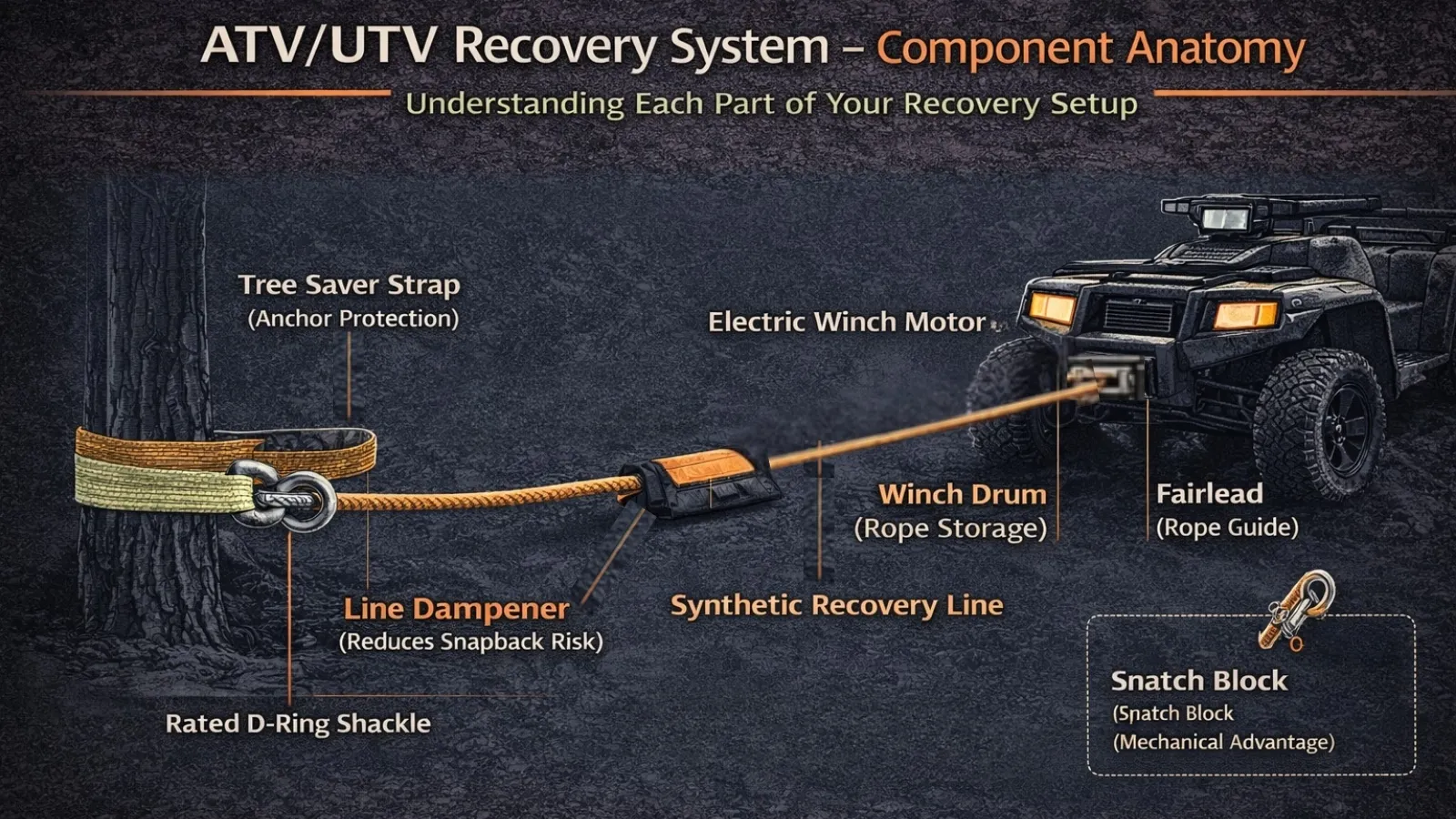
A winch’s rated pulling force only applies when the mounting system transfers that force safely into the vehicle frame. Installation affects alignment, stress distribution, and long-term durability. Poor mounting choices can lead to frame fatigue, bracket bending, or uneven rope wear. The sections below explain structural load paths, mounting plate design, fairlead compatibility, and recovery point strength.
How to Install an ATV Winch – System Overview
Installing a winch is not just a mechanical task — it is a structural and electrical integration process.
At a high level, installation involves:
- Securing the winch to a compatible mounting plate
- Attaching the mounting plate to structural frame members
- Routing wiring safely to the battery and control unit
- Installing the fairlead to guide the line
- Testing operation under light load
The most important principle is load path integrity.
When the winch pulls, force transfers:
Line → Drum → Winch Housing → Mounting Plate → Frame Rails
If any one of those connections is weak, the system’s rated capacity becomes irrelevant.
Common installation mistakes include:
- Mounting to decorative bumpers rather than frame-supported plates
- Allowing wiring to rub against sharp edges
- Failing to verify bolt torque after initial pulls
- Misaligning fairlead with drum
An ATV winch may only weigh 20–30 pounds, but under load it can exert thousands of pounds of pulling force. That force must be directed cleanly into structural components designed to handle it.
For full step-by-step installation instructions with diagrams and torque guidance, see How to Install an ATV Winch.
Winch Mounting Plates & Fitment
The mounting plate is the structural backbone of the recovery system.
Model-specific mounting plates are engineered to:
- Match bolt patterns
- Align the drum with the fairlead opening
- Distribute load across frame rails
- Avoid interference with suspension or cooling components
Universal plates can work in some cases, but improper fitment increases stress concentration — where force is concentrated in a small area rather than spreading evenly. A mounting system that shifts under load magnifies stress on every other component.
Frame stress points matter.
ATV and UTV frames are not uniformly reinforced. Certain cross members are designed to handle vertical loads (suspension forces), not forward-pulling loads. Mounting in the wrong location can create bending forces rather than straight-line tension.
Front mounting is most common because recovery typically involves pulling forward out of obstacles. However, rear mounting may be useful for work tasks or backing out of deep mud.
When evaluating mount position, consider:
- Pull direction alignment
- Steering clearance
- Suspension compression under load
- Frame rail thickness
A winch’s rated capacity only applies if the mounting structure can transfer that force into the frame without flexing or distortion. Structural integrity always limits real-world capacity.
For compatibility charts and vehicle-specific fitment details, see Winch Mounting Plates & Fitment.
Fairleads Explained – Hawse vs Roller
The fairlead guides the rope or cable as it exits the drum and prevents sharp-edge abrasion.
There are two common types:
Hawse fairlead: A smooth, curved aluminum or steel opening designed primarily for synthetic rope.
Roller fairlead: Uses rotating steel rollers to reduce friction, typically paired with a steel cable.
The difference is not cosmetic — it affects wear behavior.
Synthetic rope performs best with a smooth hawse surface. Roller fairleads can develop grooves or edge wear over time, which may abrade synthetic fibers under tension.
Steel cable, on the other hand, tolerates roller systems well because rollers reduce metal-on-metal friction during angled pulls.
Alignment also matters. The fairlead opening must match the drum position so that the line feeds evenly. Poor alignment can cause uneven spooling, side loading, and premature rope wear.
The fairlead does not increase pulling power — it protects the line and extends its lifespan.
For deeper comparisons, maintenance considerations, and compatibility scenarios, see Fairleads Explained: Hawse vs Roller.
Recovery Points & Anchor Strength
The winch can only pull as safely as the anchor points involved.
Recovery points include:
- Frame-mounted tow hooks
- Reinforced bumpers
- Dedicated recovery tabs
- External anchor objects (trees, rocks, other vehicles)
Vehicle-side recovery points must be structurally connected to frame members — not decorative bumper covers or thin brackets.
Anchor strength is critical.
If a recovery point fails under load, the sudden release of tension can create dangerous recoil energy in the line. Even synthetic rope, while safer than steel cable, can cause injury if the hardware fails.
When choosing anchor points:
- Avoid sharp edges
- Ensure rated hardware (shackles, soft shackles) matches winch capacity
- Maintain straight-line pull whenever possible
Tree recovery requires protective straps to distribute force and prevent bark damage. Using a winch hook directly around a tree can both harm the tree and create uneven load angles.
Additionally, the recovery angle affects load distribution. Pulling at severe side angles increases stress on mounting plates and drum bearings.
The recovery system must be evaluated as a complete force chain:
Anchor → Line → Fairlead → Winch → Mount → Frame
Weakness at any point compromises safety. Most catastrophic recovery failures I’ve seen occur at attachment points—not inside the winch housing.
For detailed installation guidance, rating guidance, and best practices for anchor selection, see the Recovery Points Guide.
Rigging and Recovery Hardware Complete the Winch System
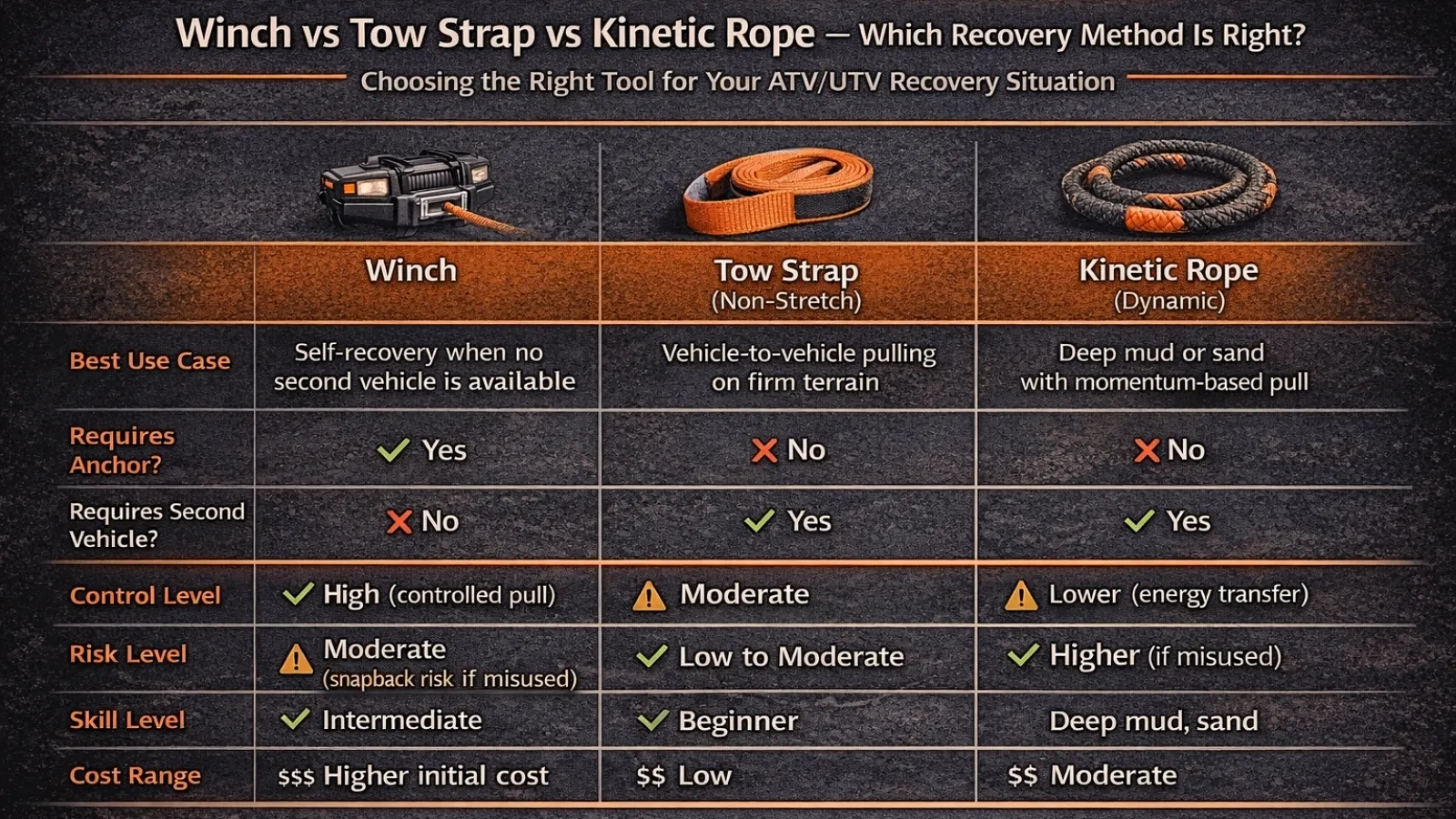
A winch alone does not guarantee safe recovery. Accessories such as snatch blocks, straps, shackles, and dampers determine how force is distributed and controlled. Proper rigging reduces strain on the motor, improves anchor alignment, and protects both vehicle and bystanders. The following sections explain essential hardware, anchoring techniques, and common rigging mistakes that compromise safety.
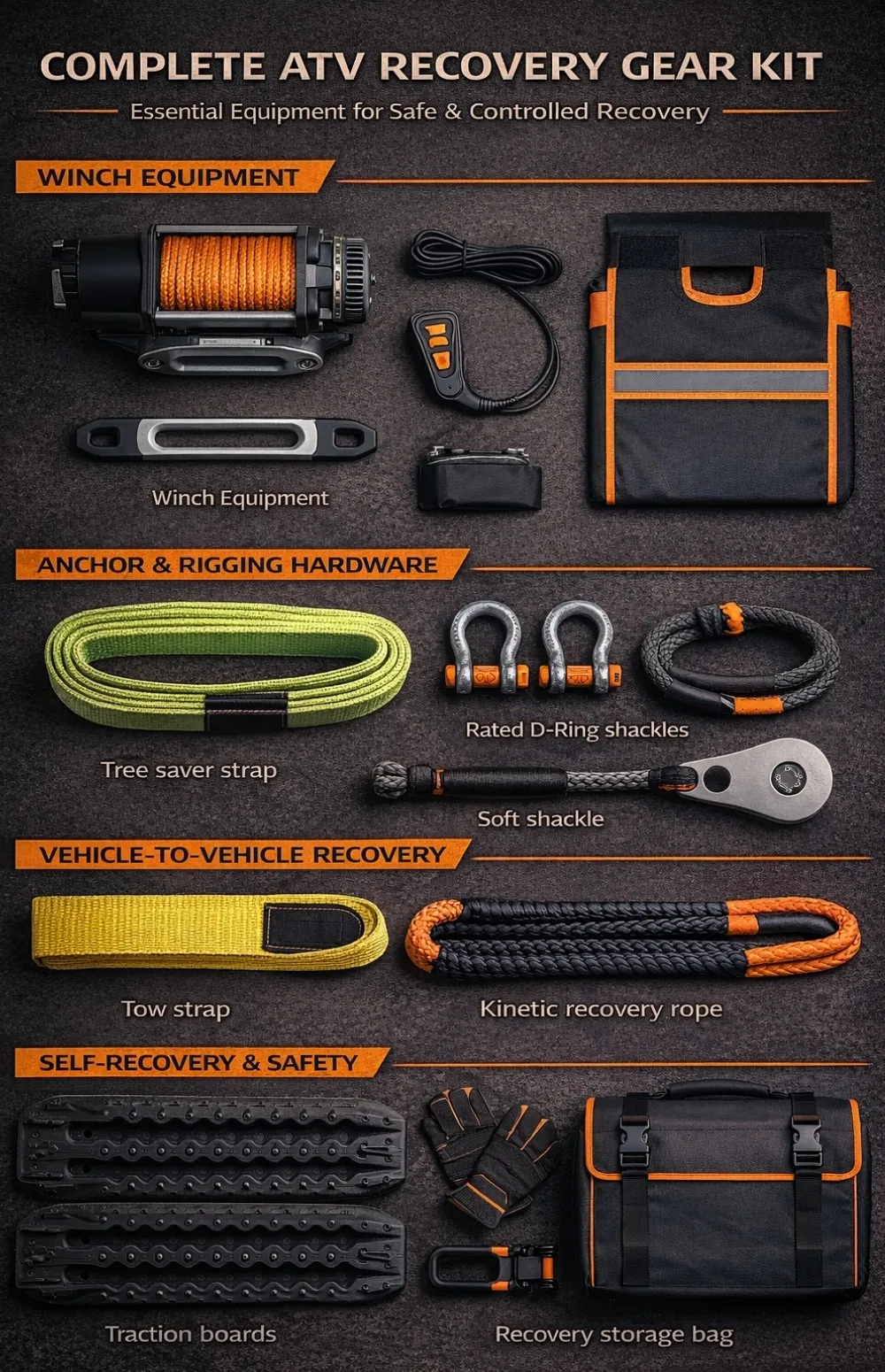
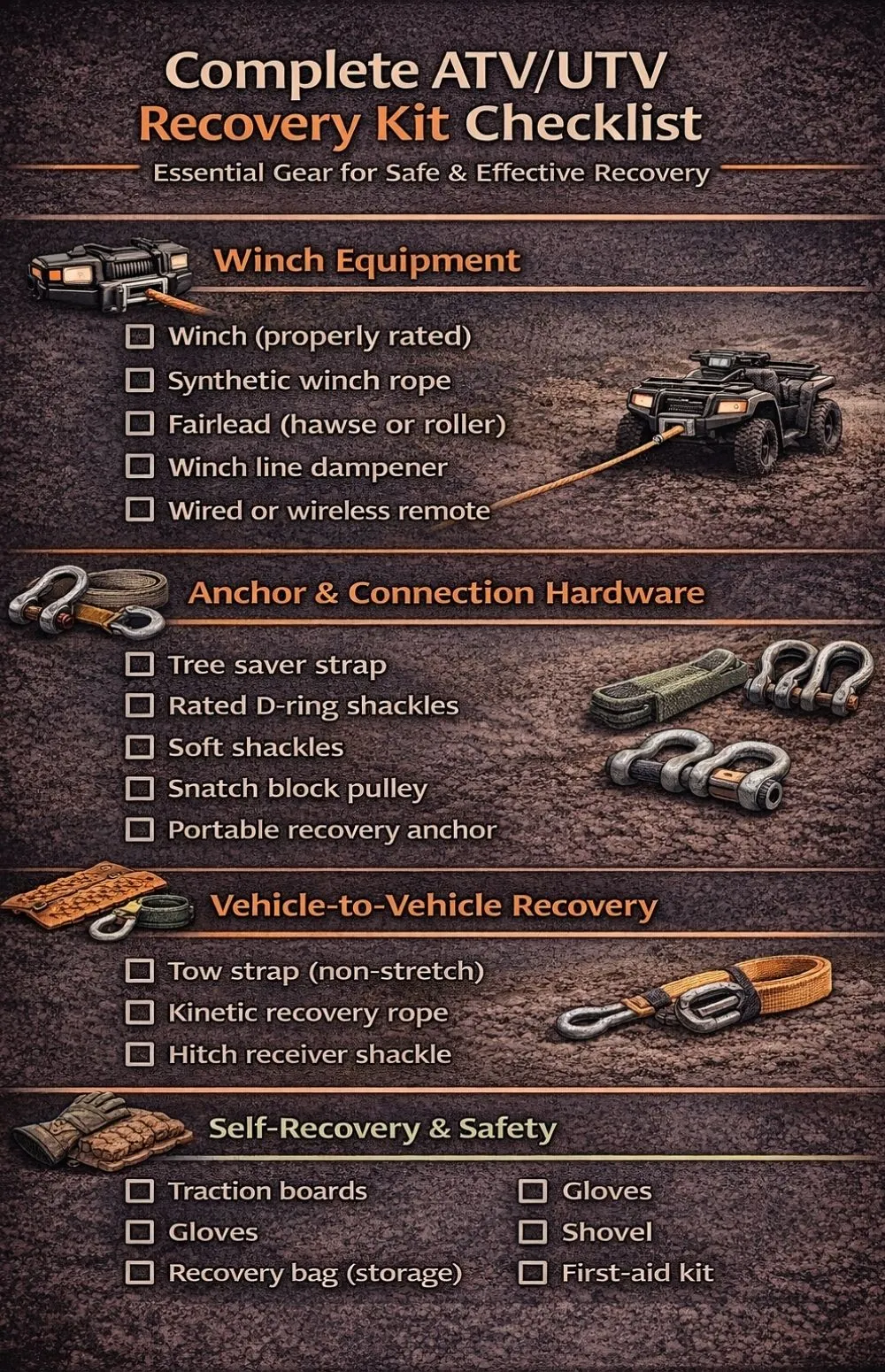
Essential Winch Accessories
A winch by itself is only a pulling device. Recovery accessories determine whether that pulling force is controlled, redirected, or safely distributed.
The most essential accessories include:
- Snatch block
- Tree saver strap
- Soft shackles or rated steel shackles
- Heavy-duty gloves
- Line dampers
Each serves a distinct function in the recovery chain.
Snatch Block
A snatch block allows you to redirect the winch line or create a double-line pull. This reduces strain on the winch motor and distributes the load more effectively during difficult recoveries.
It is particularly useful when:
- Recovering uphill
- Extracting from deep mud
- Operating near winch capacity
- Preserving battery voltage
Tree Saver Strap
A tree saver strap wraps around an anchor tree to evenly distribute force. It prevents bark damage and reduces the risk of the strap cutting into the trunk under tension.
Directly wrapping the winch line around a tree can:
- Damage the tree
- Create sharp load angles
- Increase hardware failure risk
Soft Shackles
Modern synthetic soft shackles are lightweight and reduce the risk of metal recoil in the event of failure. They are especially popular in ATV/UTV recovery kits because they are easy to handle and float.
Steel shackles remain strong and durable but require inspection for corrosion and thread integrity.
The Tree Saver & Soft Shackle Guide might prove very helpful for you.
Gloves
Handling winch line — especially steel cable — without gloves risks cuts and punctures. Even synthetic rope can embed grit and debris, which can abrade skin under tension.
Line Dampers
A line damper adds weight to the center of the winch line. If a failure occurs, the damper helps reduce recoil energy and keeps the line closer to the ground.
Accessories are not optional extras — they complete the recovery system.
For gear comparisons and recommended kits, see Best Winch Accessories for UTV.
Snatch Blocks Explained
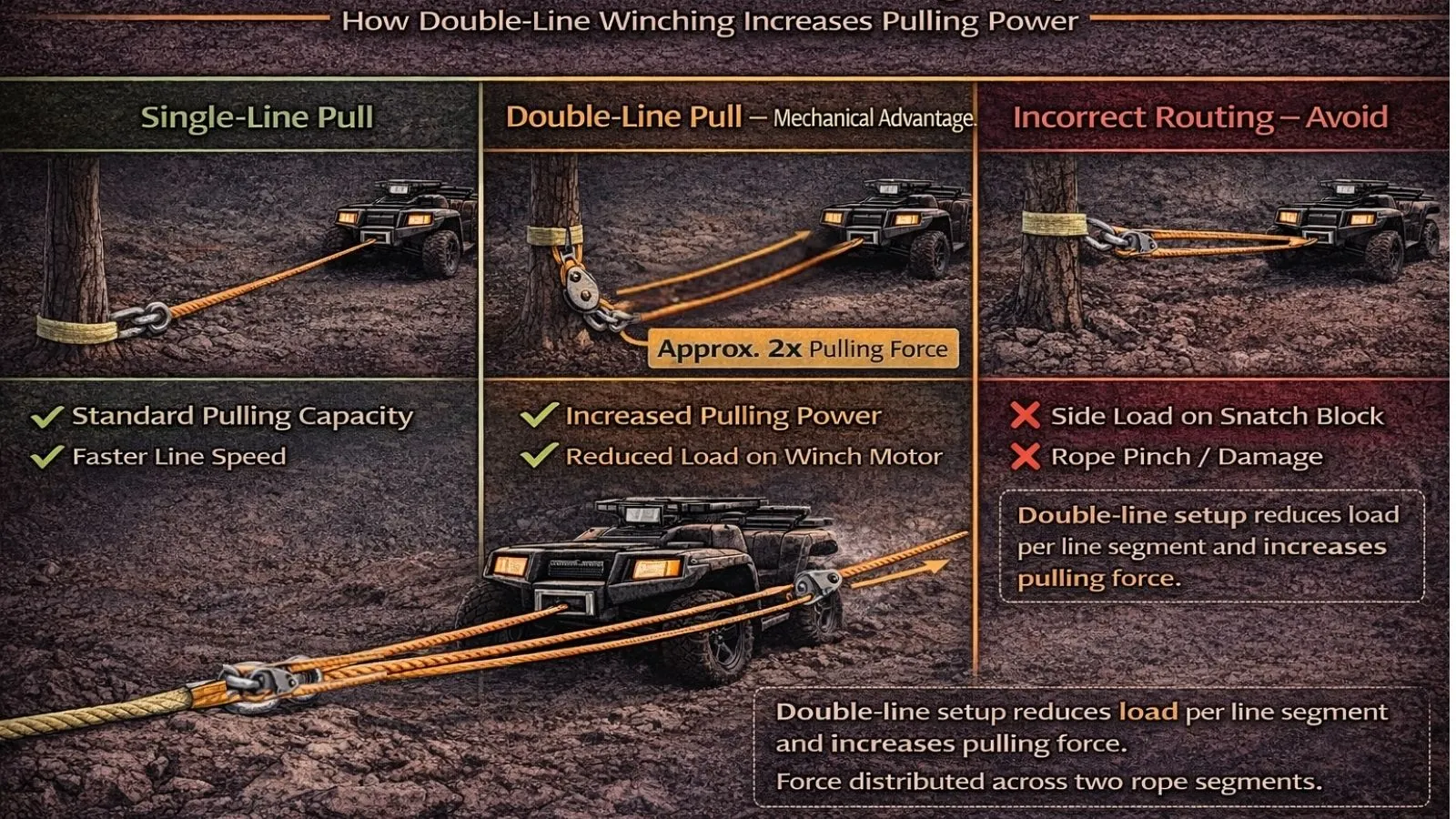
A snatch block is a pulley system housed within a side-opening frame that allows the winch line to be inserted without having to feed the entire length through.
Its primary functions are:
- Creating mechanical advantage (double-line pull)
- Redirecting line direction
- Reducing load on the winch motor
- Managing anchor angles
In a double-line configuration, the line runs from the winch to the snatch block at the anchor and back to the vehicle. This effectively splits the load between two segments of rope.
Practical effects include:
- Reduced strain on the motor
- Lower amperage draw
- Increased pulling control
However, mechanical advantage comes with trade-offs:
- Slower line speed
- Additional setup time
- Increased hardware load on the anchor point
Snatch block ratings must match or exceed winch capacity. The block itself becomes part of the load path:
Anchor → Snatch Block → Line → Winch
Improperly rated hardware introduces a weak link in the system.
Snatch blocks are especially valuable in ATV/UTV scenarios where:
- The vehicle is deeply embedded in mud
- Recovery angle is steep
- Battery preservation is important
They are less necessary for light rolling recoveries on flat terrain.
For full load distribution explanations and setup variations, see the dedicated Snatch Block Guide.
Safe Anchoring Techniques
The anchor is often the most overlooked component in recovery — yet it carries the full load of the pull.
Anchors typically fall into three categories:
- Natural anchors (trees, rocks)
- Vehicle anchors (another ATV/UTV)
- Artificial ground anchors
Trees
When anchoring to a tree:
- Use a tree saver strap to distribute load.
- Position the strap as low as practical to reduce leverage.
- Avoid small-diameter trees that may flex excessively.
The goal is even force distribution, not cutting force.
Another Vehicle
When using another ATV or UTV as an anchor:
- Ensure the vehicle is heavier or securely braced.
- Set parking brake and apply wheel chocks if possible.
- Maintain straight-line alignment.
The anchoring vehicle must resist forward movement under load. If both vehicles slide toward each other, the recovery’s effectiveness decreases.
Ground Anchors
In open terrain without trees or vehicles, ground anchors or buried objects may be used. These systems rely on soil resistance and must be properly rated for load conditions.
Regardless of anchor type, angle matters.
Side-angle pulls increase:
- Drum side loading
- Fairlead wear
- Frame stress
- Anchor hardware stress
Straight-line alignment is always the safest configuration when possible.
Safe anchoring transforms winching from brute pulling into controlled extraction.
The Recovery Force Chain: Where Failures Actually Occur
Every winch recovery follows a force chain.
Anchor → Strap/Shackle → Winch Line → Fairlead → Winch → Mounting Plate → Frame
Pulling force travels through each link in that sequence. If any component is weaker than the others, it becomes the failure point.
For example:
- An underrated shackle can fail even if the winch is properly sized.
- A thin bumper bracket can bend before the winch reaches full capacity.
- Worn synthetic rope can snap under sustained tension.
Recovery strength is not determined by the winch alone. It is determined by the weakest component in the chain.
Thinking in terms of the force chain shifts recovery from “how strong is my winch?” to “how balanced is my system?”
That systems mindset prevents most catastrophic failures.
Real-World Failure Example: When the Weakest Link Fails
During a muddy trail recovery, a mid-size ATV equipped with a properly rated 3,000 lb winch failed — not at the motor, but at the connection point.
The rider anchored to a tree using a light-duty strap instead of a rated tree saver. Under steady load, the strap fibers stretched and snapped. The winch, mount, and motor were all within safe operating range — but the underrated strap became the failure point in the force chain.
The result was sudden release of tension and hardware recoil. Fortunately, no one was standing near the line path.
This type of failure illustrates an important principle:
A winch system does not fail at its strongest component — it fails at its weakest one.
Balanced load ratings across anchor, strap, shackle, rope, and mounting hardware are what create a safe recovery system.
Common Rigging Mistakes
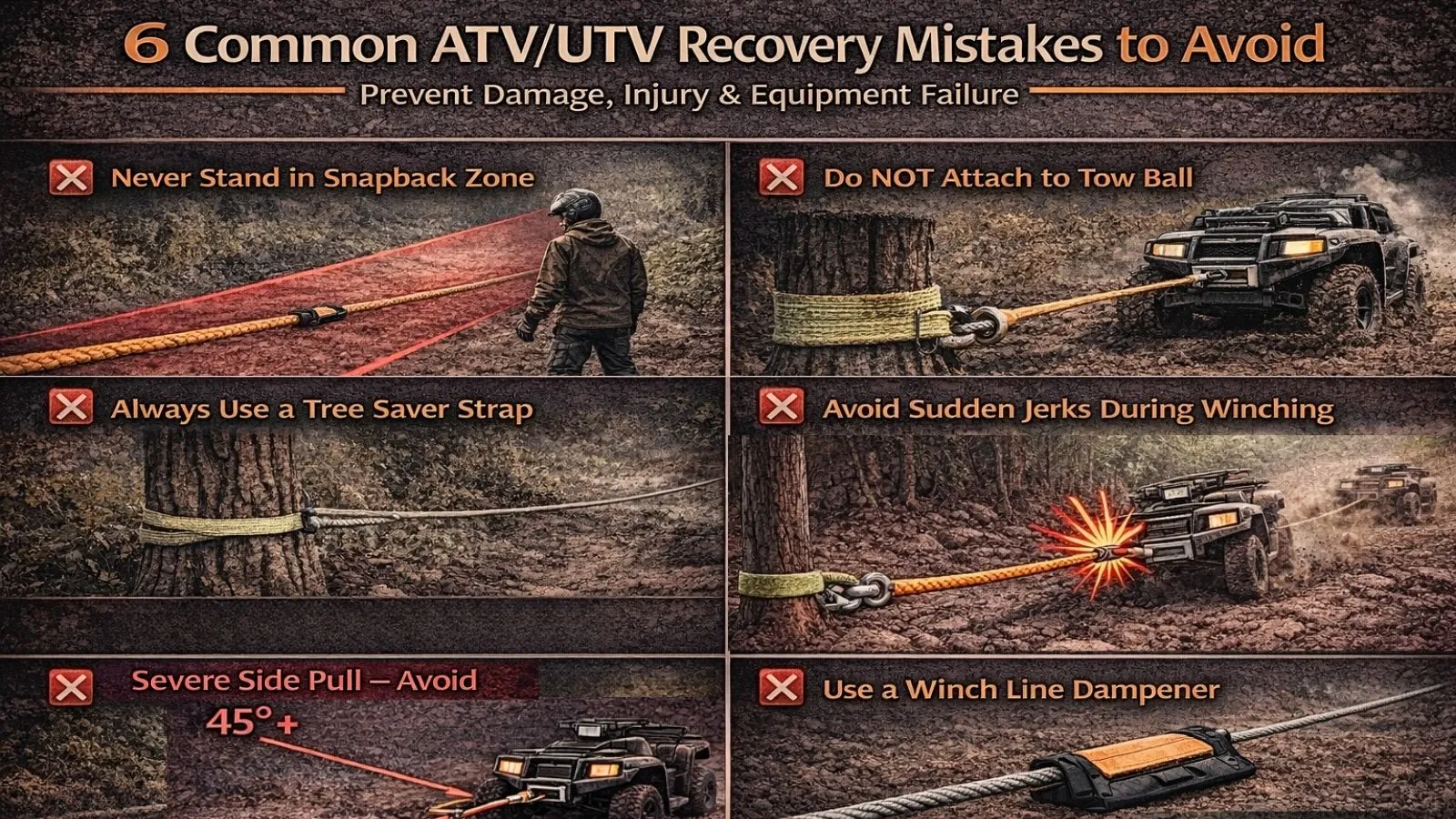
Most winch failures during recovery are not motor failures — they are rigging errors.
Some of the most common mistakes include:
Shock Loading
Jerking the line instead of applying steady tension creates sudden force spikes. These spikes increase:
- Frame stress
- Bolt shear risk
- Anchor hardware strain
Winching should always be gradual and controlled.
Side Loading the Drum
Pulling at sharp side angles causes rope to stack unevenly on the drum. This can:
- Damage rope layers
- Stress bearings
- Reduce effective pulling power
Ignoring Line Condition
Worn synthetic rope or kinked steel cable reduces safety margins. Abrasion, UV damage, and heat exposure weaken fibers over time.
Skipping Line Dampers
Even with synthetic rope, stored energy exists under tension. A damper reduces recoil risk if something fails.
Using Underrated Hardware
Every component in the recovery chain must be rated appropriately:
Winch capacity is meaningless if shackles or straps fail first.
Improper Anchor Selection
Attaching to thin bumpers or decorative components creates dangerous failure points.
Recovery is a force chain. In any recovery, the component with the lowest load rating determines the system’s true capacity.
To fathom the failure scenarios and prevention strategies full, Common Winching Mistakes article is a must read.
A lot of these problems come down to mismatched or incomplete setups—this is exactly why choosing the right ATV/UTV winch installation kit matters more than just picking a winch.
How Different Terrain Conditions Change Winch Recovery Strategy
Recovery methods vary significantly depending on whether the vehicle is buried in mud, sliding on snow, tilted on a side-hill, or flipped entirely. Each scenario alters load direction, traction, and anchor requirements. Understanding these differences improves efficiency and reduces equipment stress. The following sections apply system principles to practical, real-world recovery situations.
How to Recover an ATV Stuck in Mud
Mud recovery is one of the most demanding situations for a winch system because the resistance isn’t just vehicle weight — it’s suction.
When an ATV sinks deep enough that the frame or skid plate contacts mud, the tires are no longer rolling freely. Instead of a rolling load, you’re fighting:
- Tire suction
- Frame drag
- Mud compaction around axles
This dramatically increases the required pulling force.
In this situation:
- Spool out more line to reach first-wrap pulling power.
- Use a tree saver strap if anchoring to a tree.
- Consider a double-line pull if the ATV does not move under steady tension.
Double-line pulls reduce strain on the motor and battery, especially when the winch is operating near capacity.
Avoid jerking the throttle to “assist” the winch. Shock loading increases frame stress and can damage mounting hardware.
The key principle in mud recovery is controlled, sustained tension — not speed.
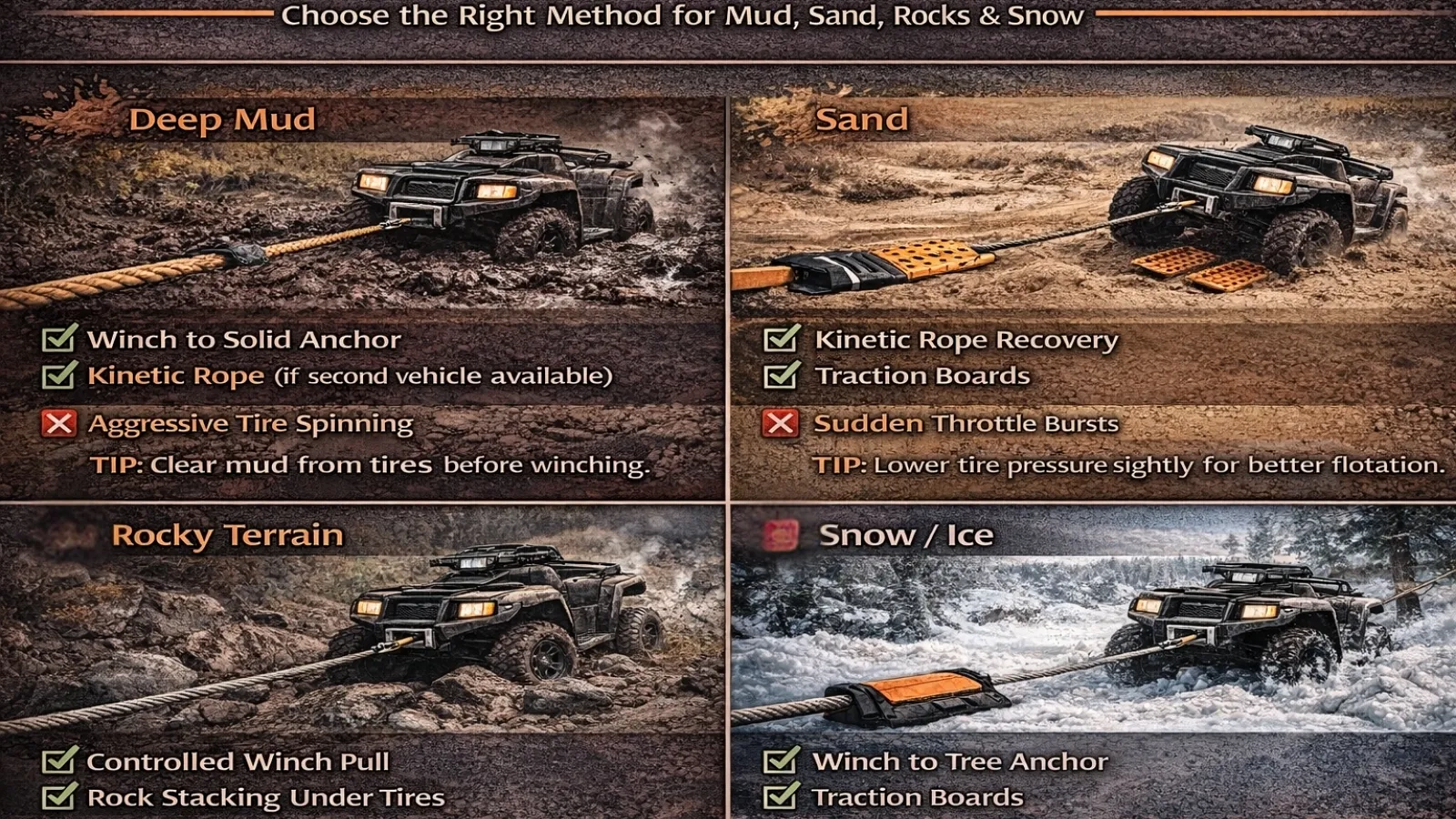
Snow Recovery
Snow presents a different type of resistance.
Unlike mud, snow often allows some tire rotation, but traction is reduced. Packed snow and ice can create sliding rather than suction.
Cold temperatures also affect recovery in two ways:
- Batteries lose output in freezing conditions.
- Synthetic rope becomes stiffer but remains easier to handle than steel cable.
When recovering in snow:
- Keep the engine idling to maintain battery voltage.
- Clear packed snow from in front of the tires before winching.
- Maintain a straight-line pull to prevent lateral slide.
Because traction is limited, the vehicle may move sideways if the anchor angle is off-center. This increases side loading on the drum and fairlead.
Snow recoveries often require less brute force than mud, but they demand careful alignment and electrical awareness due to cold-weather voltage sag.
Side-Hill Recovery
Side-hill recoveries introduce unique mechanical stress.
When a vehicle is stuck on an incline or tilted on a slope, pulling straight forward may not be possible. Off-angle pulls create:
- Lateral drum loading
- Uneven rope stacking
- Increased frame torsion
The winch is designed to pull forward, not to the side. Severe side loading can stress bearings and mounting plates.
If possible:
- Reposition the vehicle slightly to reduce angle.
- Use a snatch block to redirect the pull into a straighter alignment.
- Apply steady tension while correcting steering angle gradually.
Side-hill recoveries also raise rollover risk. If the center of gravity shifts during extraction, the ATV may tip further rather than recover.
Slow, incremental pulling combined with steering correction is safer than sudden throttle input.
The principle here is load alignment. The straighter the force path, the lower the stress on components.
Flipped ATV Recovery
A winch can be used to return a flipped ATV to an upright position, but this must be done carefully.
When an ATV rolls onto its side or roof, the objective is controlled rotation—not a sudden snapback.
Key considerations:
- Choose a stable anchor point directly opposite the roll direction.
- Attach to a strong structural point on the frame, not plastic racks.
- Apply slow, gradual tension.
As tension increases, the vehicle’s center of gravity shifts. The moment it passes the tipping point, gravity assists the rotation.
If the line is pulled too aggressively, the ATV may slam down hard, causing suspension or rack damage.
Using a snatch block can help control angle and direction if the anchor is not ideally positioned.
Clear the area of bystanders before initiating the pull. Even controlled flips involve shifting weight and tension changes.
The priority is stability and control — not speed.
The Core Safety Principles Behind Controlled Winch Recovery
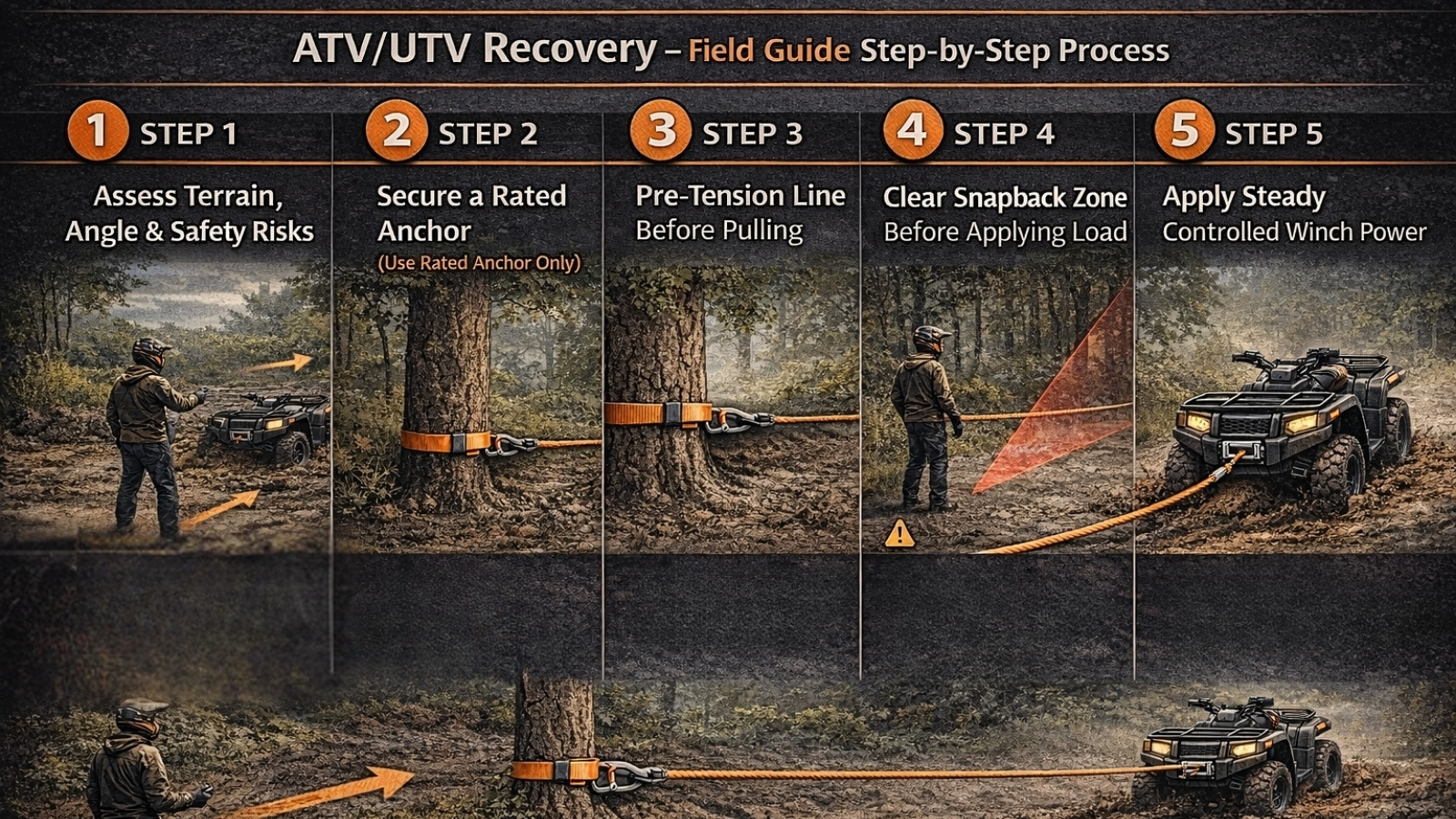
Winching is safe when force is applied gradually, components are rated properly, and the recovery zone is controlled. Most failures occur at connection points, not inside the winch housing. A structured safety framework reduces injury risk and protects vehicle components. The sections below outline checklist procedures, bystander positioning, protective equipment, and structural risk awareness.
The Winching Safety Checklist
Winching is a controlled force application. When done correctly, it is predictable and safe. When done carelessly, it becomes one of the highest-risk operations in off-road riding.
At a minimum, every recovery should include these safety principles:
- Use properly rated recovery points
- Maintain steady, gradual tension
- Keep bystanders clear of the line path
- Inspect rope or cable before use
- Align pull direction whenever possible
- Wear gloves when handling line
- Apply steady tension to prevent sudden load spikes
These rules are not optional best practices — they are baseline risk control measures.
Most winch-related failures occur not because the equipment is too weak, but because force was applied suddenly, at poor angles, or through underrated hardware.
Before each pull, pause and evaluate:
- Is the anchor stable?
- Is the line free of damage?
- Is the vehicle aligned with the anchor?
- Are all observers at a safe distance?
Recovery is not a race. Slower, controlled pulls protect equipment and people.
For a more detailed pre-pull checklist and communication guidance, see the Winching Safety Checklist article.
Bystander Safety Zone
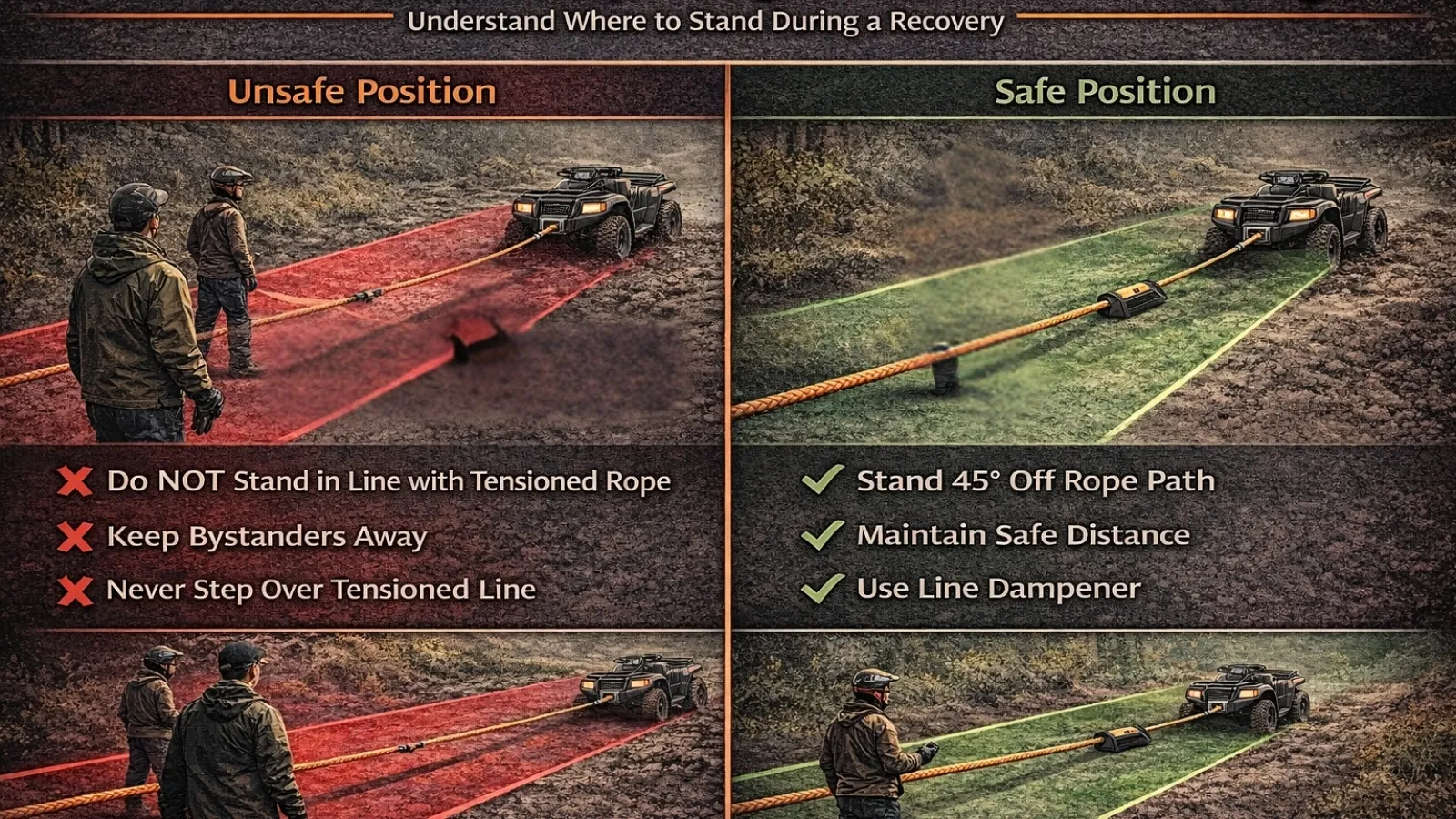
One of the most overlooked risks during recovery is the position of spectators.
Under load, the winch line stores energy. If a component fails — whether it’s a shackle, hook, strap, or mounting point — that stored energy is released suddenly.
A safe rule is to keep bystanders at least 1.5 times the length of the extended winch line away from the recovery path.
No one should stand:
- Directly in line with the rope
- Near the anchor point
- Between the anchor and the vehicle
Communication matters as well. Establish clear hand signals or verbal commands before beginning the pull.
Children and pets should be moved well outside the recovery area. Recovery zones are not spectator events.
The operator should also avoid leaning over the drum while under tension. Mechanical failures are rare with proper equipment — but when they occur, they happen quickly.
Safe spacing dramatically reduces injury risk, even if a component unexpectedly fails.
Line Dampers & Gloves
Even with synthetic rope — which stores less recoil energy than steel cable — stored tension still exists.
A line damper adds mass to the rope, typically placed at the midpoint. If a failure occurs, the added weight helps force the rope downward rather than allowing it to whip freely.
Line dampers are particularly useful during:
- Heavy mud recoveries
- Double-line pulls
- Maximum-capacity operations
Gloves are equally important.
Steel cable can develop small burrs or broken strands that puncture skin. Synthetic rope can embed sand and grit, creating abrasive surfaces.
Beyond protection, gloves improve grip and control when guiding line during spooling.
Handling line without gloves may seem harmless — until tension increases or debris is present.
Line dampers and gloves do not increase pulling power. They reduce injury risk and improve control.
Frame & Bumper Damage Risks
Winches apply thousands of pounds of force. That force must travel through mounting plates and into the frame.
Damage most commonly occurs when:
- Winches are mounted to non-structural bumpers
- Pull direction is severely angled
- Shock loading is applied
- Hardware bolts loosen over time
Decorative bumpers are often not designed for sustained pulling force. Even if they appear sturdy, the underlying brackets may not be rated for recovery loads.
Repeated heavy pulls can cause:
- Bolt elongation
- Plate bending
- Frame rail cracking
- Weld fatigue
Side-angle pulls increase torsional stress on the frame. Over time, this can loosen mounting hardware or create micro-cracks in high-stress areas.
After heavy recoveries, inspect:
- Mounting bolts
- Plate alignment
- Frame welds
- Bumper brackets
A winch system should not flex visibly under load. If the mount or bumper shifts significantly, reinforcement may be necessary. Visible flex under load is not normal and indicates structural weakness.
For deeper structural failure analysis and prevention guidance, see the article on Common Winching Mistakess.
How Routine Inspection Extends Winch Life and Prevents Failure
Regular inspection prevents most winch-related failures before they occur under load. Rope wear, electrical corrosion, and control unit degradation often develop gradually. Seasonal checks and post-recovery inspections protect both performance and safety margins. The following checklist highlights the key maintenance points every ATV and UTV owner should monitor.
Winch Maintenance Checklist
A winch that works once a year in ideal conditions requires different care than one used regularly in mud, water, or snow. Regardless of frequency, routine inspection prevents most failures.
At a minimum, perform a visual and functional check at the start of each riding season — and after any heavy recovery. Especially after submersion in deep water, inspect and dry components immediately.
Rope or Cable Inspection
- Look for fraying, flattening, heat glazing, or abrasion.
- Check for tight nesting or uneven spooling on the drum.
- Replace steel cable if strands are broken or kinked.
- Clean and dry synthetic rope before long-term storage.
A damaged line reduces safety margins even if the winch motor remains strong. Synthetic rope should be cleaned and dried before storage to prevent internal fiber weakening.
For detailed cleaning procedures and abrasion prevention tips, go through the Rope Care Guide.
Electrical Terminals
- Inspect battery connections for corrosion.
- Tighten loose terminals.
- Check ground attachment points for rust or paint buildup.
High-resistance connections increase voltage drop and heat under load.
Solenoid / Contactor Function
- Listen for consistent engagement when activating the switch.
- Watch for delayed response or intermittent clicking.
Delayed response, intermittent clicking, or inconsistent operation may indicate internal wear or moisture intrusion.
Re-Spooling Properly
After a heavy pull, respool the line under light tension to prevent loose layers. Uneven wraps can crush lower layers during the next recovery and reduce effective pulling force.
For detailed cleaning procedures and storage guidance, see the full Winch Maintenance Guide (if available).
Consistent inspection extends lifespan — and protects the entire recovery system.
Which Off-Road Winch to Go for: Electric or Manual
Choosing between an electric and manual winch mostly comes down to riding conditions and how often recovery situations happen. Manual winches are lighter, simpler, and useful for occasional utility work, but they demand physical effort and become frustrating in deep mud, snow, or steep terrain.
Electric winches, on the other hand, dominate modern off-road riding because they offer faster and more controlled recovery with minimal effort. They are especially valuable during solo rides where traction disappears and quick self-recovery matters.
For most ATV and UTV riders, electric systems provide the better balance of convenience, recovery strength, and trail practicality. Riders who only need occasional low-intensity pulling may still find manual winches sufficient for basic tasks.
Practical Winch Setups Should Match Riding Style, Terrain, and Recovery Needs
A successful recovery system begins with the right combination of capacity, hardware, and electrical support — not simply the biggest number printed on a winch label. Different riding conditions, vehicle types, and use patterns demand tailored configurations to balance pulling power, control, and longevity. This section outlines three recommended recovery system tiers — from budget-friendly ATV setups to heavy-duty UTV configurations — helping you match gear to needs in a way that reflects real-world application rather than speculation.
Budget ATV/UTV Recovery Setup
For recreational riders who primarily use their ATV for trail riding and occasional light recovery, a simple but balanced setup is usually sufficient.
Recommended baseline components:
- 2,500–3,500 lb winch
- Synthetic rope with hawse fairlead
- Basic snatch block
- Rated recovery point
- Gloves and line damper
This configuration provides enough overhead for most mid-weight ATVs without adding unnecessary front-end weight.
The snatch block is especially important in a budget setup. It effectively increases recovery capability without requiring a larger winch. In deep mud, a double-line pull can reduce motor strain and protect the electrical system.
Synthetic rope keeps weight low and improves safety during occasional recovery operations.
This setup is ideal for:
- Trail riders
- Hunters
- Weekend recreational use
- Light self-recovery situations
It emphasizes simplicity, portability, and adequate reserve capacity.
ATVNotes recommendations for budget UTV winches may add crucial insight in this conneection
Intermediate Trail Setup
For riders who encounter frequent mud, water crossings, or group trail recovery situations, additional margin becomes valuable.
Recommended system components:
- 3,500–4,500 lb winch
- Synthetic rope
- Snatch block
- Tree saver strap
- Soft shackles
- Upgraded battery cables (if needed)
This configuration provides greater pulling headroom and improved durability during repeated use.
The tree saver strap expands anchor options while protecting natural anchor points. Soft shackles reduce weight and simplify rigging.
Upgraded cables help reduce voltage drop under higher load demand, especially in colder weather or extended recovery operations.
This setup is well-suited for:
- Dedicated mud riders
- Trail leaders assisting other vehicles
- Mixed terrain riding
- Riders who winch multiple times per outing
The goal here is resilience — not just pulling power.
Heavy-Duty UTV Recovery Setup
Working UTVs and heavily loaded recreational machines require a more robust recovery system.
Recommended components:
- 4,500–6,000 lb winch
- Reinforced mounting plate
- Synthetic rope
- Snatch block rated above winch capacity
- Tree saver strap and multiple shackles
- Dual battery system or electrical upgrades
Heavier UTVs place greater demand on both mechanical and electrical components. A larger-capacity winch reduces strain during high-resistance pulls, while a dual battery system improves voltage stability during extended operation.
An advanced rigging kit provides flexibility in difficult terrain, where anchor positioning and pull direction must be carefully managed.
This setup is appropriate for:
- Utility and ranch work
- Snow plowing
- Frequent group recoveries
- Large, accessory-heavy UTVs
A heavy-duty recovery system is not just about winch size — it is about matching mechanical strength, electrical supply, and rigging capability as a unified system.
Winch size should match vehicle weight, not ego.
For detailed model comparisons and specific winch options within each capaci, explore the commercial buying guides in this cluster.
- ATV winch recommendations for heavy-duty use
- Top-quality UTV winch for safey recovery
FAQs on Off-road Winch Recovery Systems
Is synthetic rope better than steel cable for ATV winches?
Yes, synthetic rope is generally better for ATV/UTV use.
It is lighter, safer if it snaps, easier to handle, and floats in water. Steel cable is more abrasion-resistant but heavier and more dangerous under tension.
Can I install a winch on an ATV without upgrading the battery?
Yes, but performance may suffer.
Stock ATV batteries can handle occasional light winching. However, frequent recovery pulls may cause voltage drop. For regular winch use, upgrading the battery or cables improves reliability and prevents electrical failure.
Do I need a snatch block for ATV recovery?
A snatch block is not mandatory, but highly recommended.
It allows double-line pulls, reduces motor strain, increases pulling capacity, and improves control in difficult recoveries like deep mud or steep inclines.
Can a winch flip an ATV back over?
Yes, a properly rated winch can flip an ATV upright.
Use controlled tension and secure anchor points. Always clear the area of bystanders and avoid sudden jerks. A snatch block may help stabilize the recovery.
How do I know if my winch is too small?
If your winch struggles, stalls, overheats, or requires repeated double-line pulls in normal conditions, it may be undersized. Frequent electrical strain or slow recovery speed also indicates insufficient winch capacity.
Should I mount a winch on the front or rear of my ATV?
Front mounting is standard and handles most recovery situations.
Rear winches are useful for work tasks or pulling backwards out of mud. Some riders install both for maximum versatility.
How do I maintain an ATV winch?
Inspect rope or cable regularly for wear, clean synthetic rope after mud use, check electrical connections, and respool under tension. Perform a full inspection at least once per season to ensure reliable operation.
What is the safest way to use an ATV winch?
Use rated recovery points, wear gloves, keep bystanders at least 1.5x line length away, use a line damper, and avoid shock loading. Always maintain steady tension instead of jerking the line.
Do I need a waterproof winch for trail riding?
If you ride in mud, water crossings, or wet climates, a sealed waterproof winch with IP-rated protection significantly increases longevity and reliability. Occasional dry trail riding may not require full waterproofing.
Can a winch damage my ATV frame?
Yes. Improper mounting plates, weak bumper mounts, or shock loading can bend frames or crack welds. Always use model-specific mounting hardware and avoid jerking pulls.
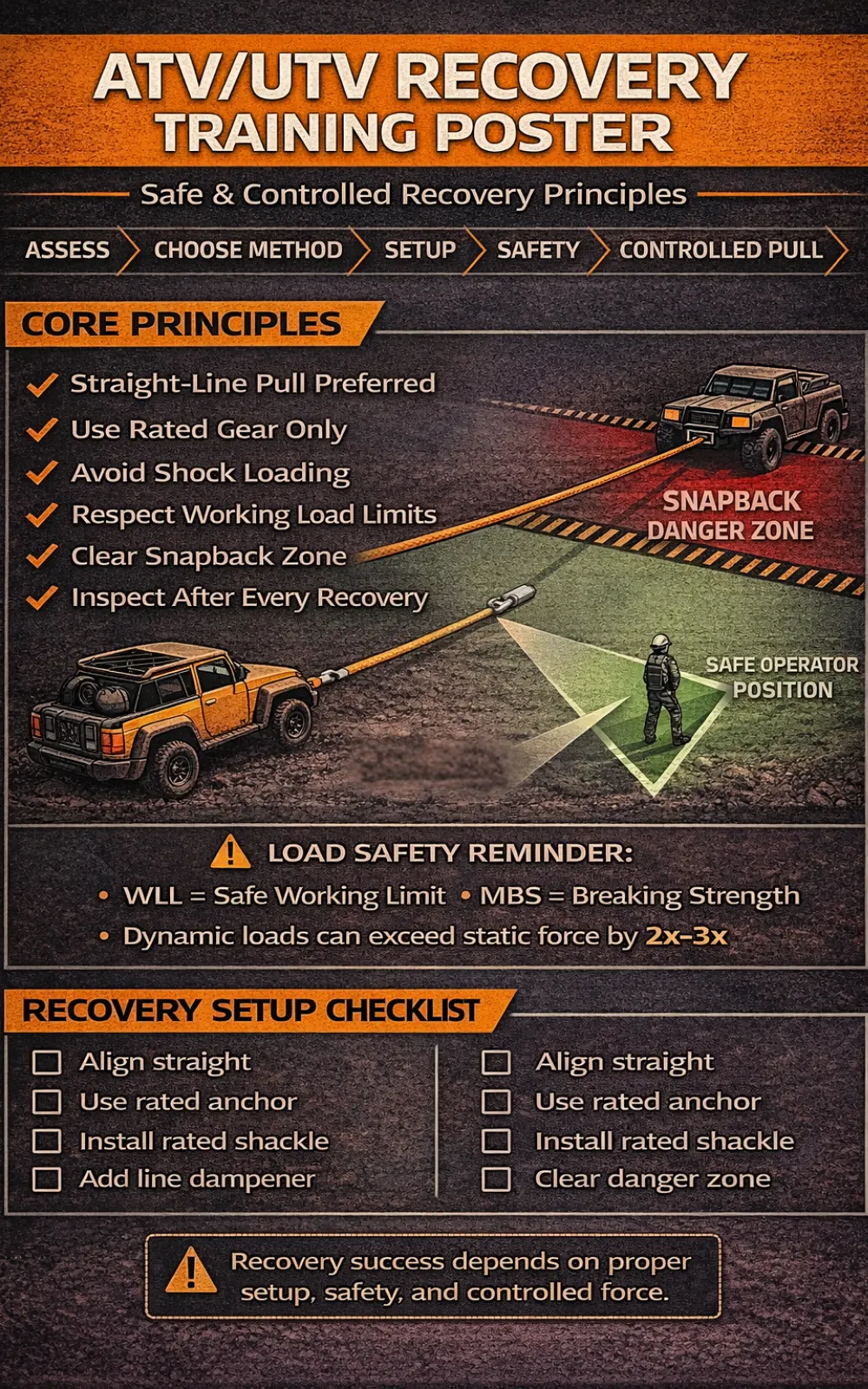
Building a Reliable Recovery System — Not Just Buying a Winch
A winch by itself is just a motor turning a drum.
What determines whether recovery feels controlled or chaotic is everything around it — the electrical supply, the mounting structure, the line path, the anchor hardware, and the way force is applied in real terrain.
Throughout this guide, one theme repeats: recovery is about force management.
Capacity matters, but only in context. A properly sized winch paired with stable voltage, strong mounting, and intelligent rigging will outperform a larger winch installed on a weak system. Mechanical advantage often reduces strain more effectively than oversizing. Alignment and steady tension prevent more failures than raw horsepower ever will.
Most recovery failures are not dramatic explosions of equipment. They are small weaknesses compounded over time — loose hardware, voltage sag, rope abrasion, repeated side loading. When each component of the system supports the others, those weaknesses are minimized.
If you’re building your setup from scratch, start with honest evaluation:
- How often will you actually use the winch?
- What terrain do you regularly encounter?
- Is your electrical system stable under load?
- Are your recovery points rated and properly mounted?
From there, build outward. Size appropriately. Reinforce intelligently. Add hardware that reduces strain rather than increasing brute force.
A balanced recovery system doesn’t just extract your vehicle — it does so predictably, without unnecessary stress on your equipment.
If you want to go deeper into any part of the system — sizing calculations, wiring specifics, rigging techniques, or hardware selection — the detailed guides linked throughout this article break each topic down further.
Recovery is rarely about overpowering the terrain.
It’s about understanding it — and preparing your system accordingly.

ATVNotes is an off-road resource focused on ATV and UTV winching, recovery systems, safety gear, tires, batteries, and essential off-road equipment. Content is produced by the ATVNotes Expert Team and written from the perspective of a practical off-road recovery advisor, emphasizing real-world performance, system compatibility, and safety-first practices across trail riding, utility use, and off-road exploration.