
When a winch line comes under tension, control depends on more than pulling power. UTV winch accessories shape how force moves through the recovery system, influencing anchor stability, load behavior, and how the system responds as resistance changes mid-pull.
That response determines whether a recovery stays under control or starts to unravel. Without deliberate load management, anchors shift, connections become weak points, and stored energy builds where it shouldn’t. The right accessories change that outcome by spreading force, stabilizing attachment points, and managing energy before small changes turn into sudden failures.
This guide breaks down the essential UTV winch accessories used in real-world recovery and explains how each one functions as conditions evolve. In some situations, organizing these accessories into simple safety or load-control kits helps reduce decision-making under pressure, but the focus remains on understanding how and when each component contributes to a predictable, controlled pull.
Jump To Contents
- How do UTV Winch Accessories Control Load and Recovery Behavior?
- What Winch Accessories Do You Need for a UTV?
- How Do Winch Accessories Reduce Load and Prevent Overheating?
- Which Winch Accessories Protect the Operator During Recovery?
- When Are Additional Winch Accessories Required?
- What Are the Most Common Winch Accessory Mistakes?
- How Do Winch Accessories Work Together During Recovery?
- What Is the Minimum Winch Accessory Checklist for UTV Recovery?
- Pre-Built UTV Winch Accessory Kits — What to Buy & Why
- FAQs on Essential UTV Winch Accessories
- Wrap Up: Setting Recovery Limits Before Choosing a Winch
How do UTV Winch Accessories Control Load and Recovery Behavior?
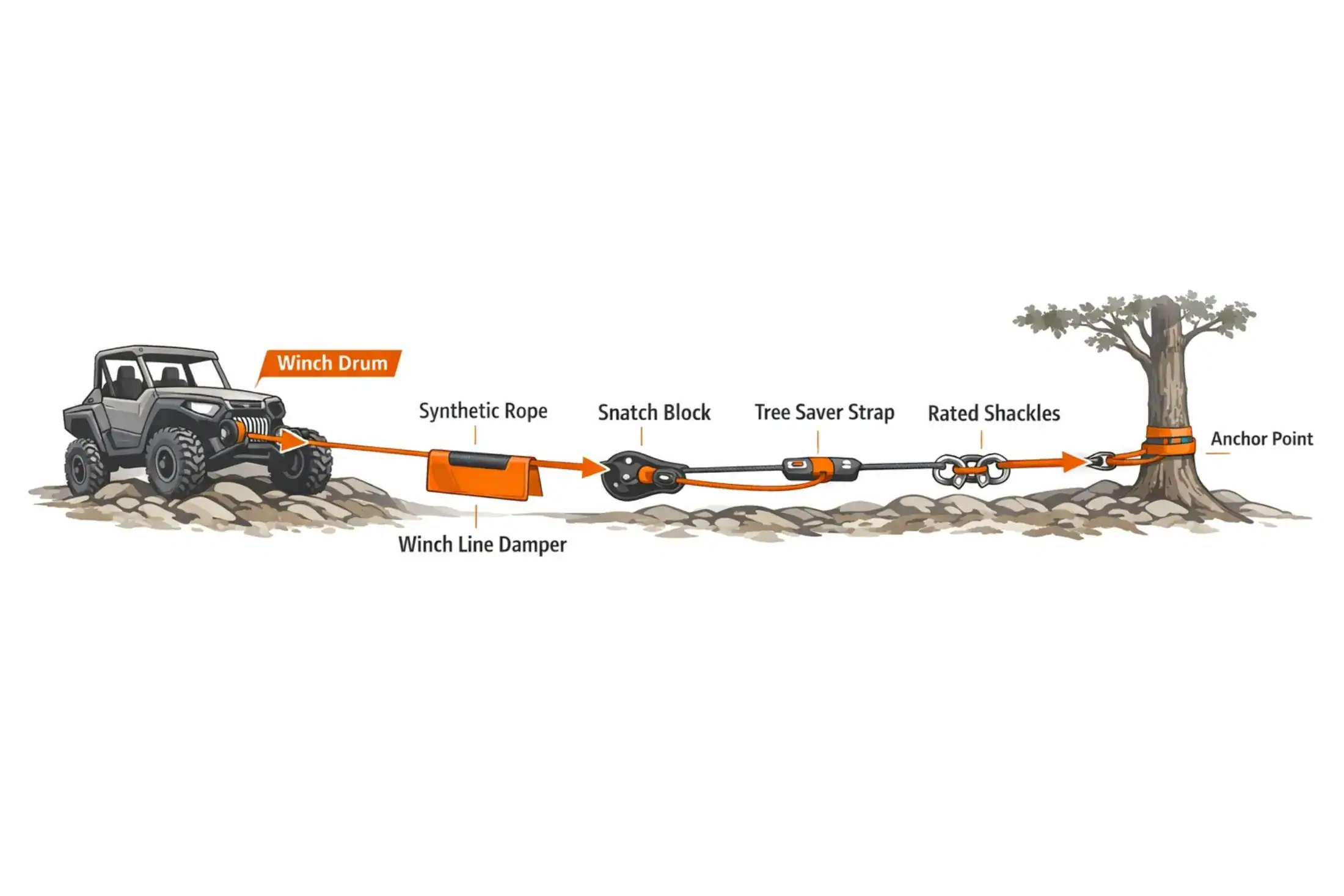
A winch provides force—but force alone does not equal control. The moment a winch line is tensioned, risk is introduced unless that force is managed correctly. This is where winch accessories become essential, not optional.
UTV winch accessories serve four non-negotiable functions within a recovery system:
- Load management: Snatch blocks and rigging accessories reduce strain on the winch, rope, and electrical system during heavy or sustained pulls.
- Anchor protection: Tree saver straps distribute force across anchor points, reducing damage and minimizing the risk of anchor failure.
- Recoil energy control: Winch line dampers manage stored energy if a rope or anchor fails, shrinking the danger zone around the line of pull.
- Operator safety: Rated shackles, recovery gloves, and rope stoppers reduce projectile, pinch, and line-handling injuries during winching.
The role of accessories is force management, not force creation — they make winching controlled, repeatable, and safe under changing terrain and load conditions.
Keep in mind that recovery accessories depend on a winch that’s properly matched to the vehicle and recovery demands, which is why choosing the right model matters as much as how it’s rigged — a topic covered in our guide to the best UTV winch for real-world recovery.
What Winch Accessories Do You Need for a UTV?
The most important UTV winch accessories are those required for every recovery.
These items address hazards that exist as soon as a winch line is tensioned, and they are non-negotiable safety equipment. Have a quick comparison in the table below, and details of the most important ones after it.
| Accessory | What It Does | Primary Safety Benefit | Required? |
| Winch line damper | Absorbs stored recoil energy | Reduces snapback injury risk | Yes |
| Tree saver strap | Spreads load across anchor | Prevents anchor failure | Yes |
| Rated shackles | Create secure connections | Prevents hardware projectile failure | Yes |
| Snatch block | Reduces winch load | Prevents overheating & stall | Recommended |
| Recovery gloves | Protect hands during handling | Prevents abrasion & pinch injuries | Recommended |
Winch Line Damper – Recovery Blanket
Most people understand what a winch line damper does. Fewer people understand when it actually matters.
A damper isn’t there to make a pull smoother or more professional-looking. It’s there for the moment something doesn’t hold. When a rope, shackle, or anchor fails under tension, the line doesn’t politely drop to the ground — it reacts. The damper’s only job is to take some of that stored energy and force it down instead of letting it travel.
That matters even on short pulls and even with synthetic rope. If the line is tight, energy is stored. The damper doesn’t care whether the recovery feels easy or hard — it only cares that something might let go.
If you’re already winching and the line is under load, the damper should already be on the rope. Anything else is just hoping the system behaves.
While dampers are critical regardless of rope type, the way stored energy behaves under tension differs by material, which is why understanding synthetic rope vs steel cable for UTV winches matters for recovery safety.
Tree Saver Strap — Anchor Protection Strap
When anchors fail during winching, it’s rarely because the tree or post wasn’t strong enough. It’s because the load was applied too narrowly, crushing bark, cutting fibers, or concentrating force into a single failure point.
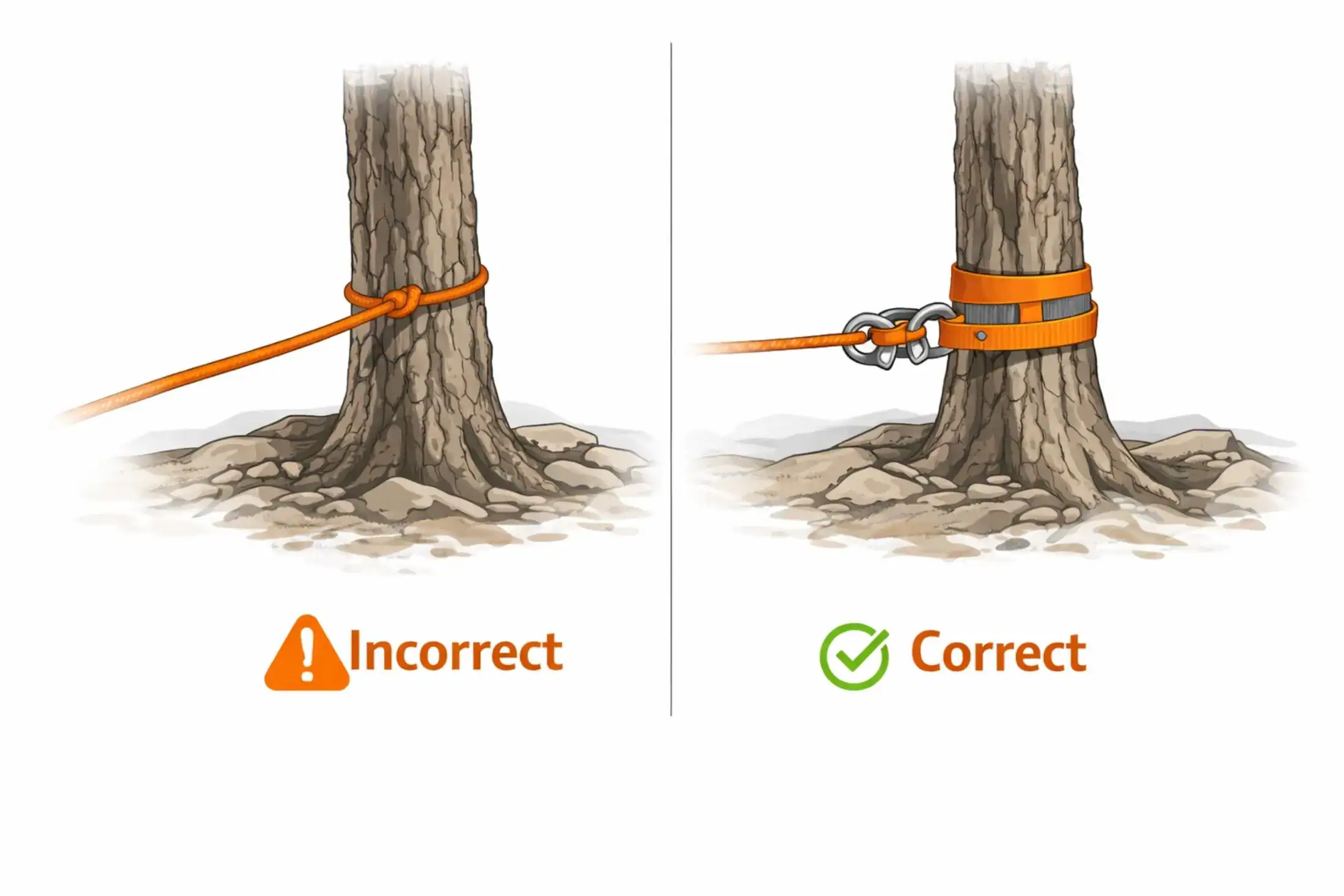
A tree saver strap exists to solve that exact problem.
By spreading the load across a wider surface area, it turns a point load into a distributed one. That reduces damage to the anchor and lowers the chance of sudden, unpredictable failure under tension. It’s not about being gentle on trees — it’s about keeping the anchor stable for the entire duration of the pull.
Using a winch line or narrow strap directly around an anchor may hold at first, but as tension increases, the contact point deforms. Once that happens, the anchor doesn’t fail gradually — it fails all at once. That’s when recoil becomes dangerous, and control is lost.
Tree saver straps make anchor behavior predictable. They maintain force consistency, reduce movement at the attachment point, and provide the rest of the recovery system with a stable foundation to work from. If the anchor isn’t protected, everything downstream is at risk — no matter how good the winch or rigging might be.
Any recovery that relies on a fixed anchor first relies on load distribution. Tree saver straps aren’t an accessory to winching; they’re part of making the anchor usable in the first place.
Rated Shackles — Load-Rated Connectors
In a winch recovery, connections matter more than pulling power. Every strap, snatch block, or anchor point relies on the hardware that links them, and that hardware takes the full load when the line comes tight.
Rated shackles exist to make those connections predictable under tension. Unlike unrated hooks or hardware-store connectors, they’re designed to handle sustained recovery loads without deforming, popping, or failing suddenly.
Most winch failures don’t start at the winch — they start at a weak connection. Using properly rated shackles keeps the force where it belongs and prevents small components from becoming dangerous projectiles in the event of failure.
Read on to learn about other important winch accessories and function.
How Do Winch Accessories Reduce Load and Prevent Overheating?
Load-control accessories -snatch block – manage how much force a winch must generate and sustain during recovery. They reduce mechanical and electrical strain, improve control, and prevent overheating during difficult pulls.
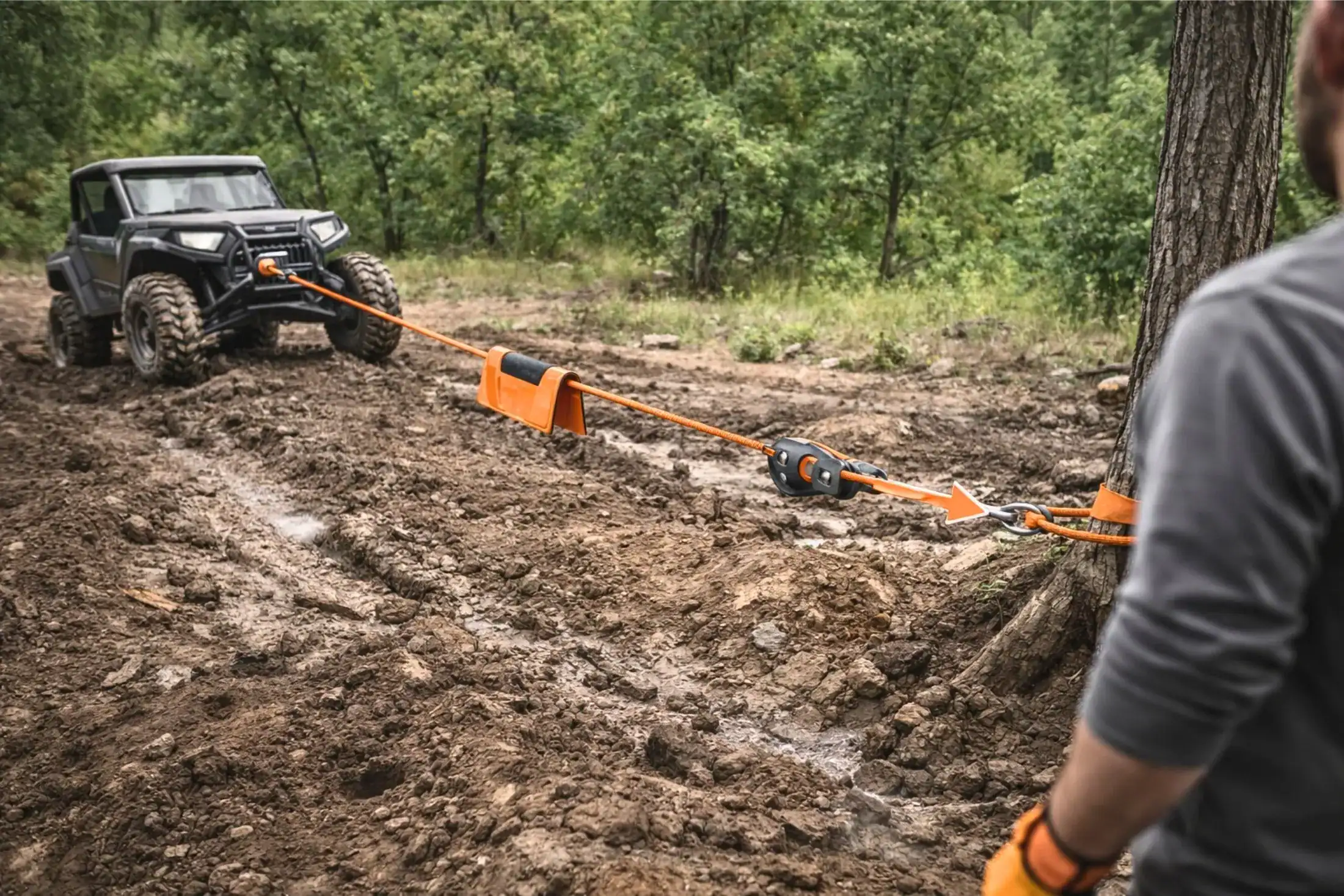
Snatch Block — Load-Reduction Pulley
Snatch blocks are often treated like a last resort — something you pull out only after the winch starts struggling. That mindset is where a lot of problems start.
When a winch is pulling hard, everything else in the system is already under stress – the motor, the rope, the battery, the mounts. If the winch slows down sharply or sounds strained, the system is telling you the load is too high. Ignoring that and continuing to pull is how winches overheat, ropes glaze, and electrical systems take damage.
This is where a snatch block changes the recovery.
By doubling the line, you reduce the load the winch has to work against and slow the pull down. And the vehicle moves more gradually, which gives you time to watch what’s happening instead of reacting after something breaks.
What usually goes wrong when people skip the snatch block is shock loading. The line tightens, the vehicle suddenly pops free, and all that force transfers instantly through the system. That’s when hooks bend, fairleads get damaged, or mounts start to crack — not because the winch was bad, but because it was forced to do too much too fast.
Reducing mechanical load also reduces electrical strain, which becomes critical during sustained pulls—an issue explored further in UTV winch duty cycle and overheating risks.
Real-World Recovery Anecdote
A few years back, I watched a routine recovery go sideways on what should’ve been an easy pull. A UTV was buried in shallow mud, solid anchor, short distance — nothing about it felt risky. The operator skipped the damper because it was “just a quick tug.”
Halfway through the pull, the anchor strap slid down the trunk and popped free. Nobody was standing in the line of pull, but the winch line snapped back hard enough to bury itself in the dirt a few feet from where someone had been standing moments earlier. No injuries, no broken gear — just a quiet pause while everyone realized how close it was.
That recovery didn’t fail because the winch was undersized or the terrain was extreme. It failed because the setup assumed nothing would change once the line was tight. That assumption is what gets people hurt.
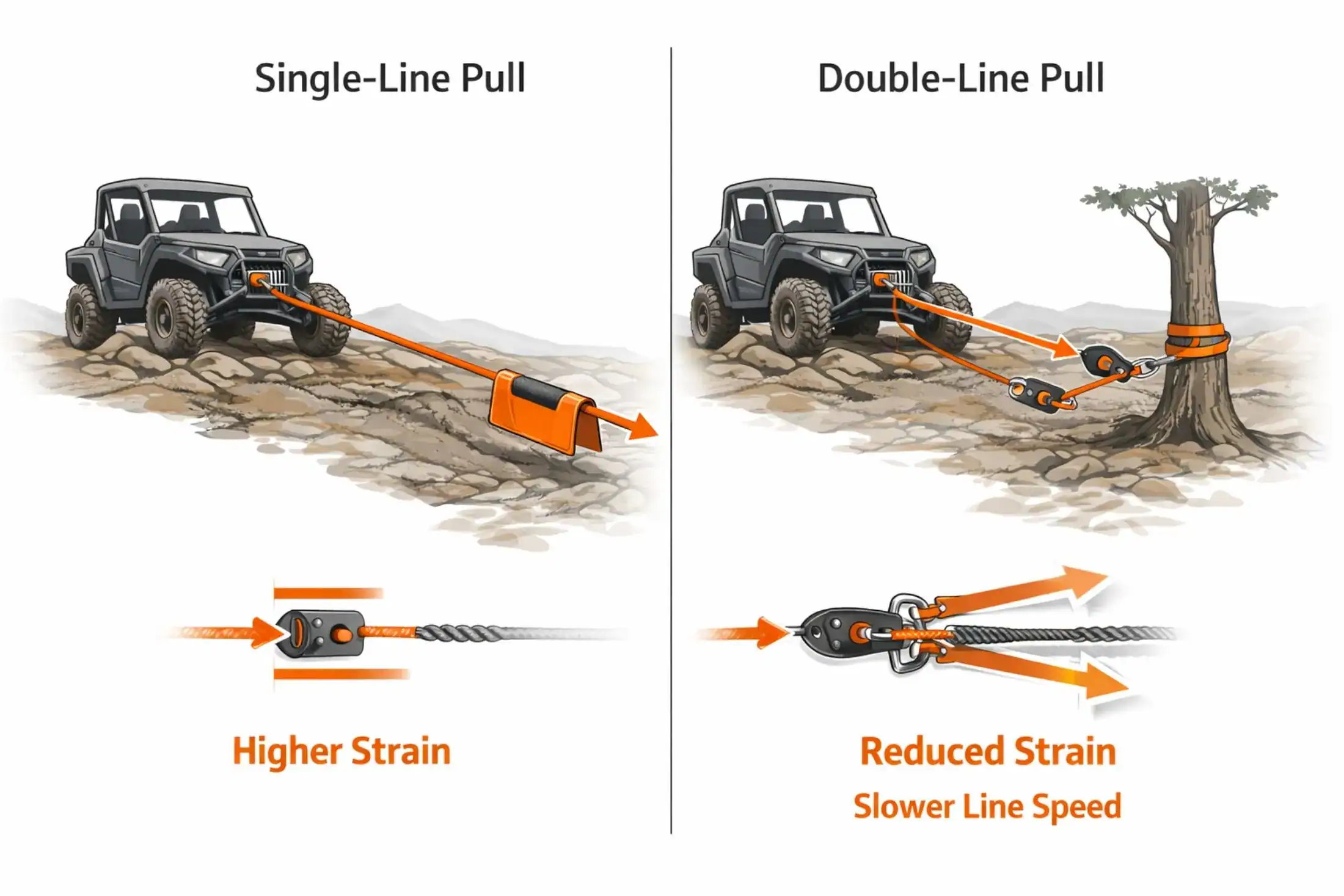
Experienced operators don’t wait for the winch to stall before adding mechanical advantage. They use a snatch block early, when resistance first shows up, to keep the recovery controlled instead of aggressive. For a closer look at how mechanical advantage changes load behavior — and when doubling the line actually makes sense — learn how snatch blocks work for UTV winching.
Which Winch Accessories Protect the Operator During Recovery?
Line-handling accessories reduce the risk of injury during setup, spooling, and repositioning. Many winching injuries occur before or after the pull, not during it.
Operator position during winching also affects exposure to risk, which is why control methods—such as wired vs wireless winch remotes for UTV recovery—play a role in overall recovery safety.
Now, on two winch accessories that act as saviors for the protector during recovery.
Line Handling & Control Gear
Most winching injuries don’t happen during the pull — they happen while handling the line before and after tension is applied. Dirty rope, pinch points, heat buildup, and sudden movement are where hands and equipment are most at risk of damage.
Recovery gloves exist for that moment. They let you guide, spool, and tension the line without risking rope burn, crushed fingers, or cuts from grit and frayed fibers. Once the line starts moving, bare hands are a liability.
A rope stopper solves a different but related problem. It prevents the winch hook from slamming into the fairlead during spooling, which quietly damages the rope, fairlead, and winch over time. That damage isn’t dramatic, but it adds up and shows up later when the system is under load.
Neither of these items adds pulling power, but both protect the parts you rely on to work smoothly. Good line control keeps recoveries calm, repeatable, and free of small mistakes that turn into bigger failures down the road.
Many of the risks addressed by these accessories stem from repeatable mistakes during setup and tensioning, which we explore in detail in our breakdown of UTV winching safety and how failures actually occur.
When Are Additional Winch Accessories Required?
Situational winch accessories are required when terrain, distance, or geometry prevents standard recovery setups. They allow recoveries to remain controlled when assumptions about anchors or alignment fail.
Ground Anchors / Deadman Systems
Ground anchors create reliable anchor points where no fixed anchors exist.
- When do I need them? Open terrain such as deserts, snowfields, or utility corridors
- Required or situational? Situational, but essential in anchorless environments
- What happens if I skip them? Recovery may be impossible or unsafe
Winch Extension Straps
Winch extension straps increase reach without over-spooling the drum.
- When do I need them? When anchors are beyond safe spooling distance
- Required or situational? Situational
- What happens if I skip them? Reduced pulling efficiency and increased rope wear
When This Matters Most:
If you ride in open terrain, deep mud, or steep hills where straight-line pulls aren’t possible, situational accessories like snatch blocks, extension straps, and ground anchors become essential—not optional.
What Are the Most Common Winch Accessory Mistakes?
Most winch accidents are not caused by extreme conditions—they result from preventable errors. Understanding where recoveries commonly go wrong is just as important as carrying the right equipment.
The most common winch accessory mistakes include:
- Using tow straps in place of tree saver straps, which stretch under static winch loads and can fail unpredictably.
- Connecting unrated hardware, which can become dangerous projectiles under tension.
- Skipping winch line dampers, even on short pulls, where stored energy is still present once the line is tensioned.
- Shock loading the system by winching against slack, causing sudden load spikes that damage ropes, winches, snatch blocks, and electrical components.
- Neglecting inspection and maintenance, allowing UV exposure, abrasion, and contamination to degrade recovery gear over time.
Winch accessories only improve safety when they are rated for recovery loads, properly maintained, and used with controlled technique. But treating these casually is one of the most common causes of preventable winching failures.
How Do Winch Accessories Work Together During Recovery?
Each accessory addresses a specific hazard, but real safety comes from how they are used together. Winch recovery is a system, and removing or misusing any component shifts stress and risk elsewhere.
A proper UTV winch recovery system follows this sequence:
- Anchor protection: A tree saver strap spreads load across the anchor point, preventing damage and reducing the chance of anchor failure.
- Secure load transfer: Rated shackles create reliable connection points between the anchor, snatch block, and winch line.
- Load reduction through mechanical advantage: A snatch block doubles the winch line, reducing strain on the winch motor, rope, and UTV electrical system during heavy recoveries.
- Recoil energy management: A winch line damper absorbs and redirects stored energy, shrinking the danger zone if a rope or anchor fails.
- Controlled line handling: Recovery gloves protect hands during spooling and tensioning, while a rope stopper prevents over-spooling damage at the fairlead.
Removing even one accessory shifts stress elsewhere in the system and increases failure risk. This is why experienced operators prioritize accessory sequencing and recovery technique over raw winch capacity. Accessories convert force into a managed, safer recovery process.
What Is the Minimum Winch Accessory Checklist for UTV Recovery?
A controlled recovery depends on preparation, not improvisation. This checklist reflects what experienced recovery trainers and utility operators carry to manage load, protect anchors, and reduce injury risk in real conditions.
Mandatory – Carry for every recovery.
- Winch line damper or recovery blanket: Reduces recoil energy and snapback risk if the rope or anchor fails.
- Tree saver strap: Protects anchor points and spreads load across trees, posts, or fixed objects.
- Rated shackles: Provide secure, load-rated connection points between straps, snatch blocks, and winch lines.
Strongly recommended – Load and control management.
- Snatch block: Reduces load on the winch, rope, and electrical system through mechanical advantage.
- Recovery gloves: Protect hands during spooling, tensioning, and rope handling.
- Rope stopper: Prevents over-spooling damage to the fairlead and winch housing.
Situational – Terrain and anchor dependent.
- Ground anchor or deadman system – for open terrain without trees
- Winch extension straps – for distant or inaccessible anchors
This checklist prioritizes function over quantity. As said earlier, carrying these accessories ensures a winch can be used within its limits across mud, snow, hills, and utility conditions—without improvisation or unnecessary risk.
Accessories work best when paired with a winch that’s correctly sized for your UTV, terrain, and recovery load. Winch capacity, electrical limits, and accessories should be considered together—not separately.
Pre-Built UTV Winch Accessory Kits — What to Buy & Why
Winch accessories only work when deliberately chosen. Mixing random pieces of gear based on price or convenience usually leads to the same outcome – a recovery that works, but only because nothing went wrong.
The kits displayed side by side reflect how those principles are applied as recovery conditions become more demanding.
| Kit Type | Best For | Included Accessories |
| Safety kit | Light trail & utility use | Damper, tree saver, shackles |
| Load-control kit | Mud, snow, hills | Damper, tree saver, shackles, snatch block |
| Advanced recovery kit | Remote or open terrain | Damper, tree saver, shackles, snatch block, extension strap, ground anchor |
Now, go for details.
1. Baseline Safety Kit (Minimum Required Setup)
If you use a winch without this setup, you’re relying on luck more than you think.
Most recoveries look low-risk at the start. Short pull, solid anchor, no drama. The baseline kit exists to remove the obvious failure points before the line ever comes tight.
Anchor protection keeps force from chewing into the attachment point. Rated connections keep small hardware from becoming projectiles. A damper manages stored energy when something shifts or lets go.
This kit doesn’t make the winch more capable. It makes you less exposed. If a winch is on your vehicle, this setup shouldn’t be negotiable.
2. Load-Control Recovery Kit (Most Versatile Setup)
When a winch sounds strained or the line speed drops off, the recovery is already headed in the wrong direction.
Pushing through that resistance is how winches overheat, batteries get drained, and mounts start to suffer. Load-control gear fixes the problem at its source by changing how force is applied instead of demanding more from the winch.
Mechanical advantage reduces stress across the entire system and slows recovery enough to keep it under control. Better pull angles reduce side loading and keep the rope tracking correctly.
When resistance shows up early, re-rigging before the winch stalls keeps strain down and the recovery controlled.
3. Advanced Terrain & Remote Recovery Kit (Scenario-Based)
In remote or open terrain, recoveries fail because there’s nothing reliable to pull from and no clean way to manage the load.
This kit solves that problem. Ground anchors create options where none exist. Snatch blocks reduce load and allow controlled pulls when straight-line recovery isn’t possible. Extension straps aren’t about convenience — they’re about keeping enough wraps on the drum to pull safely.
These recoveries aren’t fast, and they aren’t improvised. They’re built deliberately, with rated connections and energy management in place before anything moves. When there’s no easy anchor and no room for mistakes, this setup keeps the recovery controlled rather than desperate.
FAQs on Essential UTV Winch Accessories
Even experienced operators have questions about when accessories are required and how they reduce risk. These answers address the most common misconceptions surrounding UTV winch accessories and recovery safety.
Do I still need winch accessories if I use synthetic rope?
Yes. Synthetic rope reduces recoil severity compared to steel cable, but it still stores energy under load. Accessories such as winch line dampers, tree saver straps, and rated shackles are still required to manage recoil risk, protect anchors, and control load during recovery.
What is the most important winch accessory for safety?
A winch line damper is widely considered the most important safety accessory. It reduces snapback force if the rope or anchor fails, helping protect people and equipment in the line of pull.
Can winch accessories help prevent winch overheating?
Yes. Load-control accessories, such as snatch blocks, reduce the force the winch must pull against. This lowers amp draw, reduces heat buildup in the winch motor, and helps protect the UTV’s battery and stator during sustained recoveries.
Are ATV and UTV winch accessories interchangeable?
Some accessories are interchangeable, but all recovery gear must be rated appropriately for UTV recovery loads. UTVs are heavier and often require higher-rated straps, shackles, and snatch blocks than ATVs.
Do I need accessories for light or short winch pulls?
Yes. Recoil energy and anchor failure risk exist as soon as the winch line is tensioned. Short or “easy” pulls do not eliminate the need for dampers, anchor protection, and rated connections.
Wrap Up: Setting Recovery Limits Before Choosing a Winch
Winch recoveries rarely unfold exactly as expected. Loads shift, anchors behave differently under tension, and resistance can build faster than anticipated. The sections above show how these variables are managed in practice through deliberate rigging and the selection of accessories to address specific risks rather than assumed conditions.
Each accessory serves a distinct purpose, but its real value appears when conditions change mid-recovery. Together, they influence how predictable the pull remains—whether by stabilizing an anchor, reducing strain on the winch, or managing stored energy once the line is tight.
Seen this way, accessories aren’t an add-on to a winch; they define how that winch operates when recovery conditions become unpredictable. Choosing accessories first establishes system behavior and limits before pulling power becomes a factor. From there, selecting a winch that matches those demands becomes a matter of fit, not guesswork.
Continue exploring related topics:
- ATV vs UTV winch recovery differences
- Best-value UTV winch options
- UTV winch design and manufacturer differences

ATVNotes is an off-road resource focused on ATV and UTV winching, recovery systems, safety gear, tires, batteries, and essential off-road equipment. Content is produced by the ATVNotes Expert Team and written from the perspective of a practical off-road recovery advisor, emphasizing real-world performance, system compatibility, and safety-first practices across trail riding, utility use, and off-road exploration.