
Winch remotes might seem minor until you’re in the middle of a recovery and something goes wrong. Both wired and wireless remotes work, but they affect where you stand, how well you can see, and how much safety margin you have as the load increases.
This article goes beyond convenience to show how wired and wireless winch remotes perform during real UTV recoveries, especially when visibility is low, footing is tricky, and reliability is more important than features. By the end, you’ll know when to use each type and why many experienced riders use both.
Quick Takeaway – Read This First
- Starting the pull: Wired or wireless, both work
- Once the line is under load, Wired control is safer and more predictable
- Best overall setup: Both wired and wireless available
- Worst setup: Wireless-only control with no wired backup
In short, wireless remotes help you stand in a safer spot, but wired remotes give you the control you need when tension, cold, or heavy electrical loads come into play.
Jump To Contents
- Which Is Safer: Wired or Wireless Winch Remote for UTV Recovery?
- Wired vs Wireless Winch Remotes: What’s the Real Difference in UTV Recovery?
- Wired vs Wireless Winch Remotes: Quick Comparison
- Why “Wireless Is Safer” Is an Oversimplification
- Wired Winch Remotes: Reliability, Strengths, and Limitations
- Wireless Winch Remotes: Safety Benefits and Common Issues
- Wired vs Wireless Winch Remote Comparison – Quick Reference
- When to Use a Wired vs Wireless Winch Remote During UTV Recovery
- Why the Best UTV Winch Setup Uses Both Remotes
- Common Winch Remote Mistakes That Reduce Safety
- Do Winch Remotes Affect Which UTV Winch You Should Buy?
- FAQs: Wired vs Wireless Winch Remotes for UTVs
- Final Verdict
Which Is Safer: Wired or Wireless Winch Remote for UTV Recovery?
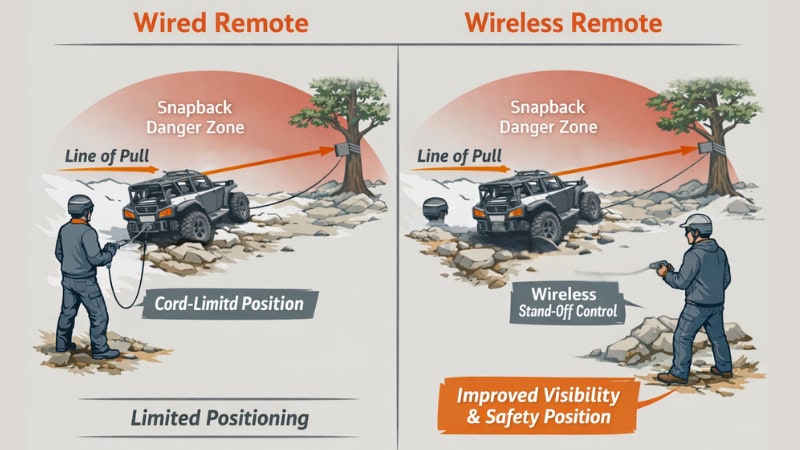
Wireless remotes are safer once there’s tension in the line. Before that, distance isn’t as important. When the rope is under load, even a small move to the side or a better view can help you manage the pull calmly instead of reacting too late.
During a late-fall recovery in wet clay and rocks, I started the pull with a wireless remote so I could watch the anchor tree and fairlead from the side. Halfway through, the line began stacking unevenly on the drum, and the wireless remote hesitated when I tried to stop under load. I switched to the wired remote for more predictable control, corrected the vehicle angle, and finished the recovery from an offset position once the tension was steady. The recovery ended fine, but it could have gone badly if wireless had been my only option. After that, I stopped using wireless as my main control. Now, I treat it as a safety tool, not the main system.
If you use only a wireless remote, you’re depending on a battery and a radio signal for recovery. That’s risky when the winch is under load.
Wireless remotes improve recovery safety by:
- Allowing a stand-off distance from the tensioned rope
- Improving line-of-sight during angled or uphill pulls
- Reducing the need to reposition while under load
In real recoveries, your safety depends on where you stand, while control depends on how reliably the winch responds when the line is under tension.
Wired vs Wireless Winch Remotes: What’s the Real Difference in UTV Recovery?
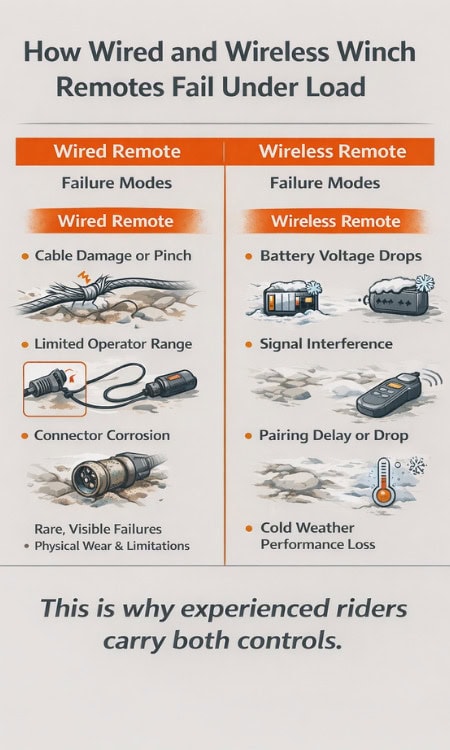
Wired and wireless winch remotes differ in how they send control signals to the winch, which affects reliability and where you can stand. Both types activate the winch solenoid, but they use different methods.
Wired winch remotes use a cable that connects straight to the solenoid or control port. This direct link gives you immediate, predictable response and avoids problems like signal loss, interference, or delays that can happen with wireless remotes.
Wireless winch remotes send a radio signal from a handheld controller to a receiver on the winch. This lets you control the winch from a distance and can improve safety and visibility during recovery.
Key functional differences include:
- Signal delivery: physical cable vs RF signal
- Operating range: cord-limited vs stand-off positioning
- Failure modes: cable damage vs battery or pairing issues
- Primary advantage: reliability vs safety positioning
Knowing these differences is important before deciding how to control your UTV winch during real recoveries.
Wired vs Wireless Winch Remotes: Quick Comparison
| Scenario | Wired Remote | Wireless Remote |
| Cold weather | ✅ Reliable | ⚠️ Battery risk |
| High-load stop control | ✅ Immediate | ⚠️ Possible delay |
| Operator positioning | ❌ Limited | ✅ Flexible |
| Solo recovery | ⚠️ Less ideal | ✅ Strong |
| Best role | Primary control | Safety positioning |
Why “Wireless Is Safer” Is an Oversimplification
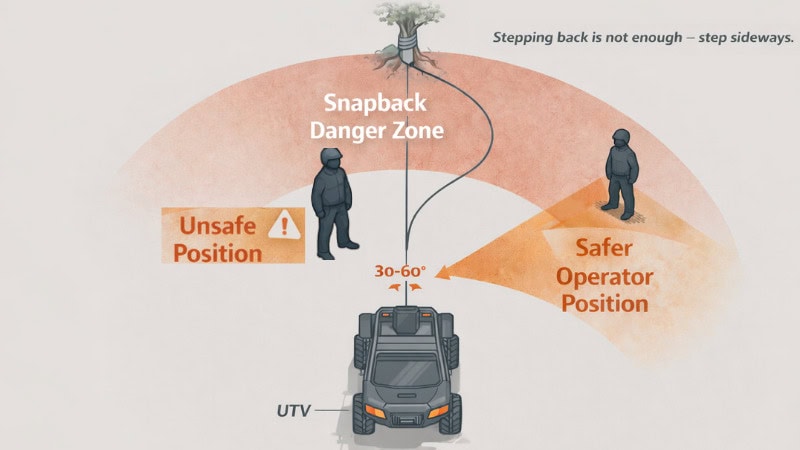
Many articles say wireless winch remotes are safer because you can stand farther away. Distance helps, but it isn’t the only factor in safety.
The real risk during UTV recovery comes from stored energy in the winch line, regardless of remote choice, especially when comparing synthetic and steel winch rope and their recoil behavior under failure. Standing ten feet farther back but still in line with the rope does little to reduce injury risk if something fails.
Wireless remotes make recovery safer by letting you position yourself better and see more clearly, not because they are more reliable under load. This difference is important. When the line is tight, safety depends on two things:
- Where you stand (angle, line-of-sight, snapback avoidance)
- How predictably the winch responds when you need to stop or adjust
This is where simple advice doesn’t hold up. Wireless remotes can fail because of batteries, signal problems, or pairing delays. These issues don’t usually appear during light use, but they become important during long or heavy pulls.
Experienced operators don’t use wireless as a replacement for wired control. They use wireless for safer positioning, with a wired remote as backup. When conditions change—like more load, colder weather, or uneven line stacking—reliable control matters more than convenience.
The issue isn’t with wireless technology itself. The real problem is thinking it’s always safer, when real recoveries need both good positioning and reliable control.
Wired Winch Remotes: Reliability, Strengths, and Limitations
Wired winch remotes are the baseline whenever reliability under load matters. The direct connection between the remote and solenoid eliminates signal loss, pairing errors, and battery failures. When something stops responding under load, it rarely feels like a clean failure. It feels like hesitation at the worst moment when it’s necessary here.
During testing and real recoveries, one thing becomes obvious quickly – control isn’t really about how far you stand from the winch. It’s about how predictably the system responds as the load starts to change.
In real-world UTV recoveries, wired remotes perform consistently during:
- Cold-weather operation
- Long, sustained pulls
- High electrical load scenarios
Key strengths of wired winch remotes include:
- No batteries to fail
- No signal interference
- Immediate and predictable response
- High reliability during prolonged recoveries
Wired winch remotes aren’t designed for convenience or comfort. They’re made to keep control steady when load, temperature, and electrical demand become real challenges. Learning how heat, electrical load, and duty cycle affect a winch under load helps explain why remote response can slow or hesitate during tough recoveries.
Wireless Winch Remotes: Safety Benefits and Common Issues
Wireless winch remotes improve operatoWireless winch remotes improve operator safety and situational awareness by removing the physical tether between the user and the winch. The upside is flexibility, which allows safer positioning, especially during solo or technical recoveries.motes
- Ability to stand clear of the winch line
- Improved visibility of the anchor and rope path
- Reduced need to reposition during tension changes
These benefits make wireless remotes especially helpful for solo recoveries, training, and working on uneven ground.
Common Issues With Wireless Winch Remotes
- Battery depletion, especially in cold conditions
- Signal interference or pairing failures
- Reduced responsiveness under electrical load
When wireless control fails, it usually does so quietly, not suddenly. This often happens when stopping or repositioning is more important than starting the pull.
Cold weather introduces a different kind of wireless failure that doesn’t involve signal loss, and it catches many riders off guard.
A Cold-Weather Failure Most Riders Don’t Expect
During a winter recovery on a side-by-side buried to the skid plates in drifted snow, a rider I was spotting relied solely on a wireless remote. The pull started clean, but halfway through the recovery, the remote stopped responding when he tried to pause and reset line tension. The battery hadn’t died — it was simply too cold to maintain voltage under load. The winch continued pulling until someone reached the vehicle and shut it down manually.
Nothing broke mechanically, but control was lost at the worst time. Since then, that rider always keeps a wired remote plugged in and uses wireless only for positioning.
Wired vs Wireless Winch Remote Comparison – Quick Reference
Wired and wireless winch remotes serve different recovery priorities. Neither is universally superior; each excels in specific conditions.
- Safety positioning: The real advantage isn’t just distance, but angle. Most people step back, not to the side. Wireless control helps because it lets you move off to the side, where you’re less likely to be hit by rope recoil or a failed hook.
- Reliability: wired is more dependable under stress; wireless depends on signal and batteries
- Cold-weather performance: wired is consistent; wireless may degrade
- Ease of use: wireless offers flexibility; wired offers simplicity
- Failure risk: wired failures are rare; wireless failures are manageable with backup.
A Hard Truth About Wireless Winch Remotes
It may be controversial, but wireless winch remotes are often sold as convenience tools and misunderstood as main controls. If you use them alone, you might get overconfident and take risks. When used as a positioning aid with wired control as backup, they make recovery much safer. The real danger isn’t the wireless technology—it’s trusting it under load when batteries and physics don’t care about marketing.
When to Use a Wired vs Wireless Winch Remote During UTV Recovery
The safest remote choice depends on the recovery situation, not just personal preference. Different conditions call for different control methods. Wireless remotes are best for:
- Solo recoveries requiring visibility and distance
- Complex pulls where the line angle must be monitored
- Training or instructional environments
I’ve seen recoveries stall or become risky because someone kept using a wireless remote after conditions changed, instead of switching to wired control when the load and angle became a problem.
After seeing this happen a few times, switching remotes during a recovery starts to feel normal, not optional.
Wired remotes are best for:
- Cold-weather recoveries
- Sustained, high-load pulls.
- Situations where wireless reliability is uncertain
Why the Best UTV Winch Setup Uses Both Remotes
No one regrets having a wired backup when a wireless remote stops working during a pull. Many regret not having one. Using both types lets you combine safe positioning with reliable control.
Wireless control provides:
- Distance from the winch line
- Better visibility during recovery
Wired control provides:
- Guaranteed operation
- Backup when wireless systems fail
Many modern UTV winches suppoMany modern UTV winches support both control methods for this reason. When evaluating winches, remote capability should be considered alongside capacity, electrical demand, and duty cycle, especially for riders who recover frequently or ride alone.
Common Winch Remote Mistakes That Reduce Safety
Most winch-remote injuries are caused by operator error, not equipment failure. Wired and wireless remotes are both safe when used correctly, but small mistakes quickly negate their benefits under load.
The most common safety-reducing mistakes are:
- Not testing the wireless remote before applying tension.
- Wireless remotes should always be tested before recovery begins. Pairing issues and weak batteries usually appear after the load is applied, when stopping or repositioning becomes more difficult.
- Standing inline with the winch rope
- Just stepping back isn’t enough. You should stand to the side of the pull, outside the snapback zone, and make sure you can see the anchor and fairlead clearly.
- Relying on wireless control without a wired backup
- Wireless remotes make recovery safer but can fail. Without a wired backup, a dead battery or lost signal can stop recovery when it matters most.
- Improper receiver or antenna placement
- Receiver modules exposed to heat, vibration, or moving parts are more likely to fail. Secure, protected mounting improves reliability.
Avoiding these mistakes improves recovery safety more than increasing winch capacity or speed. Many of these mistakes are covered in more detail in our guide to UTV recovery safety fundamentals, especially positioning and snapback risk.
Do Winch Remotes Affect Which UTV Winch You Should Buy?
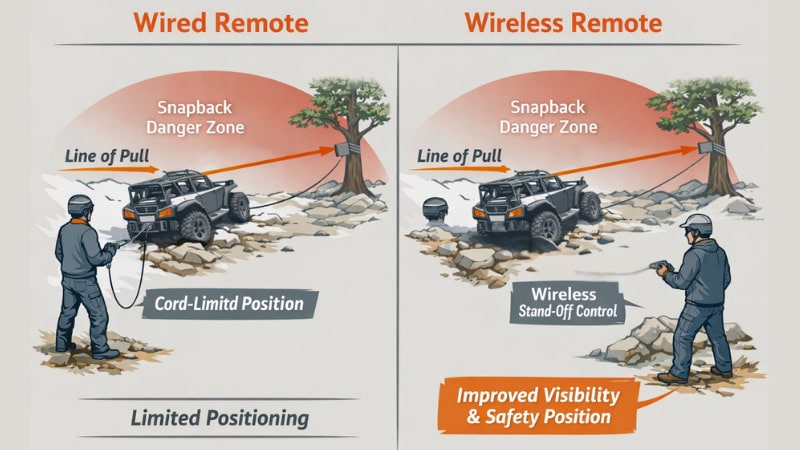
Yes. Winch remote options directly affect recovery safety and usability, especially during solo or technical recoveries. The type of remote determines where the operator can stand and how reliably the winch responds under load.
In addition to handheld remotes, some UTV winches go for handlebar-mounted or in-cab switches. These controls provide fixed-position operation and are often favored for utility work or frequent short pulls, such as snow plowing or equipment positioning.
However, fixed switches limit operator movement. Because they are mounted close to the vehicle, they do not allow the same stand-off distance as wireless remotes and may reduce visibility during angled or technical recoveries. Handlebar or in-cab switches are best viewed as convenience controls, not primary safety controls.
When evaluating winch systems, fixed switches work best as a supplement to wired or wireless remotes, not a replacement. Recovery safety depends on positioning and visibility, which handheld remotes provide more effectively in high-tension scenarios.
When choosing a UTV winch, consider:
- Whether it supports both wired and wireless control
- Whether the wireless system is integrated or an add-on
- Whether a wired remote is included as standard equipment
Wireless remotes make recovery safer by improving your position and visibility. Wired remotes give you steady control, while wireless systems can be affected by cold, interference, or battery problems.
Many of the best UTV winches reviewed in our best UTV winch recommendations include dual-control capability, making them better suited for real-world recovery conditions.
FAQs: Wired vs Wireless Winch Remotes for UTVs
Can a wireless winch remote fail during recovery?
Yes. Battery failure, pairing problems, or signal interference can interrupt control, which is why a wired backup is recommended.
Do wireless winch remotes work reliably in cold weather?
Wireless remotes are more susceptible to cold-related battery issues than wired remotes.
Should every UTV winch have both wired and wireless remotes?
For most riders, yes. Having both types of remotes gives you the best mix of safety, reliability, and flexibility. Most experienced operators develop their habits first, then pick the remote that fits those habits instead of adjusting to the remote.
Final Verdict
Most UTV recovery mistakes aren’t caused by picking the wrong remote. They happen when the operator doesn’t adapt as conditions change. Wireless remotes help by improving your position and visibility, but they can fail when the line is under load. Wired remotes are still the most reliable way to control a winch during long or high-tension pulls.
The safest recovery setups normalize switching between the two. Wireless should be treated as a safety layer, not a single point of control. No place for hesitation. Reliability under load still matters more than convenience, and experienced riders build their habits around that reality, not around range claims or features.
Continue exploring related topics:
- Understanding snatch block use and control
- Essential accessories for safer winch recovery
- Proper wiring and setup for reliable winch operation

ATVNotes is an off-road resource focused on ATV and UTV winching, recovery systems, safety gear, tires, batteries, and essential off-road equipment. Content is produced by the ATVNotes Expert Team and written from the perspective of a practical off-road recovery advisor, emphasizing real-world performance, system compatibility, and safety-first practices across trail riding, utility use, and off-road exploration.