
Imagine being deep in the wild, mud swallowing your tires, and your ATV refusing to budge. In such moments, a reliable winch isn’t just an accessory—it’s your lifeline. But with so many options out there, how do you pick the right one?
We’ve done the hard work for you, narrowing down the best ATV winches that deliver power, durability, and value.
Whether you’re a weekend warrior or an off-road pro, this guide will help you find the perfect winch to keep you moving.
Jump To Contents
- How These ATV Winches Fit Into a Complete Recovery System
- What Are the Best ATV Winches for Different Riding Conditions?
- Comparison Table of 15 Top-rated ATV Winches
- In-depth Reviews of Top 15 ATV Winches in 2025
- 1. WARN ProVantage Series Winch — Dependable All-Around Performance
- 2. Superwinch Terra 45 — Heavy-Duty Capacity with Smooth Power Delivery
- 3. KFI SE35 Stealth — Durable and EfficientFI SE35 Stealth
- 4. WARN VRX 25 — Practical, Entry-Level Competent Recovery
- 5. MotoAlliance VIPER Elite 4500 — Strong Waterproof Performance with Modern Control
- 6. Champion Power Equipment 4,000-lb Winch — Strong Pulling Power for Budget-Conscious Riders
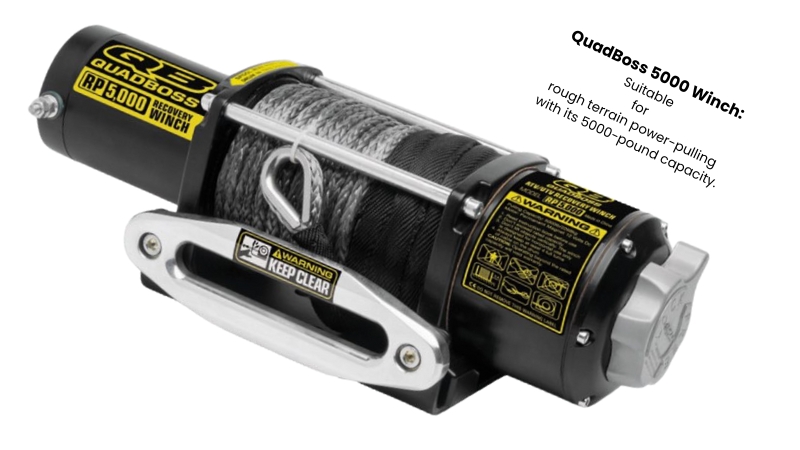
- 7. QuadBoss 5,000-lb Winch — High Capacity for Larger ATVs and Tough Terrain
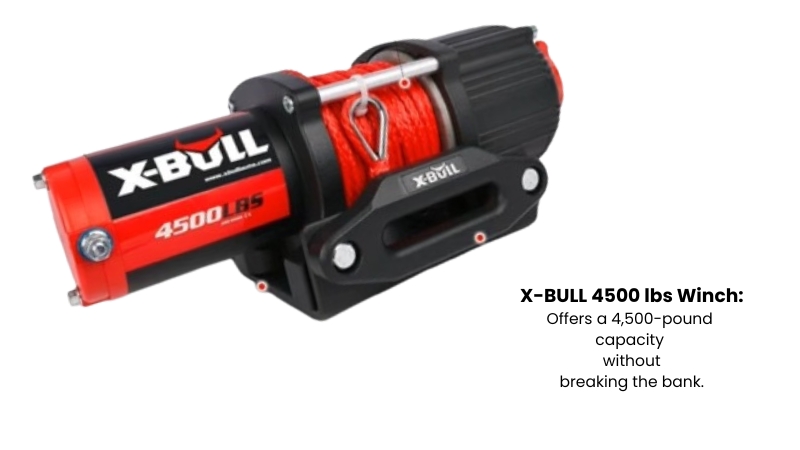
- 8. X-BULL 12V Winch — Affordable High-Capacity Option with Trade-Off Awareness
- 9. Smittybilt 97495 XRC GEN2 — Balanced Mid-Range Power with Modern Features
- 10. KFI A2500 Winch — Reliable Entry-Level Option for Light Recovery
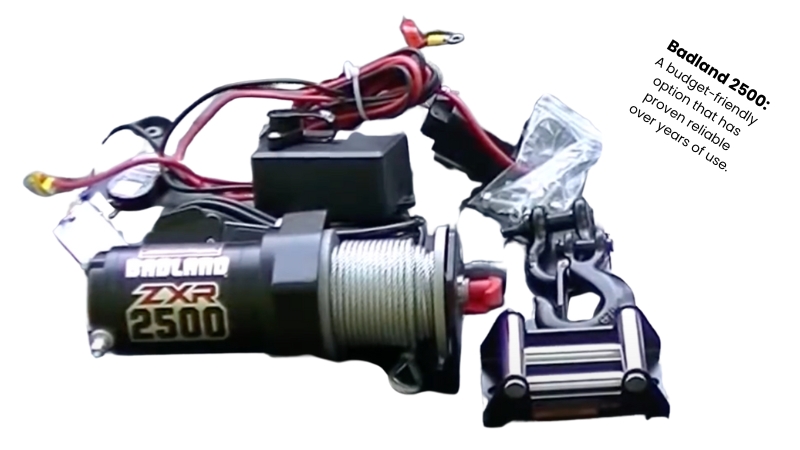
- 11. Badland ZXR 2500-lb Winch — Budget-Friendly Backup Recovery Solution
- 12. Tusk 3500-lb ATV Winch — Trail-Focused Reliability with Practical Capacity
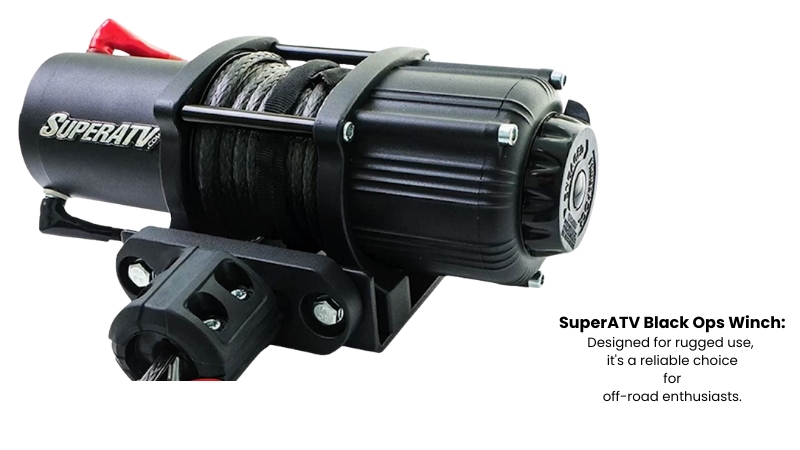
- 13. SuperATV 3500-lb Black Ops Winch — Balanced Performance with Modern Controls
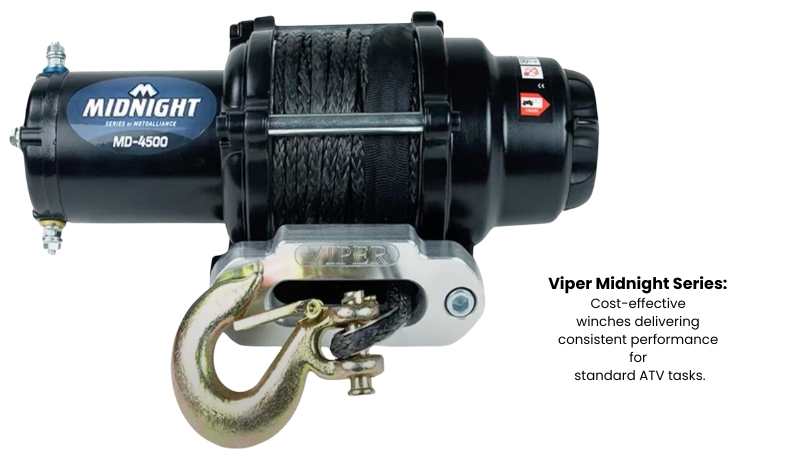
- 14. Viper Elite 3000-lb Winch — Compact and Well-Sealed for Wet Conditions
- 15. Runva 3500 — Steady Torque and Practical Trail Reliability
- What to Look for Before Buying an ATV Winch
- 1. Start With Proper Capacity
- 2. Confirm Mounting Compatibility and Frame Support
- 3. Evaluate Electrical Compatibility
- 4. Understand Motor Type and Heat Tolerance
- 5. Consider Gear System Behavior
- 6. Choose the Right Rope Type
- 7. Look at Waterproof Rating and Environmental Protection
- 8. Decide on Remote Control Type
- 9. Consider Brand Reputation and Warranty Support
- Final Buying Reality Check
- Common Mistakes When Choosing an ATV Winch
- Real-World Buying Scenarios
- How to Ensure System Integration While Installing an ATV Winch
- ATV vs UTV Winching: How Do They Differ?
- FAQs About ATV Winches
- Final Verdict: Choosing the Right ATV Winch for Your Riding Style
How These ATV Winches Fit Into a Complete Recovery System
Choosing the best ATV winch isn’t just about selecting the highest pulling capacity — it’s about how that winch integrates with your overall recovery setup. A winch works as part of a system that includes the mounting plate, battery and wiring, fairlead type, rope choice, and recovery hardware like snatch blocks and straps.
For example, a 3,000 lb winch may be ideal for a mid-size trail ATV, but only if the mounting plate properly transfers load into the frame and the electrical system can supply stable voltage under strain. Similarly, choosing synthetic rope instead of steel cable affects fairlead compatibility and overall front-end weight distribution.
Motor type and gear system also influence how the winch performs during sustained mud recoveries or steep incline pulls. Only a system-balanced approach ensures that capacity, electrical demand, structural integrity, and rigging hardware all support each other rather than creating weak points.
If you’d like a deeper breakdown of how all the components work together, see our full guide to building a reliable ATV and UTV winch setup.
What Are the Best ATV Winches for Different Riding Conditions?
Below are our top ATV winch recommendations, selected based on real-world terrain demands, electrical compatibility, mounting reliability, and recovery performance.
WARN ProVantage 3500 – Best for Reliability: Built with durable construction, sealed components, and consistent torque delivery, it’s a dependable option for riders who prioritize long-term trail performance over flashier features.
Superwinch Terra 45 – Best for Heavy-Duty Use: Designed to handle sustained pulling demands with stable power delivery and robust internal components, it suits riders who regularly face tougher extractions and higher resistance terrain.
KFI SE35 Stealth – Best for Durability: With a sealed design and balanced performance, it delivers dependable recovery strength for riders who want consistent operation across varied trail conditions.
WARN VRX 25 – Best for Budget-Friendly Reliability: Offering straightforward installation and dependable light-to-moderate recovery performance, it fits riders who want trusted brand quality without stepping into higher-tier configurations.
MotoAlliance VIPER Elite 4500 – Best for Waterproofing: Featuring enhanced environmental sealing and versatile control options, it’s well-suited for riders who frequently encounter water crossings, mud-heavy terrain, or unpredictable weather conditions.
Champion 4000 Power Equipment Winch – Best for Budget-Friendly Power: Offering strong pulling capability with practical construction and straightforward controls, it suits riders who want dependable recovery performance without investing in premium-tier systems.
QuadBoss 5000 Winch – Best for Larger ATVs and Demanding Terrain: Built to handle heavier loads and resistance-heavy extractions, it provides the added pulling confidence needed for steep inclines and challenging mud conditions.
X-BULL 12V ATV/UTV Winch Kit – Best for Value-Focused High-Capacity Recovery: Delivering impressive pulling potential at an accessible price point, it fits riders who want extra recovery strength for occasional tough situations without frequent extreme-duty use.
Smittybilt 97495 XRC GEN2 Winch – Best for Versatile All-Terrain Use: Combining durable construction with balanced load handling and modern control features, it performs reliably across mixed trail environments where steady recovery matters most.
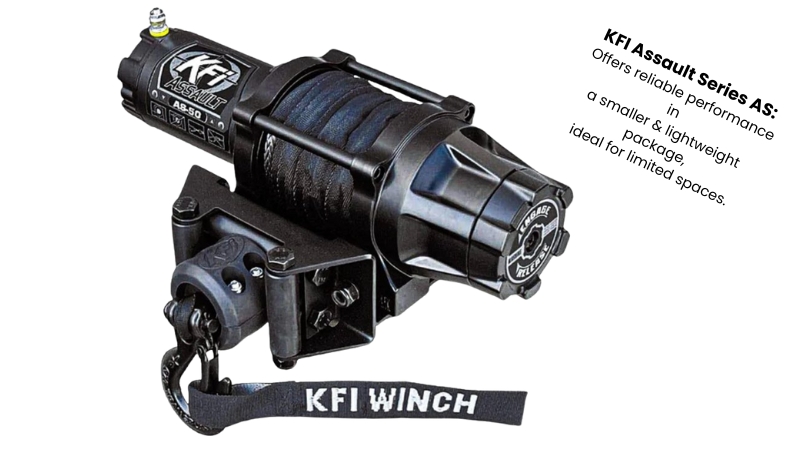
KFI Assault Series AS-25 – Best for Lightweight ATVs and Emergency Backup Use: Designed for smaller machines and occasional recovery needs, it provides dependable light-duty performance when preparedness matters more than sustained heavy pulling.
Badland ATV Winch – Best for Budget-Conscious Casual Riders: Designed as an affordable entry-level recovery solution, it suits riders who want light-duty extraction capability without investing in premium construction or advanced features.
Tusk ATV Winch Kit – Best for Recreational Trail Riders Seeking Balanced Performance: Offering dependable recovery strength with straightforward controls and trail-ready reliability, it fits riders who need consistent performance for typical off-road conditions.
SuperATV Black Ops (All-in-One Quick Connect) – Best for Convenient Plug-and-Play Installation: Its integrated wiring and quick-connect design simplify setup, making it ideal for riders who value easy installation and clean system integration.
Viper Midnight Series Winch – Best for Wet and Muddy Riding Environments: With enhanced environmental protection and dependable load handling, it performs well for riders who frequently encounter moisture-heavy terrain and unpredictable conditions.
Runva ATV Winch – Best for Riders Seeking Durable All-Terrain Reliability: Built for consistent recovery performance with solid construction and balanced torque delivery, it suits trail users who prioritize long-term dependability
Comparison Table of 15 Top-rated ATV Winches
Side-by-side comparison of the best ATV winches, breaking down key specifications, what one is best for, and standout features to simplify your decision-making process.
| Winch Model | Capacity | Cable Type | Motor | Waterproof | Remote Type | Best For |
| WARN ProVantage 3500 | 3,500 lbs | Synthetic Rope | 12V DC | Yes | Handlebar Rocker | Reliability |
| Superwinch Terra 45 | 4,500 lbs | Steel Cable | 1.6 HP 12V DC | Yes | Wired Remote | Heavy-Duty Use |
| KFI SE35 Stealth | 3,500 lbs | Synthetic Rope | 12V DC | Yes | Handlebar Rocker | Durability |
| WARN VRX 25 | 2,500 lbs | Synthetic Rope | 12V DC | Yes | Handlebar Rocker | Budget-Friendly Reliability |
| MotoAlliance VIPER Elite 4500 | 4,500 lbs | Synthetic Rope | 12V DC | IP67 | Wireless | Waterproofing |
| Champion Power Equipment 4000 | 4,000 lbs | Steel Cable | 12V DC | No | Wired Remote | Affordability |
| Quadboss 5000 Winch | 5000 lbs | Synthetic Rope | 12V DC | Yes | Wireless | Rough Terrain |
| X-BULL 4500 | 4,500 lbs | Synthetic Rope | 12V DC | Yes | Wireless | High Capacity at a Low Price |
| Smittybilt 97495 XRC GEN2 | 9,500 lbs | Steel Cable | 12V DC | Yes | Wired Remote | Extreme Conditions |
| KFI Assault AS-25 | 2500 lbs | Synthetic Rope | 12V DC | Yes | Handlebar-mounted switch | Compact & LightweightDesign |
| Badland 2500 | 2,500 lbs | Steel Cable | 12V DC | No | Wired Remote | Budget Reliability |
| Tusk Winch | 3,500 lbs | Synthetic Rope | 12V DC | Yes | Wireless | Balanced Performance |
| SuperATV Black Ops | 4,500 lbs | Synthetic Rope | 12V DC | Yes | Wireless | Rugged Use |
| Viper Midnight Series | 3,500 lbs | Synthetic Rope | 12V DC | Yes | Wireless | Cost-Effective Performance |
| Runva 3500 | 3,500 lbs | Synthetic Rope | 12V DC | Yes | Wired Remote | Enhanced Torque |
In-depth Reviews of Top 15 ATV Winches in 2025
Get ready to dive deep into the best ATV winches on the market, breaking down their features, pros, and cons to help you choose the perfect fit for your adventures.
1. WARN ProVantage Series Winch — Dependable All-Around Performance
Key Specifications:

- Capacity: 3,500 lbs
- Cable: 50 ft steel rope
- Motor: 12V permanent magnet
- Waterproof: Yes
- Remote: Handlebar-mounted switch
Overview
This winch is a strong choice for riders seeking a balance of capability and long-term reliability on mixed terrain. With a 3,500 lb capacity and proven planetary gear train, it provides consistent pulling torque for everyday trail recovery without overwhelming most stock ATV electrical systems.
The sealed motor housing and all-metal gear construction offer environmental protection against mud, dust, and moisture, which matters in real trail use more than advertised IP numbers alone. While steel cable offers durability in abrasion-prone conditions, it also requires regular inspection and use of gloves to handle safely.
This is not a lightweight option — but for riders who value a robust build that can handle a wide range of recoveries, it delivers predictable performance.
Best for: Riders who want a reliable, well-rounded winch for general trail and moderate mud recovery.
Pros:
✔ Durable all-metal construction
✔ Smooth and efficient operation
✔ Sealed motor for enhanced reliability
✔ Easy installation with comprehensive instructions
Cons:
✖ Higher price point compared to some competitors
✖ Steel rope requires regular maintenance to prevent corrosion
Dig Deeper: Superwinch ATV/UTV winches to Pull out of Sticky Situation
2. Superwinch Terra 45 — Heavy-Duty Capacity with Smooth Power Delivery
Key Specifications:

- Capacity: 4,500 lbs
- Cable: 55 ft steel rope
- Motor: Sealed 1.6 HP
- Waterproof: Yes
- Remote: Handlebar and handheld
Overview
For riders who frequently tackle deep mud, steep inclines, or heavier ATV setups, this 4,500 lb capacity winch steps up the performance scale. Its larger motor and high-efficiency gear system deliver the torque needed to move more resistant loads while maintaining smooth operation under stress.
The sealed solenoid and circuit protection help keep components functioning through wet and muddy conditions, but heavier steel cable means increased handling weight and maintenance needs. The ergonomic clutch design makes engaging and disengaging under load easier, which is valuable for repeated or prolonged recovery scenarios.
This Superwinch unit is best viewed as a system anchor in tougher terrain — powerful and dependable when paired with a properly reinforced mount and solid electrical supply.
Best for: Heavy-duty riders who regularly face challenging conditions and need extra capacity.
Pros:
✔ High pulling capacity suitable for larger ATVs
✔ Sealed motor and solenoid for extended lifespan
✔ Efficient and smooth planetary gear operation
✔ Robust construction for rugged use
Cons:
✖ Heavier than some alternatives, potentially affecting vehicle balance
✖ Steel cable may require more maintenance and is prone to kinking
Dig Deeper: KFI winches – your tested friend in rugged terrains
3. KFI SE35 Stealth — Durable and EfficientFI SE35 Stealth
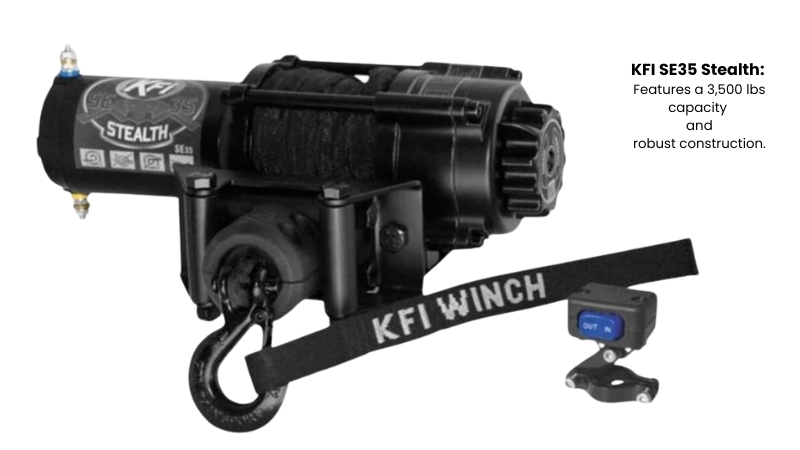
Key Specifications:
- Capacity: 3,500 lbs
- Cable: 50 ft synthetic rope
- Motor: 1.5 HP 12V DC
- Waterproof: Yes
- Remote: Handlebar-mounted switch
Overview
This model is ideal for riders who prioritize ease of handling and consistent performance without excess weight. With a 3,500 lb rating and synthetic rope, it reduces front-end bulk and makes line handling safer, especially in low-visibility or high-tension situations.
The sealed drum and high-performance motor support reliable operation in varied trail conditions, while the lightweight synthetic rope minimizes control fatigue during frequent short recoveries. However, synthetic rope can be more susceptible to abrasion and UV degradation compared with steel, so it benefits from cleaning and inspection after heavy use.
Designed to withstand extreme conditions, the winch features a sealed drum and high-performance motor, ensuring consistent performance in various environments. This KFI winch won’t deliver utility-grade grunt, but its combination of lightweight handling and dependable torque makes it a strong match for typical trail-focused riders.
Best for: Off-road riders who want a manageable, effective winch without unnecessary weight.
Pros:
✔ Lightweight and safe synthetic rope
✔ Sealed components for resistance against harsh weather
✔ Quiet operation suitable for noise-sensitive areas
✔ Sturdy construction for long-term use
Cons:
✖ May not be ideal for the heaviest applications
✖ Synthetic rope can be susceptible to abrasion and requires careful handling
4. WARN VRX 25 — Practical, Entry-Level Competent Recovery
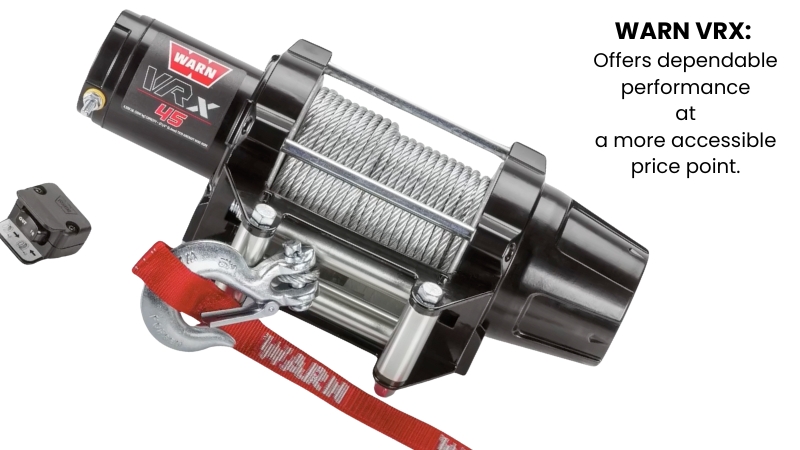
Key Specifications:
- Capacity: 2,500 lbs
- Cable: 50 ft steel rope
- Motor: 12V permanent magnet
- Waterproof: Yes
- Remote: Handlebar-mounted switch
Overview
As one of the more accessible options in the lineup, this 2,500 lb winch suits lighter ATVs or riders who winch infrequently. Its planetary gear system and sealed housing provide dependable operation in basic recoveries, and the more compact footprint preserves vehicle balance.
The steel cable offers abrasion resistance and strength for its size class but requires regular care to prevent rust and frays. Its lower capacity means it may struggle in deep mud or on steep terrain, so pairing it with a snatch block for mechanical advantage is often worth considering during tougher recoveries.
For riders on a lighter machine or those prioritizing cost-effective preparedness over frequent heavy use, this winch serves well.
Best for: Smaller ATVs and riders seeking competent performance for light to moderate recoveries.
Pros:
✔ Cost-effective without sacrificing essential features
✔ Resistant to corrosion, suitable for diverse environments
✔ Compact and lightweight, ideal for smaller vehicles
✔ Dependable braking system for enhanced safety
Cons:
✖ Limited pulling capacity may not suit larger ATVs
✖ Steel cable maintenance is necessary to prevent rust and kinks
5. MotoAlliance VIPER Elite 4500 — Strong Waterproof Performance with Modern Control
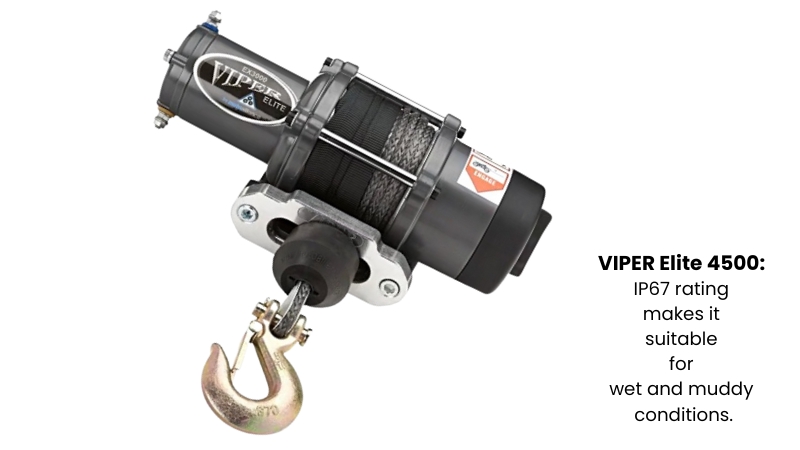
Key Specifications:
- Capacity: 4,500 lbs
- Cable: Synthetic rope
- Motor: Sealed 1.8 HP
- Waterproof: Yes
- Remote: Wireless and handlebar-mounted switch
Overview
This 4,500 lb winch is positioned for riders who frequently encounter wet, muddy, or water-crossing terrain. The combination of synthetic rope, IP67 sealing, and wireless control makes it especially practical for off-road environments where moisture exposure is routine rather than occasional.
The higher pulling capacity provides useful overhead beyond the 1.5× vehicle weight rule, particularly for heavier ATVs or riders who often deal with suction-heavy mud recoveries. Synthetic rope reduces handling risk and front-end weight compared to steel cable, while the sealed motor and contactor help protect internal components from water intrusion.
Because of its capacity, electrical demand is higher under sustained load, so battery health and clean grounding connections matter more with this model than lighter-duty options.
Best for: Riders who prioritize waterproof reliability and higher-capacity recovery in muddy or wet conditions.
Pros:
✔ High pulling capacity suitable for larger ATVs and UTVs
✔ Synthetic rope reduces weight and is safer to handle
✔ Wireless remote adds convenience and safety
✔ Sealed motor for enhanced durability
Cons:
✖ Higher price point compared to some competitors
✖ Synthetic rope requires regular inspection for wear and tear
6. Champion Power Equipment 4,000-lb Winch — Strong Pulling Power for Budget-Conscious Riders
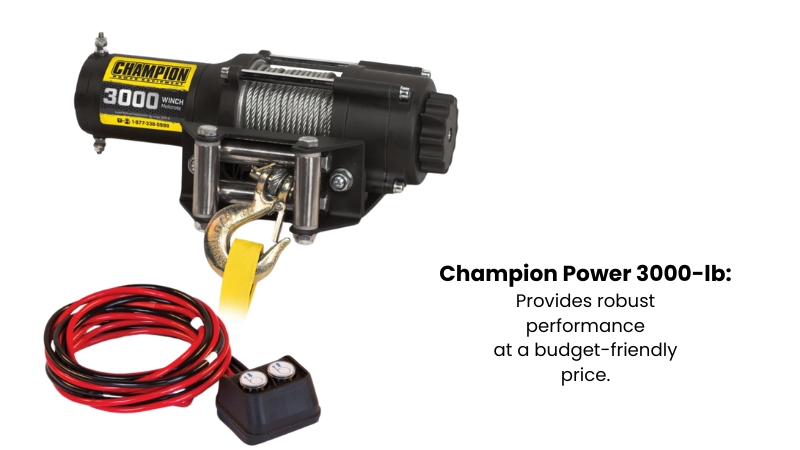
Key Specifications:
- Capacity: 4,000 lbs
- Cable: 46 ft galvanized steel
- Motor: 1.3 HP 12V DC
- Waterproof: Yes
- Remote: Handlebar-mounted switch
Overview
This 4,000-lb winch is a practical option for riders who want higher capacity without stepping into premium pricing. The added pulling margin makes it more forgiving in mud and incline recoveries, especially for mid-size ATVs carrying extra gear or accessories.
Its motor delivers solid torque for occasional heavier pulls, but extended recovery sessions may generate noticeable heat if used continuously. The steel cable provides abrasion resistance in rocky or debris-filled terrain, though it requires inspection to prevent fraying over time.
While not engineered for constant heavy-duty utility work, it performs reliably when paired with proper mounting support and realistic expectations.
Best for: Riders who want extra pulling capacity on a reasonable budget without frequent extreme-duty use.
Pros:
✔ Comprehensive kit includes mounting hardware and accessories
✔ Durable galvanized steel cable suitable for rugged terrains
✔ Efficient gear system ensures reliable performance
✔ Competitive pricing offers excellent value
Cons:
✖ Steel cable is heavier and requires regular maintenance to prevent rust
✖ Limited to handlebar-mounted switch; lacks wireless remote
7. QuadBoss 5,000-lb Winch — High Capacity for Larger ATVs and Tough Terrain
Key Fearures:
- Capacity: 5,000 lbs
- Cable: 50 ft synthetic rope
- Motor: 12V DC
- Waterproof: Yes
- Remote: Wireless remote
Overview:
With a 5,000-lb rating, this winch targets riders running larger ATVs or consistently facing heavy resistance conditions. The additional capacity provides greater recovery margin, particularly when dealing with suction-heavy mud or steep slope extractions.
Its gear train is designed to prioritize torque over speed, which benefits controlled recovery rather than rapid line retrieval. However, increased capacity also means higher amperage draw, so maintaining a healthy battery and clean electrical connections becomes more important.
This is not a lightweight system, and proper frame-supported mounting is essential to safely handle its load potential.
Best for: Larger ATVs and riders who regularly encounter high-resistance terrain.
Pros:
✔ High pulling power for serious recovery jobs
✔ Synthetic rope offers durability without added weight
✔ Wireless remote allows easy, hands-free operation
✔ Waterproof for all-weather performance
Cons:
✖ Higher price point
✖ May be overkill for casual ATV users
8. X-BULL 12V Winch — Affordable High-Capacity Option with Trade-Off Awareness
Key Specifications:
- Capacity: 4,500 lbs
- Cable: 50 ft steel cable
- Motor: 12V DC
- Waterproof: Yes
- Remote: Two wireless remotes
Overview
The X-BULL winch offers higher rated capacity at a more accessible price point, making it attractive for riders who want strong numbers without premium branding costs. In moderate recovery situations, it provides adequate torque for typical ATV applications.
However, long-term durability and sealing quality may not match higher-end models under repeated heavy mud exposure. The synthetic rope improves handling and reduces recoil risk, but proper care and inspection are necessary to extend its lifespan.
For occasional use within its limits, this winch can perform well — but it’s best treated as a value-driven solution rather than a heavy-duty workhorse.
Best for: Budget-focused riders who want higher capacity for occasional recovery situations.
If you’re considering this model, you can also read a detailed evaluation of how this budget winch performs on actual trail recoveries.
Pros:
✔ High pulling capacity suitable for larger ATVs and also for UTVs
✔ Includes two wireless remotes for convenient operation
✔ Durable steel cable designed for heavy-duty use
✔ Free spooling clutch allows for quick rope deployment
Cons:
✖ Steel cable is heavier and requires regular maintenance to prevent rust
✖ Some users have reported that the battery cable length may be insufficient for certain vehicle models
9. Smittybilt 97495 XRC GEN2 — Balanced Mid-Range Power with Modern Features

Key Specifications:
- Capacity: 9,500 lbs
- Cable: 94 ft steel cable
- Motor: 6.6 HP 12V series wound
- Waterproof: IP67 rated
- Remote: Wired remote
Overview
The Smittybilt XRC GEN2 sits in the mid-range capacity bracket, offering a balanced blend of torque and manageable electrical demand. Its sealed components and durable construction make it suitable for varied trail conditions, including moderate mud and wet environments.
The gear system provides steady pulling strength rather than aggressive speed, which supports controlled recovery scenarios. While it’s capable of handling demanding pulls, riders should still monitor battery health during sustained winching sessions.
This model strikes a middle ground between entry-level and heavy-duty systems, offering dependable capability without excessive complexity.
Best for: Riders who want reliable mid-tier performance across mixed trail conditions.
Pros:
✔ High pulling capacity suitable for heavy-duty applications
✔ Powerful motor ensures efficient operation
✔ Waterproof construction enhances durability
✔ Comes with all necessary wiring for installation
Cons:
✖ Heavier and bulkier than other models, which may not be ideal for smaller ATVs
✖ Steel cable requires regular maintenance to prevent corrosion
10. KFI A2500 Winch — Reliable Entry-Level Option for Light Recovery
Key Features:
- Capacity: 2,500 lbs
- Cable: 50 ft synthetic rope
- Motor: 12V DC
- Waterproof: Yes
- Remote: Handlebar-mounted switch
Overview:
The KFI A2500 is a practical choice for riders with lighter ATVs or limited recovery demands. Its 2,500-lb capacity aligns well with smaller machines and occasional use scenarios.
The steel cable offers abrasion resistance but requires proper maintenance to prevent wear. Because of its lower capacity, riders should use mechanical advantage techniques like a snatch block when facing higher resistance terrain.
When matched correctly to vehicle weight and usage expectations, it delivers dependable light-duty performance.
Best for: Lightweight ATVs and riders who need basic emergency recovery capability.
Pros:
✔ Reliable for moderate recovery needs
✔ Lightweight and easy-to-handle synthetic rope
✔ Waterproof construction for extended durability
✔ Simple and intuitive controls
Cons:
✖ Limited pulling capacity for heavier applications
✖ No wireless remote option
11. Badland ZXR 2500-lb Winch — Budget-Friendly Backup Recovery Solution
Key Specifications:
- Capacity: 2,500 lb
- Cable: 50 ft steel wire
- Motor: 12V DC, 1.5 HP permanent magnet
- Waterproof: No (weather-resistant)
- Remote: Wired handlebar control
Overview
This 2,500-lb winch provides an accessible entry point for riders who want emergency recovery coverage without major investment. It performs adequately for light trail extraction when mounted properly and used within its rated limits.
Its motor and sealing design are better suited to occasional use than repeated heavy-duty pulls. Synthetic rope improves handling safety, but consistent inspection and cleaning remain essential.
It’s best viewed as preparedness equipment rather than a high-demand mud recovery tool.
Best for: Riders seeking an affordable backup winch for light-duty use.
Pros:
✔ Budget-friendly option for casual ATV users
✔ Reliable steel wire cable for durability
✔ Easy-to-install and simple wired control
✔ Compact and lightweight design
Cons:
✖ Not fully waterproof—limited protection against harsh weather
✖ No wireless remote option
✖ Steel wire cable requires more maintenance and can fray over time
12. Tusk 3500-lb ATV Winch — Trail-Focused Reliability with Practical Capacity

Key Specifications:
- Capacity: 3,500 lb
- Cable: 50 ft synthetic rope
- Motor: 12V DC, 1.2 HP
- Waterproof: Yes
- Remote: Wireless and handlebar-mounted switch
Overview
The Tusk 3,500-lb winch fits squarely into the sweet spot for mid-size ATVs used primarily on trails. It offers sufficient pulling strength for incline recoveries and moderate mud situations while remaining compatible with most stock electrical systems.
Synthetic rope reduces front-end weight and simplifies handling, especially during solo recoveries. The motor is designed for intermittent trail use rather than extended heavy-duty operation, making it important to avoid long continuous pulls without cooldown periods.
This is a practical, no-nonsense choice for riders who want dependable performance in typical trail conditions.
Best for: Trail riders who want balanced capacity without moving into utility-grade systems.
Pros:
✔ Affordable yet powerful for most ATV applications
✔ Waterproof build ensures longevity in extreme conditions
✔ Wireless remote for added convenience
✔ Synthetic rope is lightweight and safer than steel
Cons:
✖ Slightly slower line speed compared to premium models
✖ Mounting hardware may require additional modifications for some ATVs
13. SuperATV 3500-lb Black Ops Winch — Balanced Performance with Modern Controls
Key Specifications:
- Capacity: 4,500 lbs
- Cable: 50 ft synthetic rope
- Motor: 12V DC
- Waterproof: Yes
- Remote: Wireless remote
Overview
This 3,500-lb winch offers a practical mix of pulling strength and control features. It handles common trail recovery situations well, particularly when paired with a proper mounting plate and healthy battery.
The included synthetic rope reduces handling risk and front-end weight, and its control system provides smooth engagement under load. During prolonged heavy pulls, monitoring heat buildup is still advisable, as with any mid-range winch.
It represents a well-rounded option for riders who want dependable recovery capability with modern convenience features.
Best for: Recreational riders who value ease of use and balanced performance.
Pros:
✔ Comprehensive kit includes all necessary components for installation
✔ Durable synthetic rope is safer and easier to handle
✔ Wireless remote enhance operational convenience
✔ The quick-connect system allows for easy attachment and removal
Cons:
✖ Higher price point compared to some standalone win
14. Viper Elite 3000-lb Winch — Compact and Well-Sealed for Wet Conditions
Key Specifications:
- Capacity: 3,000 lb
- Cable: 50 ft synthetic rope
- Motor: 12V DC, 1.2 HP
- Waterproof: Yes
- Remote: Wired and wireless remote control
Overview
The Viper Elite 3,000-lb model emphasizes environmental sealing and compact design. For riders who regularly encounter wet terrain, mud crossings, or unpredictable weather, its protective housing helps maintain consistent performance.
Its capacity suits most standard ATVs while keeping electrical demand moderate. The synthetic rope enhances safety and ease of handling but requires routine cleaning after muddy recoveries to maintain longevity.
While not designed for heavy utility workloads, it performs reliably in recreational trail and moderate mud environments.
Best for: Riders who prioritize sealing and compact design for wet trail conditions.
Pros:
✔ Lightweight synthetic rope for easy handling
✔ Comes with both wired and wireless remote controls
✔ Waterproof and durable for all-weather use
✔ Affordable pricing for the features offered
Cons:
✖ Not the best choice for heavy-duty recovery tasks
✖ Some users report slower pulling speeds under heavy loads
15. Runva 3500 — Steady Torque and Practical Trail Reliability

Key Specifications:
- Capacity: 3,500 lb
- Cable: 45 ft synthetic rope or steel wire (options available)
- Motor: 12V DC, 1.4 HP
- Waterproof: Yes (IP67-rated)
- Remote: Wired and wireless remote control
Overview
The Runva 3500 is well suited for riders who need dependable pulling strength without stepping into heavy-duty territory. It delivers steady, controlled torque that performs confidently during typical trail recoveries, including moderate mud and incline extractions.
Its gearing favors consistent pulling force rather than aggressive line speed, which helps maintain smoother recoveries when tension needs to stay stable. The synthetic rope improves handling safety and keeps overall front-end weight manageable, making it easier to work with during solo or repeated recoveries.
Electrical demand remains reasonable for most standard ATV setups, provided the battery and grounding connections are in good condition. The wired remote offers simple, reliable operation without relying on wireless signals that may be affected by wet or muddy conditions.
This winch is not built as a utility-grade workhorse, nor is it a lightweight emergency-only option. It sits comfortably in the middle — focused on balanced performance and dependable trail recovery.
Best for: Riders who want steady pulling performance and practical reliability for everyday trail conditions.
Pros:
✔ High-quality motor with excellent pulling power
✔ Fully waterproof (IP67) for all-terrain use
✔ Comes with both wired and wireless remote options
✔ Available in both synthetic and steel cable versions
Cons:
✖ Slightly heavier than competitors in the same category
✖ Installation may require extra wiring adjustments
What to Look for Before Buying an ATV Winch
Before choosing a model, consider how the winch will integrate into your overall recovery setup, including mounting strength, electrical capacity, and the type of terrain you ride most often.
Below are the key factors that matter in real-world use.
1. Start With Proper Capacity
As a baseline, your winch should be rated at least 1.5 times your ATV’s fully loaded weight. This provides enough overhead to handle incline pulls and moderate resistance.
However, capacity alone doesn’t guarantee performance. Mud suction, steep terrain, and drum wrap layers can increase the load beyond the vehicle’s weight. Riders who frequently encounter deep mud or heavy obstacles may benefit from stepping slightly above the minimum.
So, the importance of calculating proper winch sizing for your specific ATV is paramount.
Capacity determines whether a winch can do the job. Everything else determines how well it does it.
Riders running side-by-side machines should remember that UTVs typically require higher recovery capacity due to their weight and cargo loads. For a deeper look at models designed specifically for those heavier machines, see our guide to UTV winches built for real-world recovery loads.
2. Confirm Mounting Compatibility and Frame Support
Even a correctly sized winch becomes unsafe if mounted improperly.
Your ATV needs a model-specific mounting plate designed to transfer load into structural frame components — not cosmetic bumpers. Recovery forces travel through mounting hardware first, which means bracket strength directly affects real pulling capability.
If you want to dive deep into how mounting plates differ across ATV models or how load transfer works during recovery, analyzing the mounting and fitment is crucial.
Capacity without structural support creates weak points in the recovery system.
Read: Why you need properly sized ATV winch fuse
3. Evaluate Electrical Compatibility
Winches draw significant current under load. Higher-capacity units draw more amperage, especially during stalled or slow pulls.
A stock battery in good condition may handle occasional recovery without issue. But voltage drop, weak grounding, or undersized cables can reduce pulling performance even when the winch is properly rated.
Often overlooked, a reliable solenoid responsible for switching winch power deserves critical evaluation in the winch electrical system. It acts as the electrical gatekeeper between the battery and the winch motor and ensures smooth recovery operation.
If you ride frequently in deep mud or expect repeated pulls, it’s wise to review your ATV’s electrical system before upgrading capacity. Our winch amps draw guide and electrical upgrade breakdown explain how battery health, grounding, and cable size affect real-world performance.
Electrical compatibility ensures your winch performs consistently — not just on paper.
4. Understand Motor Type and Heat Tolerance
Most ATV winches use either permanent magnet or series-wound motors.
Permanent magnet motors perform well for light and occasional use. Series-wound motors generally handle sustained heavy pulls better because they tolerate heat buildup more effectively.
Heat management becomes especially important during slow, high-resistance recoveries where airflow is limited. If you frequently ride in deep mud or perform long extractions, motor design influences durability more than line speed.
A detailed comparison of motor types is crucial for understanding how heat resistance, duty cycle, and electrical load interact under real recovery conditions.
5. Consider Gear System Behavior
Planetary gear systems are common in ATV winches because they provide a compact balance of speed and torque. Worm gear systems operate more slowly but offer self-locking and controlled-load behavior.
While both designs can work well, gear system choice influences how the winch behaves during recovery — whether it prioritizes faster retrieval or controlled torque under strain.
A deeper technical breakdown of planetary versus worm-gear behavior, including durability and heat buildup considerations, will help you choose the right winch for your riding style.
6. Choose the Right Rope Type
Synthetic rope and steel cable both perform reliably when used correctly, but they behave differently under load.
Synthetic rope is lighter, easier to handle, and stores less recoil energy in case of failure. Steel cable offers abrasion resistance but adds front-end weight and requires more careful handling over time.
Rope type also affects fairlead compatibility and rigging setups, especially when using snatch blocks or double-line pulls. You need to explore these trade-offs in greater depth as rope choice influences safety, handling, and the integration of recovery hardware.
7. Look at Waterproof Rating and Environmental Protection
ATVs are routinely exposed to mud, water crossings, and wet storage conditions. IP ratings provide a general indication of dust and water resistance, but repeated submersion still requires maintenance.
Sealing quality affects not only the motor housing but also solenoids and electrical connectors. Riders who frequently operate in wet environments should prioritize environmental protection.
That’s why off-roaders prefer waterproof winches. Should you do it? Before that, know how IP ratings of off-road winches translate into real-world durability and what they don’t guarantee.
Environmental exposure impacts long-term reliability more than many riders expect.
8. Decide on Remote Control Type
Wired remotes are simple and dependable, with no signal interference or battery concerns. Wireless remotes provide greater flexibility and allow you to reposition safely during solo recovery situations.
Control type becomes especially important when monitoring anchor points or line tension from different angles.
If you’re weighing convenience against reliability, the wired vs wireless remote comparison breaks down real-world trade-offs.
Yes, remote control choice affects safety positioning as much as usability.
9. Consider Brand Reputation and Warranty Support
Specifications define performance, but brand support defines long-term ownership.
Electrical components such as solenoids and contactors are wear items. Access to replacement parts, clear documentation, and responsive warranty service can matter more over time than minor feature differences.
Some riders prefer OEM integration for consistency, while others choose reputable aftermarket brands for flexibility and value. If you compare reliability expectations across winch brands, our OEM vs aftermarket winch guide examines those differences objectively.
Warranty terms should be evaluated alongside real-world durability — not in isolation.
Final Buying Reality Check
Before purchasing, ask yourself:
- How often will I realistically use this winch?
- What terrain do I encounter most?
- Is my electrical system prepared for sustained load?
- Do I have proper mounting and recovery hardware to support it?
- Am I buying for emergency use or repeated heavy recovery?
The best ATV winch is the one that integrates cleanly with your vehicle’s structure, electrical system, and recovery setup — not simply the one with the highest advertised rating.If you want to understand how sizing, electrical demand, mounting strength, rigging, and safety all work together as a unified recovery system, explore our complete off-road recovery system guide for a broader system-level perspective.
Common Mistakes When Choosing an ATV Winch
Most buying mistakes don’t come from choosing too little capacity — they come from ignoring how the winch fits into the overall recovery system. Capacity, mounting strength, electrical support, rope type, and duty cycle all interact. When one part is mismatched, performance and reliability suffer.
Here are the most common selection errors riders make.
Oversizing Without Supporting the Electrical System
Moving from a 3,000 lb winch to a 4,500–5,000 lb model increases amperage draw significantly under load. On a stock ATV battery and wiring system, that added demand can cause a voltage drop, slower line speed, and excessive motor heat.
More capacity only helps if the electrical system can deliver stable power. If you’re stepping up in size, it’s worth understanding how winch amperage and battery health affect real pulling performance before upgrading.
Ignoring Mounting Compatibility and Frame Strength
A winch’s rating assumes it’s mounted to a structurally supported plate tied into the ATV frame. Installing a higher-capacity winch onto a light-duty bumper bracket shifts the weak point from the motor to the mount.
Under tension, flexing brackets or thin plates can reduce the effective pulling force and increase the risk of failure. Proper load transfer through a frame-supported mounting system is just as important as motor power.
Choosing Rope Material Without Considering Terrain
Steel cable offers abrasion resistance, but in heavy mud, it becomes heavier to handle and more prone to contamination and corrosion. Synthetic rope is lighter and easier to manage, but requires inspection and cleaning to prevent abrasion damage.
Neither option is automatically “better.” The correct choice depends on terrain, frequency of use, and maintenance habits. If you’re unsure which fits your riding style, a direct synthetic vs steel comparison can clarify the trade-offs.
Overlooking Duty Cycle and Heat Management
Most ATV winches are designed for intermittent pulls, not continuous operation. Repeated heavy mud extractions generate heat quickly, especially in mid-range motors.
Ignoring duty-cycle limits leads to reduced performance and premature wear. Riders who frequently encounter deep resistance should pay attention to motor type and heat tolerance — not just rated capacity.
The Real Lesson
A reliable recovery setup is balanced — not oversized. When capacity, electrical supply, mounting strength, and rope choice work together, recovery becomes smoother and safer.Choosing with system awareness prevents the most common winching failures before they happen.
Real-World Buying Scenarios
Specifications matter — but terrain determines real load. The same 3,500-lb winch behaves very differently in deep mud, freezing temperatures, or repeated utility work. Matching winch capacity, motor type, and rope choice to your actual riding conditions prevents strain, overheating, and unnecessary upgrades.
Below are common riding patterns — and what they mean for reaching the right ATV winch.
If You Ride Mostly Mud Trails
Mud creates suction resistance that often exceeds the weight of the vehicle. In these conditions, consistent torque and heat tolerance matter more than line speed.
A mid-to-upper 3,000-lb winch typically provides enough recovery margin for most ATVs without overwhelming a stock charging system. Synthetic rope is often preferable for mud riders because it’s lighter, easier to handle when dirty, and safer during repeated pulls.
Frequent mud recovery also increases reliance on mechanical advantage. Using a snatch block reduces motor strain and helps control load. If you regularly ride deep mud, reviewing a dedicated off-road winch rigging and snatch block guide will clarify how double-line setups reduce electrical and thermal stress.
If You Ride in Snow or Cold Conditions
Cold weather reduces battery efficiency and increases voltage drop under load. A winch that performs normally in summer may feel slower during winter recovery.
Snow typically creates rolling resistance rather than suction, meaning extreme capacity isn’t always required — but electrical stability is. Clean ground connections and a healthy battery become critical.
If you ride in freezing temperatures, understanding how winch amperage draw affects battery performance can prevent sluggish pulls and mid-recovery voltage sag.
If You Plow Snow or Use Your ATV for Utility Work
Utility use changes the duty cycle. Instead of occasional recoveries, you may apply repeated or sustained load.
In this scenario, motor heat tolerance and mounting strength matter more than peak capacity. A 3,500–4,500 lb winch provides an additional margin of durability, but only if supported by a frame-mounted plate designed to safely transfer force.
Repeated loading stresses the mounting brackets over time. Reviewing proper winch installation and mounting fitment helps prevent frame distortion and long-term structural fatigue.
If You Ride Solo Frequently
Solo riders should prioritize control and safety over maximum capacity. Without assistance, recovery positioning and line handling become more important.
Synthetic rope improves handling safety, and remote control options allow better operator positioning. Capacity should provide a comfortable margin without creating excessive electrical strain during multiple recovery attempts.
Understanding anchor strength, recovery angles, and safe winching practices becomes especially important when riding alone. A structured winching safety checklist can help reduce risk during solo extraction.
Choose for Real-world Recovery, Not Just Ratings
The best ATV winch depends on how you actually ride. Mud riders need torque stability. Snow riders need electrical reliability. Utility users need structural integrity. Solo riders need safety and control.
Choosing based on terrain and duty pattern — not just the biggest capacity number — results in smoother recovery, less strain, and longer equipment life.
How to Ensure System Integration While Installing an ATV Winch
Installing an ATV winch isn’t just about bolting it onto the front bumper. True performance depends on how well the winch integrates with your ATV’s structural, electrical, and recovery components. A properly sized winch can still underperform if one part of the system isn’t aligned.
Start with structural integrity. The mounting plate must transfer pulling force directly into reinforced frame points, not cosmetic brackets or unsupported bumper tubing. Recovery loads travel through the mount before reaching the vehicle, so installation strength determines real-world capacity more than the number printed on the winch housing.
Next, consider electrical stability. Winches draw high amperage under load, and voltage drop reduces torque consistency. Secure grounding, clean battery terminals, and appropriately routed cables help maintain steady motor performance. Even mid-range winches benefit from a clean, resistance-free electrical path.
Recovery hardware also plays a role in system integration. Snatch blocks, tree saver straps, and rated anchor points affect how load is distributed during extraction. Proper rigging reduces motor strain and improves control, especially in high-resistance conditions like mud or incline pulls.
Finally, think of integration as balance. Mounting strength, electrical capacity, and recovery technique should all support the winch’s rated load. When these elements work together, the system operates predictably and safely — without unnecessary strain on the ATV or its components.
A winch that is properly integrated doesn’t just pull — it performs consistently when recovery conditions demand it.
ATV vs UTV Winching: How Do They Differ?
While the basic principles of winching are the same for both ATVs and UTVs, the way those principles play out in real-world recovery can differ significantly. Vehicle weight, electrical capacity, mounting structure, and intended use all influence how a winch performs under load.
Understanding those differences helps ensure you’re choosing the right setup — not just the right capacity.
1. Vehicle Weight and Load Demand
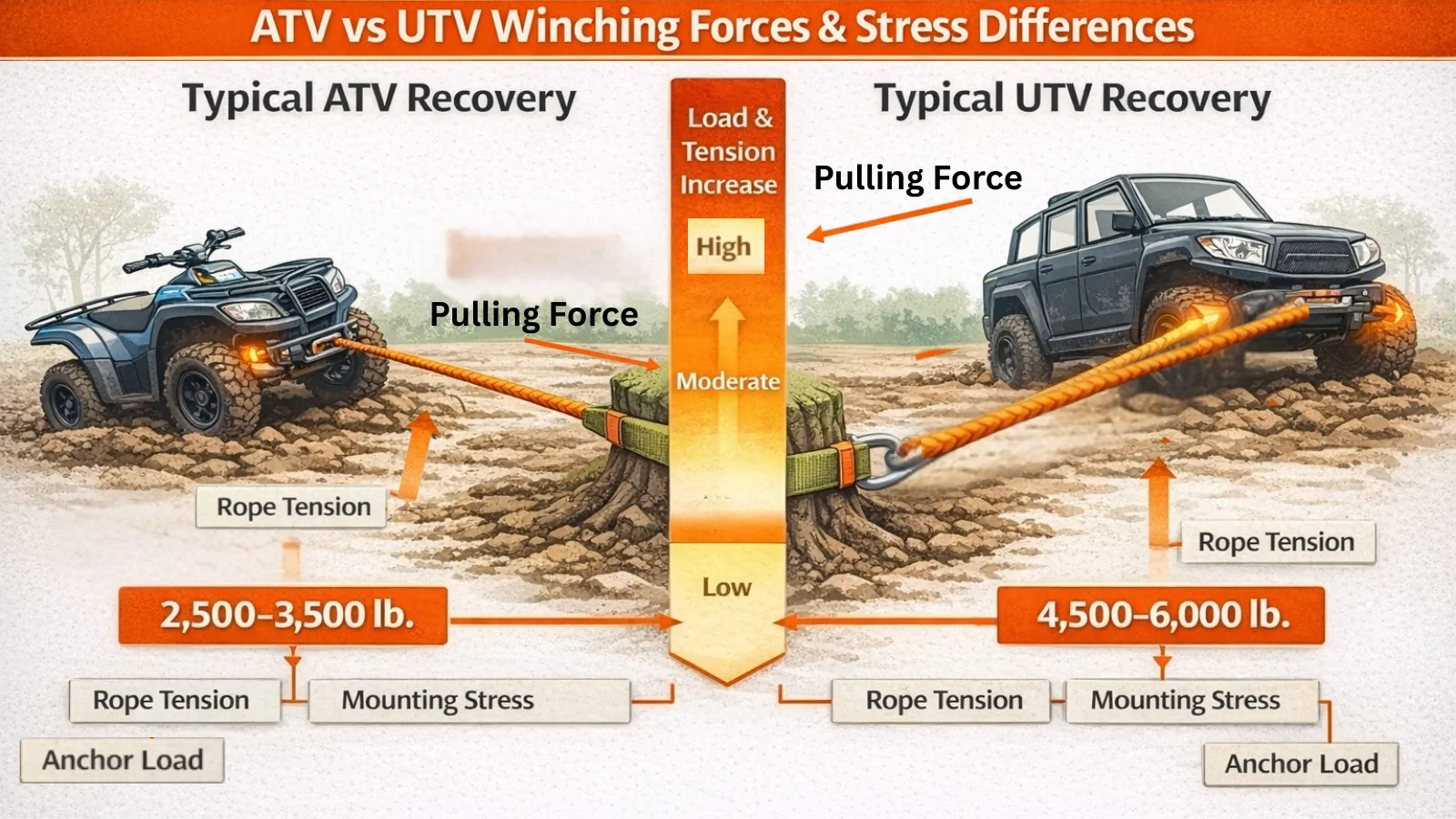
ATVs are generally lighter and commonly paired with 2,500–3,500 lb winches. UTVs are heavier and often require 4,500–6,000 lb units to maintain safe recovery margins.
The heavier the vehicle, the greater the tension on the rope, mounting hardware, and electrical components. UTV recoveries typically generate higher sustained loads, which amplify stress across the entire recovery system.
2. Electrical System Capacity
ATVs usually have simpler electrical systems with smaller batteries and lower alternator output. This makes winch sizing more sensitive to amperage draw.
UTVs often have higher-output charging systems and can power additional accessories such as lights, heaters, or plows. Electrical integration becomes more complex, and voltage stability under load becomes more important.
3. Mounting Structure and Frame Stress
ATV mounting points are typically compact and close to the frame rails. UTVs may have integrated bumpers, brush guards, or accessory mounts that affect load transfer. That also translates to the difference between a UTV winch setup and an ATV setup.
Because UTVs are heavier, mounting precision becomes more critical. Structural stress during recovery increases in proportion to vehicle mass.
This is why fitment accuracy and mounting plate design matter more as vehicle size increases.
Dig Deeper: How the UTV winch duty cycle works
4. Usage Patterns and Duty Cycle
ATVs are often used recreationally — trail riding, mud runs, and occasional self-recovery.
UTVs are frequently used for work applications such as snow plowing, hauling, and repeated extraction tasks. This increases duty cycle demands, heat buildup, and wear on electrical and mechanical components.
The more frequently a winch is used under load, the more important durability and component quality become.
5. Recovery Hardware and Safety Margins
Because UTV recoveries involve greater mass, recovery hardware ratings become more critical. Snatch blocks, straps, shackles, and anchor points must match higher working load limits. Snatch block as a load-and-heat-reduction mechanical advantage is more of a UTV winching phenomenon.
ATV setups are more forgiving due to lower vehicle mass, but safety practices remain equally important.
Regardless of vehicle type, winching should always be treated as a complete system — not just a motor and rope.
Final Perspective
The fundamentals of winching between ATV and UTV don’t change — load management, electrical stability, and safe rigging still apply.
What changes is scale.Heavier vehicles increase stress on every component in the recovery chain. Choosing the right winch for your vehicle means accounting for that scale difference, not just comparing model specifications.
FAQs About ATV Winches
Is a 2,500 lb winch enough for an ATV?
A 2,500 lb winch is sufficient for many smaller ATVs used on light trails. However, for heavier machines or frequent mud riding, a 3,000–3,500 lb winch typically offers better performance and reserve capacity without significantly increasing electrical strain.
Do ATV winches drain the battery?
Winches draw significant amperage under load, especially higher-capacity models. Short recovery pulls rarely cause problems with a healthy battery, but repeated or prolonged use can strain a stock electrical system. Maintaining battery health and clean wiring connections improves performance and reliability.
How long can you run an ATV winch continuously?
Most ATV winches are designed for intermittent duty, meaning short pulls followed by cooling periods. Continuous operation generates heat that can reduce efficiency and shorten motor life. Allowing brief cooldown intervals during extended recoveries helps protect internal components.
Do I need a snatch block with my ATV winch?
A snatch block is not mandatory but greatly improves recovery efficiency under heavy resistance. It creates mechanical advantage, reduces strain on the motor, and enables controlled extraction in deep mud or on steep inclines.
Can I use an ATV winch in water and mud?
Most ATV winches are sealed against dust and water, often with IP67-level protection. However, repeated submersion increases wear. Cleaning and inspecting the winch after muddy rides helps maintain long-term reliability.
Is a wireless winch remote worth it?
Wireless remotes improve operator positioning and reduce exposure to line tension zones, especially for solo riders. However, they rely on battery power and signal integrity. Many riders prefer having both wired and wireless options for flexibility.
Final Verdict: Choosing the Right ATV Winch for Your Riding Style
The best ATV winch isn’t defined by the highest capacity or the lowest price — it’s defined by how well it fits your riding environment and recovery habits.
If you primarily ride light trails, a balanced 2,500–3,000 lb winch provides dependable recovery without overloading your electrical system. Frequent mud riders benefit from consistent torque delivery and proper rigging tools. Utility users should prioritize mounting strength, heat tolerance, and duty cycle reliability. Solo riders should focus on safe rope handling and controlled recovery positioning.
The most important takeaway is this: a winch performs best when it’s part of a balanced system. Capacity, electrical support, mounting structure, and recovery hardware all work together under load.
And if you’re still narrowing down options, revisit the comparison table above and match each model to your real-world terrain — not just the number on the box.
Choosing carefully now ensures smoother recoveries, longer equipment life, and fewer surprises when the trail gets challenging.
Continue exploring related topics:
- ATV winch trouble shooting guide
- Why electric winch is preferred by ATV riders
- How crucial is the solenoid for a Winch

ATVNotes is an off-road resource focused on ATV and UTV winching, recovery systems, safety gear, tires, batteries, and essential off-road equipment. Content is produced by the ATVNotes Expert Team and written from the perspective of a practical off-road recovery advisor, emphasizing real-world performance, system compatibility, and safety-first practices across trail riding, utility use, and off-road exploration.