
A 3500 lb ATV winch sits right in the sweet spot for most trail machines. It’s powerful enough to pull a mid-size ATV out of mud, snow, or a steep ditch, but still compact enough to mount easily on standard ATV racks.
That’s why this size shows up on so many trail builds.
But here’s the thing, riders learn quickly: not every 3500 lb winch performs the same once the trail gets messy.
Some slow down dramatically under load.
Some struggle in wet conditions.
Others look great on a spec sheet but don’t hold up after a season of real riding.
A reliable winch needs to handle things like:
- deep mud suction
- sideways recovery pulls
- repeated use on long rides
- water crossings and rain
This guide focuses on 3500 lb ATV winches that riders actually trust in real trail situations — not just models that look good in a catalog.
We’ll walk through the strongest options, what makes them different, and how to choose the one that fits your ATV and riding style.
Jump To Contents
- What Is the Best 3500 lb ATV Winch?
- Quick Picks: Best 3500 lb ATV Winches
- Best 3500 lb ATV Winch Comparison Table
- 7 Best 3500 lb ATV Winches Reviewed
- Viper Midnight 3500 ATV/UTV Winch – Best Mid-Range All-Rounder
- Tusk 3500 ATV/UTV Winch – Best Value Trail Setup
- SuperATV Black Ops 3500 Winch – Best for Mud and Frequent Recoveries
- Champion 100428 3500-lb ATV/UTV Winch – Best Budget Workhorse
- KFI Assault 3500 lb Winch – Best Tough-Trail Steel Cable Option
- How Much Can a 3500 lb Winch Actually Pull?
- Synthetic Rope vs Steel Cable (The Trade-Off Most Riders Miss)
- What Actually Makes a Good ATV Winch
- Real Trail Scenario: When a 3500 lb Winch Saves Your Ride
- Common Mistakes When Buying an ATV Winch
- 2500 lb vs 3500 lb vs 4500 lb ATV Winches
- Final Recommendation
- FAQs on 3500 lbs ATV Winches
- Final Thoughts: Choosing the Right 3500 lb ATV Winch
What Is the Best 3500 lb ATV Winch?
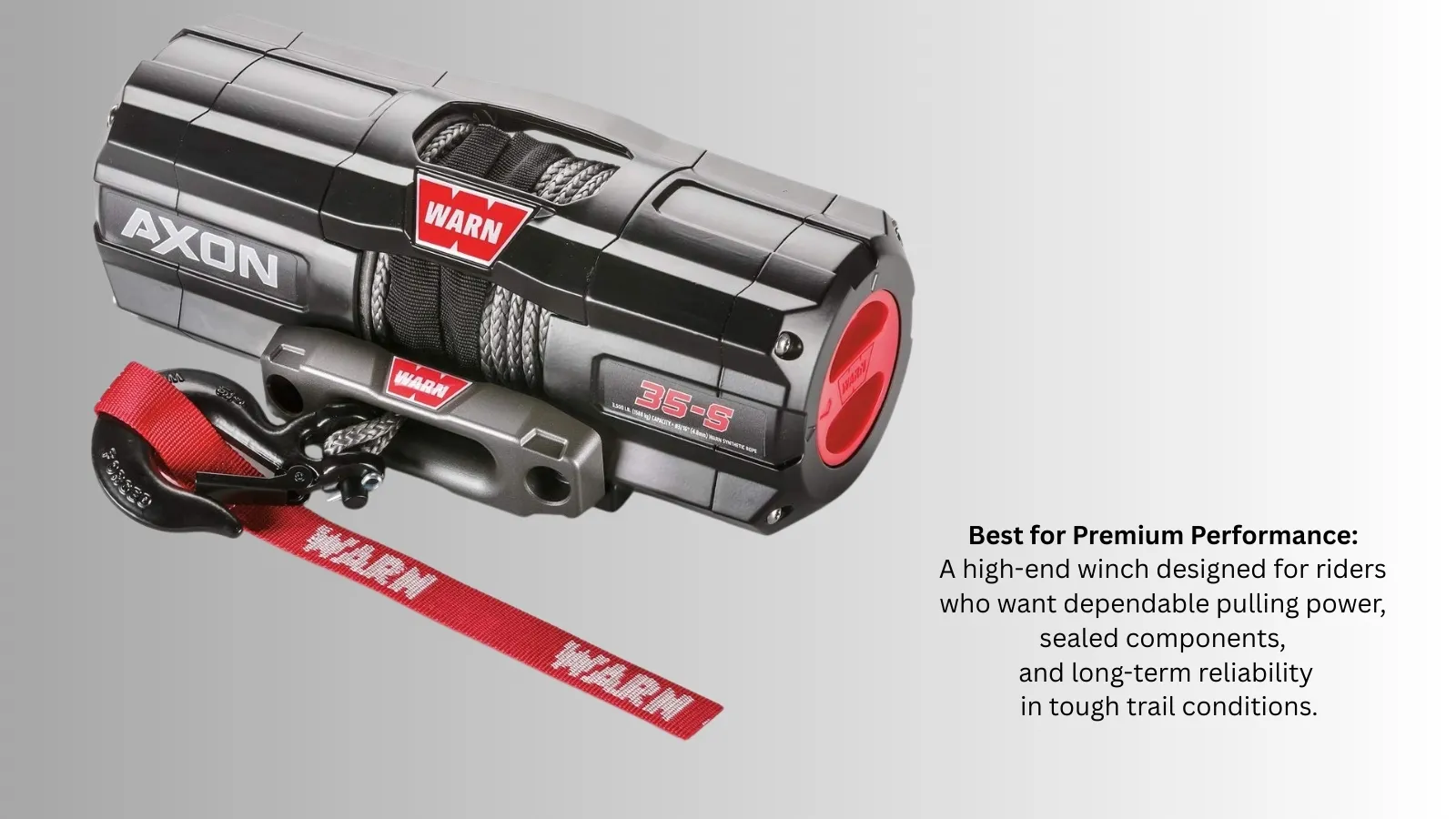
For most riders, the Warn AXON 35-S remains the most dependable 3500 lb ATV winch available.
It consistently stands out for three reasons:
- sealed motor and gearbox that handle water and mud well
- strong planetary gears that maintain pulling power under load
- reliable line speed when recovering a stuck ATV
Warn has been building winches for decades, and the Warn Axon 35-S reflects that experience. It’s not the cheapest option on the market, but riders who spend serious time on muddy trails or remote terrain often prefer it because it simply works when you need it most.
That said, it isn’t the only good choice.
Several other 3500 lb winches offer excellent value, better synthetic-rope setups, or greater durability for aggressive riding.
In the next section, we’ll look at the quick picks most riders consider first when choosing a 3500 lb ATV winch.
Quick Picks: Best 3500 lb ATV Winches
If you just want a solid winch without digging through specs, these are the models most riders start with. Each one has a slightly different strength depending on how and where you ride.
WARN AXON 35-S – Best for Premium Performance: A high-end winch designed for riders who want dependable pulling power, sealed components, and long-term reliability in tough trail conditions.
Superwinch Terra 35 – Best for Rugged Trail Use: A solid, no-nonsense recovery winch built for riders who frequently deal with muddy terrain and repeated trail recoveries.
Viper Midnight 3500 – Best Mid-Range All-Rounder: A balanced option that delivers reliable pulling performance and practical features without pushing into premium pricing.
Tusk 3500 Winch – Best Value Trail Setup: A straightforward winch kit that gives riders dependable recovery capability at a price that makes sense for most ATV builds.
SuperATV Black Ops 3500 – Best for Mud Riders: Built with aggressive trail riding in mind, making it a strong choice for riders who regularly tackle deep mud and messy recoveries.
Champion 100428 – Best Budget Workhorse: A practical entry-level winch that provides reliable pulling power for riders who want solid performance without spending a fortune.
KFI Assault 3500 – Best for Rough Terrain Recovery: A tough steel-cable winch suited for riders who often winch against rocks, roots, and other abrasive trail obstacles.
All seven winches can handle typical ATV recovery situations, but the right choice depends on how hard you ride and how often you rely on recovery gear. Riders who regularly tackle mud holes, steep trails, or remote terrain often think beyond the winch itself and build a full recovery setup for ATV and UTV riding.
Best 3500 lb ATV Winch Comparison Table
If you want to compare the top 3500 lb ATV winches side by side, this table gives a quick overview before we get into the detailed reviews.
| Winch | Rope Type | Rope Length | Gear Ratio | Motor | Waterproof Rating | Control Type | Weight | Best For |
| WARN AXON 35-S | Spydura Synthetic | 50 ft | 168:1 | 12V Permanent Magnet | IP68 | Handlebar rocker switch | ~20 lb | Premium reliability |
| Superwinch Terra 35 | Steel cable | 50 ft | 140:1 | 1.6 HP Permanent Magnet | Weather sealed | Handlebar + handheld remote | ~30 lb | Rugged trail use |
| Viper Midnight 3500 | Synthetic / Steel | 50 ft | 171:1 | 12V Permanent Magnet | Weather sealed | Wireless + handlebar | ~22 lb | Balanced mid-range |
| Tusk 3500 Winch | Synthetic | 50 ft | ~166:1 | 12V Permanent Magnet | Sealed housing | Handlebar switch | ~21 lb | DIY installs |
| SuperATV Black Ops 3500 | Synthetic | 50 ft | 166:1 | 12V 1.2 HP Permanent Magnet | Waterproof seals | Wireless remote + rocker switch | ~24 lb | Mud riding & trail recovery |
| Champion 100428 | Synthetic | 50 ft | 171:1 | 1.4 HP Permanent Magnet | Weather resistant | Handlebar switch | ~18.3 lb | Budget option |
| KFI Assault Series 3500 | Steel Cable | 50 ft | 180:1 | 12V 1.15 HP Permanent Magnet | Water-resistant seals | Handlebar rocker + corded remote | ~25.6 lb | Heavy-duty value |
In a hurry? Use the table to quickly pick a winch.
Want deeper insight? Continue with the reviews below before deciding.
These winches represent the most reliable 3500-lb recovery options currently available for ATV trail riding and utility work.
7 Best 3500 lb ATV Winches Reviewed
Below are the 3500 lb winches riders most often consider when setting up an ATV recovery system. Each one can handle typical trail recoveries, but they differ in durability, rope type, gear ratio, and long-term reliability.
The impressions below come from a trail rider and recovery trainer’s perspective, focusing on how these winches behave when an ATV is actually stuck — not just what the spec sheet promises.
WARN AXON 35-S ATV/UTV Winch – Best Premium Performance
Some winches feel fine on paper. Then there are the ones you trust when the trail turns ugly. The WARN AXON 35-S falls into that second category. I’ve seen machines buried to the skid plate where the tires were spinning like blenders in mud, and this winch still pulled with calm, steady authority.
WARN has spent decades building recovery gear that riders trust in difficult conditions, which is why the brand consistently appears among the most dependable ATV winch manufacturers used on serious trail machines.
What makes the difference is its tightly sealed design and integrated control system, which keeps water and grit out of the critical parts. Pair that with a lightweight synthetic line that’s easy to manage with cold, muddy hands, and you get a recovery tool that feels built for real trail problems—not catalog photos.
Pros
- Smooth, controlled pull even under heavy resistance
- Excellent sealing against mud and water intrusion
- Synthetic rope is lighter and safer to handle during recovery
- Integrated electronics simplify installation and wiring
- Strong reputation for long-term durability
Cons
- Premium pricing compared with most 3500-lb winches
- No wireless remote included in the base kit
- Slightly heavier than many mid-tier models
Superwinch Terra 35 ATV/UTV Winch- Best Rugged Trail Build
The Superwinch Terra 35 feels like the kind of winch you mount when you know the trail ahead is going to get ugly. I’ve watched riders sink an ATV into clay mud where the tires just churn soup, and this winch still creeps the machine forward without drama.
The heart of it is a sealed 1.6-HP permanent-magnet motor paired with a heavy, all-steel planetary gearset built to handle repeated pulls. Add the handlebar rocker switch and handheld remote, and you get a winch that’s simple, tough, and ready for the messy recoveries off-road riding inevitably brings.
Superwinch has long focused on building straightforward, hard-working recovery gear for off-road riders, and the Terra lineup reflects that philosophy. Riders curious about the brand’s other trail-ready models can explore how Superwinch designs its ATV and UTV recovery winches.
Pros
- Strong 1.6-HP sealed motor handles tough recoveries
- Durable all-steel planetary gears built for heavy pulling
- Comes with both handlebar switch and handheld remote
- Weather-sealed components resist mud and water
- Narrow drum design fits tight ATV winch mounts
Cons
- Wired remote instead of wireless control
- Basic design compared with newer premium winch electronics
Viper Midnight 3500 ATV/UTV Winch – Best Mid-Range All-Rounder
Some winches feel like delicate gadgets. The Viper Midnight 3500 feels more like a dependable trail tool you bolt on and forget about—until the day you need it. I’ve seen riders bury an ATV in swampy clay where the tires just dig deeper with every throttle blip. That’s where this winch quietly earns its keep.
Its sealed housing and steel planetary gears keep the guts protected from mud and water, while the mechanical brake holds the load steady when the pull stops. It’s not flashy, but it’s the kind of recovery partner that shows up ready to work.
Pros
- Durable steel planetary gears for steady pulling
- Sealed motor and wiring resist mud and water intrusion
- Mechanical load-holding brake improves recovery control
- Synthetic rope option is lighter and safer to handle
- Usually priced lower than premium ATV winches
Cons
- Basic wired control setup rather than advanced electronics
Tusk 3500 ATV/UTV Winch – Best Value Trail Setup
Every trail group has that one rider who doesn’t care about brand prestige — they just want gear that works when things go sideways. The Tusk 3500 winch reminds me of that rider. It’s simple, practical, and surprisingly capable when the trail decides to swallow an ATV whole.
With its 730-watt motor and 50-foot synthetic rope, it has enough pull to drag a stuck machine out of a muddy rut or lift a plow without complaint. Nothing flashy here — just a straightforward recovery tool that quietly does its job when the ride gets rough.
Pros
- Strong 730-watt motor delivers dependable pulling power
- 50-ft synthetic rope is lighter and safer than a steel cable
- Complete kit with wiring, rocker switch, hook, and fairlead
- Water-resistant sealed components handle muddy trails
Cons
- Winch mount plate usually sold separately
- Basic control setup compared with premium models
- Finish and hardware feel more utilitarian than high-end winches
SuperATV Black Ops 3500 Winch – Best for Mud and Frequent Recoveries
Mud riders know a simple truth: sooner or later, the trail turns into a trap. I’ve watched machines slide sideways into swampy ruts where throttle only makes things worse. That’s where the SuperATV Black Ops 3500 feels right at home.
It’s built with mud and water riding in mind, pairing a sealed motor with a synthetic rope that’s easy to handle when everything is coated in grit. The pull is smooth rather than violent — the kind that steadily walks a stuck ATV back onto solid ground without feeling like the winch is fighting itself.
Pros
- Strong, steady pulling power in muddy recoveries
- Synthetic rope is lighter and safer to manage on the trail
- Sealed components help resist water and dirt intrusion
- Includes handlebar controls and wireless remote option
- Designed specifically with ATV/UTV trail riding in mind
Cons
- Slightly bulkier housing than some compact winches
- Premium pricing compared with basic entry-level models
Champion 100428 3500-lb ATV/UTV Winch – Best Budget Workhorse

Usually, you will find one machine in the trail that carries simple, practical, and surprisingly capable gear. The Champion 100428 reminds me of that machine. It isn’t trying to impress anyone with flashy tech — it just shows up ready to pull when the trail turns stubborn.
The 1.4-hp motor, paired with a 171:1 planetary gear reduction, delivers steady torque for dragging an ATV out of mud or hauling gear around camp. The synthetic rope is lighter and safer to handle, especially when your gloves are soaked, and the ground is slick.
Pros
- Strong motor providing dependable pulling power
- 171:1 gear reduction delivers steady torque during recoveries
- Free-spooling clutch and handlebar remote improve control
- Backed by a 2-year warranty and lifetime technical support
Cons
- Not fully waterproof compared with premium winches
- Slightly slower line speed under heavy load
- Wired control only, no wireless remote option
Dive in: KFI winches built for ATV and UTV recovery work
KFI Assault 3500 lb Winch – Best Tough-Trail Steel Cable Option
Not every recovery happens in soft mud. Sometimes the trail throws rocks, roots, and rough bark into the mix—places where a rope can scrape and wear quickly. That’s where the KFI Assault 3500 with steel cable starts to make sense.
I’ve seen riders winch off jagged tree trunks or rocky ledges where synthetic line would need extra care. This winch is built with that kind of abuse in mind. Its 1.5-hp motor and 171:1 gearing provide steady torque, while the steel cable handles rough surfaces without complaint.
It’s a straightforward, tough recovery tool for riders who spend time in rugged terrain.
Pros
- Durable steel cable resists abrasion on rocks and rough bark
- Strong 1.5-hp motor with 171:1 planetary gearing for solid pulling torque
- Includes handlebar rocker switch and handheld remote
- Sealed components help protect the motor and gears
Cons
- Steel cable is heavier and harder to handle than synthetic rope
- Can develop sharp burrs over time if not maintained
- Slightly louder operation under heavy load compared with some winches
Now, you know the best 3500-lb options in-depth, but before locking in your decision, it’s worth understanding what a 3500-lb winch can realistically pull when the trail gets messy.
How Much Can a 3500 lb Winch Actually Pull?
A 3500-lb winch rating doesn’t mean it can only move a 3500-lb vehicle. That number refers to the maximum pulling force on the first layer of rope on the drum under ideal conditions. Out on the trail, recoveries are rarely that simple.
When an ATV gets stuck, the winch isn’t just pulling the machine’s weight. It also has to overcome mud suction, tire drag, uneven ground, and slope angle, which can dramatically increase the force needed to get the ATV moving again.
Is 3500 lb Enough for Most ATVs?
For most ATVs, the answer is yes.
Most machines weigh 500–900 pounds, and a common off-road guideline is to choose a winch rated for 1.5-2 times the vehicle’s weight. That places the ideal range for many ATVs right around 3000–3500 lb, which explains why this size is so widely used.
A quality 3500-lb winch can handle common recovery situations, such as pulling out of muddy ruts, clearing small trail obstacles, or helping another ATV get unstuck.
If you want a deeper explanation of how to calculate winch capacity, see our guide: What Size Winch Should You Put on an ATV?
When You Might Need a Bigger Winch
A larger winch may make sense if you ride heavy utility ATVs, frequently encounter deep mud, or pull trailers and equipment. Machines weighing over 900 lb often benefit from stepping up to a 4000–4500 lb winch for additional recovery margin.
Side-by-sides typically require even more pulling capacity. If you ride a UTV, our guide explains the sizing differences: What Size Winch Do You Need for a UTV?
Synthetic Rope vs Steel Cable (The Trade-Off Most Riders Miss)
When choosing a 3500 lb ATV winch, one of the first decisions you’ll face is whether to run a synthetic rope or a steel cable for off-road winches. Both can recover a stuck machine, but they behave very differently once you start using the winch regularly on the trail.
Most riders today lean toward synthetic rope, especially for recreational trail riding. It’s lighter, easier to handle, and far safer if a line ever fails. Instead of snapping back under tension like a steel cable, a synthetic rope tends to drop to the ground.
Why Many Riders Prefer Synthetic Rope
Synthetic rope is made from extremely strong polyethylene fibers and weighs far less than steel cable.
That difference becomes noticeable during real recoveries. The line spools more easily, doesn’t develop sharp burrs, and is much easier to handle when your gloves are muddy or wet.
Synthetic rope works best for riders who:
- ride muddy or technical trails
- winch frequently
- want safer, easier rope handling
When Steel Cable Still Makes Sense
Steel cable hasn’t disappeared for a reason. It remains highly abrasion-resistant, which can be useful when pulling across rocks, rough bark, or hard surfaces.
Utility riders and farm ATVs sometimes prefer steel cable because it requires less cleaning and can tolerate scraping better than rope.
What Actually Makes a Good ATV Winch
When riders compare winches, it’s easy to focus on brand names or price tags. But the real differences between a dependable winch and a frustrating one usually come down to a few key mechanical details.
If you understand these specs, it becomes much easier to pick a winch that will actually perform when your ATV is buried in mud or stuck on a trail.
Gear Ratio: Where Pulling Power Comes From
The gear ratio determines the mechanical advantage the winch provides when pulling.
A higher ratio means the motor turns more times per drum rotation, increasing pulling strength.
Typical gear ratios for 3500-lb ATV winches range from 150:1 to 180:1.
What this means in practice:
- Higher ratios (170:1+) provide a stronger pulling force but slightly slower line speed.
- Lower ratios (150:1 range) pull faster but with less torque.
For muddy trail recoveries, many riders prefer a higher gear ratio because it helps the winch keep pulling steadily under heavy load.
Line Speed: How Fast the Rope Spools
Line speed determines how quickly the rope pulls in during recovery.
A faster line speed can make repeated pulls easier, especially when riding with a group and helping other riders get unstuck.
However, there’s always a trade-off:
- Faster line speed usually means less pulling torque
- Slower winches often pull more consistently under heavy load
Most reliable ATV winches balance these two factors rather than maximizing speed. Warn’s off-road winches can strike that balance more efficiently than its competitors.
Motor Strength: The Heart of the Winch
The motor is what actually generates the pulling force.
Most 3500-lb ATV winches use a 12-volt permanent-magnet motor, which works well for compact off-road recovery systems.
What matters more than raw motor size is:
- consistent power delivery
- heat resistance
- durability under repeated pulls
A well-designed motor paired with a robust gear system will outperform a larger motor with weak internal components.
Waterproofing: Critical for Real Trail Riding
This is one spec that many buyers overlook — and it’s often the reason cheaper winches fail early.
ATV winches are regularly exposed to mud, water crossings, rain, sand, and dust. So, you should look for winches with IP67 or IP68 waterproof ratings. These ratings indicate that the motor and gearbox are well sealed to keep out water and debris.
Better sealing dramatically improves long-term reliability, especially for riders who frequently encounter wet trails or mud holes.
Build Quality and Sealing
Finally, pay attention to overall construction.
Signs of a well-built ATV winch include:
- metal gear housings
- sealed electrical connections
- durable fairlead design
- smooth spool operation
These small details often make the difference between a winch that lasts one season and one that continues working for years.
Once you understand these core specs, choosing a good 3500 lb winch becomes much easier — and you’re far less likely to end up with a model that struggles when the trail gets tough. If you want to go deeper into winch components, accessories, and selection factors, you can explore the fundamentals of choosing the right ATV winch and recovery hardware.
Real Trail Scenario: When a 3500 lb Winch Saves Your Ride
Most riders don’t think much about their winch until the moment they actually need it.
Picture a typical trail situation.
You’re riding through a wooded trail after a few days of rain. The ground looks solid at first, but halfway through a low section, your front tires sink into thick mud. You give it a little throttle — the rear tires spin and dig deeper.
Now the ATV is sitting in a muddy rut with the frame starting to drag.
This is exactly where a 3500 lb ATV winch proves its value.
In situations like this, experienced riders rarely treat a winch as a standalone tool. Gear like tree straps, snatch blocks, and recovery ropes often work together during difficult pulls. Knowing how these pieces fit into a complete off-road recovery setup for ATVs and UTVs can make trail recoveries safer and far more controlled.
Step 1: Finding a Solid Anchor
The first move is to look for something stable ahead of the ATV. Most riders use:
- a tree
- a large rock
- another vehicle
- a ground anchor
You wrap a tree strap around the trunk and attach the winch hook. Using a strap protects the tree and provides a secure connection point for the hook.
Step 2: Spooling Out the Line
Next, you pull several feet of rope off the drum and connect it to the anchor point.
A common mistake is trying to winch with only a short length of rope. Letting out more rope improves pulling efficiency because winches produce their strongest pulling power on the first layer of rope. In real recoveries, experienced riders often extend more rope or use a snatch block pulley to regain mechanical advantage.
Step 3: Controlled Winching
With the ATV in low gear and the winch engaged, you slowly apply tension.
Instead of relying entirely on the winch, most experienced riders combine light throttle with steady winch pulling. This reduces strain on the motor and helps the tires climb out of the rut.
As the rope tightens, the ATV begins to inch forward.
Slowly, the tires climb out of the mud, and the machine moves back onto solid ground.
Why a 3500 lb Winch Works Well in This Situation
In this kind of recovery, the ATV might weigh only 600–800 pounds, but mud suction and tire drag can dramatically increase resistance.
A 3500 lb winch provides enough pulling force to overcome that resistance without being oversized for the machine.
It also offers a good balance between:
- pulling power
- manageable weight on the front rack
- reasonable electrical draw from the ATV battery
For most trail riders, it’s exactly the amount of power needed to recover an ATV without carrying an unnecessarily heavy winch.
And when you’re miles from the truck or trailer, having that winch mounted on the front rack can easily turn a ride-ending problem into a quick recovery.
Common Mistakes When Buying an ATV Winch
A winch is one of those pieces of gear that seems simple — until you actually rely on it during a recovery. Many riders buy their first winch based solely on price or brand, only to realize later that a few small details would have made a big difference.
Here are some of the most common mistakes riders make when choosing a 3500 lb ATV winch.
Choosing a Winch Based Only on Price
Budget winches can work fine for light use, but very cheap models often cut corners on things like:
- motor durability
- internal gear strength
- waterproof sealing
These weaknesses usually don’t show up right away. The problems appear later — after repeated pulls, water exposure, or heavy use.
Another factor many riders overlook is the manufacturer behind the winch. Over the years, I’ve also noticed that certain winch brands simply hold up better on muddy trails and repeated recoveries. Some manufacturers build tougher motors and better-sealed housings than others. If you’re curious which brands riders trust most, check out our breakdown of the most reliable winch brands and products before making your final pick.
Ignoring Waterproof Ratings
ATV winches live in rough environments.
They’re vulnerable to:
- water crossings
- mud
- sand
- rain and snow
If the motor or gearbox isn’t properly sealed, water and debris can slowly seep in, damaging internal components.
That’s why many experienced riders recommend choosing winches with IP67 or IP68 sealing, especially if you ride in muddy areas. Our guide on how waterproof ATV winches are designed to handle mud and water explains what IP ratings mean and how proper sealing protects the motor and gears.
Buying the Wrong Rope Type for Your Riding Style
Some riders automatically choose a steel cable because it seems tougher. Others switch to synthetic rope without understanding how it behaves.
The better approach is to think about how you’ll actually use the winch.
For example:
- Trail riders often prefer synthetic rope because it’s lighter and easier to handle.
- Utility riders working around rocks or rough terrain sometimes prefer steel cable for abrasion resistance.
Neither option is universally better — the right choice depends on the type of riding you do.
Dive-in: Which mounting plate best suits your winch?
Forgetting About Mount Compatibility
Not every ATV rack or bumper supports every winch mount.
Before buying a winch, it’s worth checking:
- mounting plate compatibility
- bolt pattern
- fairlead placement
Most modern ATV winches use a fairly standard bolt pattern, but the mounting plate that connects the winch to your ATV can vary depending on the machine and bumper design. If you’re planning to install the winch yourself, understanding how ATV winch mounting and wiring are typically set up can make the process far smoother.
Overlooking Electrical Load
Winches draw significant power from the ATV battery, and many riders underestimate how demanding they can be on the electrical system.
Most 3500 lb ATV winches draw around 150–200 amps under heavy load, while light pulling or no-load operation usually requires much less current.
This is why electrical setup matters. When a winch pulls hard:
- weak batteries struggle to supply enough power
- old wiring can cause voltage drops
- undersized cables reduce pulling performance
The exact power demand can also vary depending on load and winch design. Understanding how ATV winch amperage changes during recovery pulls makes it easier to avoid electrical issues and choose the right battery and wiring setup.
If your ATV battery is several years old, upgrade it or ensure the wiring and connections are in good condition—this can noticeably improve winch performance during recovery situations. Checking how ATV winch wiring works and how it is done can help you in this regard.
Not Thinking About How Often You’ll Use It
Some riders use their winch every weekend. Others may only use it once or twice a year.
If your riding style involves frequent mud riding or remote trails, investing in a more durable winch usually makes sense.
But if the winch is mainly for occasional recovery or property work, a mid-budget model may be perfectly adequate.
Understanding how often you’ll rely on the winch helps you avoid overpaying — or underestimating the level of durability you actually need.
2500 lb vs 3500 lb vs 4500 lb ATV Winches
Sooner or later, every rider setting up a winch asks the same question: Is 3500 lb really the right size, or should you go smaller or bigger?
Winch ratings describe the maximum pulling force, but choosing the right size is more about matching the winch to the machine and the terrain you ride. For most ATVs, the decision usually comes down to three common winch classes.
2500 lb Winch — Best for Smaller ATVs
A 2500 lb winch is typically used on smaller machines.
It works well for:
- youth ATVs
- lightweight 2WD trail machines
- occasional light recovery
- property work like moving small logs or debris
However, once you start riding muddy trails or carrying gear, a 2500-lb winch can quickly run out of pulling margin.
3500 lb Winch — The Sweet Spot for Most ATVs
For most riders, 3500 lb is the ideal balance.
It’s powerful enough to recover most ATVs weighing 500–900 pounds, yet still compact enough to mount easily without overloading the electrical system.
This size handles:
- typical mud recoveries
- pulling out of ruts
- trail obstacles and fallen logs
- helping another rider get unstuck
That’s why 3500 lb winches are the most common upgrade on machines from Polaris, Yamaha, Honda, and Can-Am.
4500 lb Winch — Extra Power for Heavy Machines
A 4500 lb winch adds more pulling power but also more weight and electrical demand.
These winches make sense for riders who:
- operate heavy utility ATVs
- frequently ride in deep mud or swamp terrain
- pull trailers or equipment
They’re also common on side-by-sides, which typically require higher winch capacity. If you’re deciding between ATV and side-by-side setups, it also helps to understand how ATV and UTV winches differ in capacity, mounting, and electrical demand, since the machines place very different loads on recovery equipment.
Quick Size Guide
| Winch Size | Best For | Typical ATV Weight |
| 2500 lb | Small ATVs and light use | under ~500 lb |
| 3500 lb | Most trail ATVs | 500–900 lb |
| 4500 lb | Heavy ATVs or extreme terrain | 900+ lb |
For most riders running a mid-size ATV, a 3500 lb winch offers the best balance of pulling power, manageable weight, and reliable recovery capability.
Final Recommendation
For most riders, the Warn Axon 35-S remains the safest choice in the 3500 lb class. It consistently delivers reliable pulling power, strong sealing, and long-term durability — all things that matter when you’re miles from the trailer and stuck in deep mud.
If you ride aggressively and expect to use your winch often, the SuperATV Black Ops 3500 is another strong option, especially with its synthetic rope setup.
Riders who want dependable performance without paying premium prices will usually find the KFI Assault Series 3500 hits the sweet spot.
And if your winch will only be used occasionally — for light trail recovery or property work — the Champion 3500 still provides solid capability at a lower cost.
For the majority of ATVs weighing between 500 and 900 pounds, a good 3500 lb winch offers the ideal balance of:
- pulling power
- manageable weight
- electrical efficiency
Once you’ve had to recover your machine from deep mud or a steep trail, it quickly becomes one of the most valuable upgrades you can add to an ATV.
FAQs on 3500 lbs ATV Winches
Is a 3500 lb winch enough for most ATVs?
Yes. A 3500 lb winch is considered the sweet spot for most ATVs. It provides enough pulling power to recover machines weighing 500–900 pounds, even when mud suction, steep slopes, or tire drag increase the resistance during off-road recoveries.
What size cable or rope comes on a 3500 lb winch?
Most 3500 lb ATV winches use 3/16-inch diameter line and around 50 feet of rope or cable. Many modern winches come with synthetic rope, which is lighter and safer to handle, while some models still use steel cable for abrasion resistance.
How many amps does a 3500 lb ATV winch draw?
Under heavy load, most 3500 lb ATV winches draw between 150 and 200 amps from the battery. Light pulling requires far less power. Because of this electrical demand, it’s important to have healthy wiring, solid connections, and a good ATV battery.
Is synthetic rope better than steel cable for ATV winches?
For most trail riders, synthetic rope is preferred. It is lighter, easier to handle with gloves, and safer if the line fails because it doesn’t snap back like steel cable. However, steel cable can be more abrasion-resistant when pulling across rocks or rough surfaces.
How often should you maintain an ATV winch?
ATV winches should be inspected after muddy rides or heavy use. Check the rope or cable for damage, ensure electrical connections are clean, and rinse off mud or debris. Periodic lubrication and proper spooling help maintain reliable pulling performance and longer winch life.
Are wireless remotes useful for ATV winches?
Wireless remotes allow riders to operate the winch from a safer position, especially during difficult recoveries. They make it easier to guide the vehicle while winching. Many riders still keep a handlebar switch as a backup in case the remote battery dies.
Final Thoughts: Choosing the Right 3500 lb ATV Winch
A 3500 lb winch remains the most practical recovery upgrade for the majority of ATVs. It provides enough pulling power for typical trail situations—mud, ruts, and moderate obstacles—without adding unnecessary weight or electrical strain to the machine.
The best choice ultimately depends on how and where you ride. Riders tackling deep mud or remote trails may prioritize durability and sealing, while occasional users may focus on value and simplicity.
Whichever model you choose, pairing a reliable winch with proper recovery gear and safe winching practices will make trail recoveries faster, safer, and far less stressful when the terrain gets unpredictable.
Continue exploring related topics:
- Best ATV winches for robust off-road recovery
- Want to test best off-road winch kits?
- Best fuse size for ATV winches

ATVNotes is an off-road resource focused on ATV and UTV winching, recovery systems, safety gear, tires, batteries, and essential off-road equipment. Content is produced by the ATVNotes Expert Team and written from the perspective of a practical off-road recovery advisor, emphasizing real-world performance, system compatibility, and safety-first practices across trail riding, utility use, and off-road exploration.