
Most riders spend hours comparing winch specs—and barely a few minutes thinking about the mount that actually carries the load.
That imbalance shows up when it matters most.
A winch mount isn’t just a bracket—it’s one part of the entire off-road winch recovery system that determines how force is transferred, how efficiently your winch operates, and whether your setup holds under real load.
The problem is, most guides treat mounts like interchangeable accessories. They’re not. A mount that “fits” your ATV can still introduce misalignment, strain your frame, or quietly weaken over time.
This guide takes a different approach.
Instead of listing options without context, we break down what actually makes a best ATV winch mount—from structural design and fitment precision to real-world performance under load. Then we compare the mounts that hold up when conditions stop being ideal.
If you want a setup that works not just on paper, but when you’re buried axle-deep and relying on it, this is where the decision starts.
What Is the Best ATV Winch Mount? – Direct Answer
If you’re still evaluating your setup, understanding how to determine the right recovery winch is just as important—because the mount and winch must work as a matched system, not separate components.
If you want a quick, reliable answer:
- Best overall: Model-specific steel mounts from KFI or Warn
- Best for flexibility: Front receiver winch mounts
- Best budget option: Basic mounting plates (only if compatibility is exact)
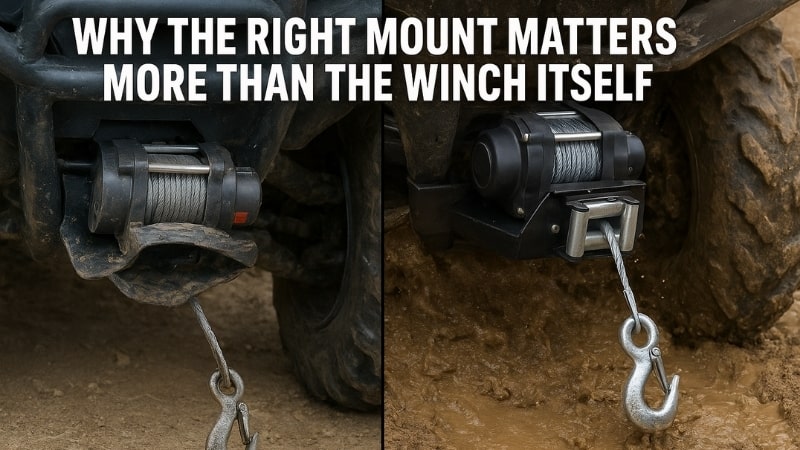
A winch mount is not just a bracket—it’s a load-bearing component that determines how effectively your winch performs under stress. A poorly chosen mount may fit your ATV, but it won’t hold up when recovery conditions become uneven or demanding.
The right mount aligns cleanly with your frame, distributes force evenly, and maintains structural rigidity when it matters most.
What Actually Makes a Good ATV Winch Mount (Most Guides Miss This)
Most buying guides reduce the conversation to compatibility. In reality, a winch mount’s performance is defined by how it handles force, not just how it bolts on.
A well-built ATV winch mount behaves like a properly stitched leather seam—it doesn’t just connect two pieces; it absorbs tension, distributes stress, and holds its form under pressure. That distinction is where most low-quality mounts fail.
Structural Thickness and Material Integrity
Steel thickness is the first real indicator of durability. Thin mounting plates—often found in budget options—flex under angled pulls. This flex may be subtle at first, but over time it leads to:
- Bolt fatigue
- Frame stress concentration
- Permanent plate deformation
Heavier-gauge steel, typically found in KFI, Warn, and SuperATV mounts, resists this flex and maintains alignment between the winch and fairlead.
Frame Integration vs Surface Mounting
Not all mounts engage the ATV frame equally.
- Frame-integrated mounts distribute load across multiple contact points
- Surface or bumper-mounted plates concentrate stress in limited areas
The difference becomes obvious during recovery scenarios. A mount that spreads load behaves predictably. One that doesn’t begins to twist, shift, or strain bolts unevenly—especially when the pull isn’t perfectly straight and the forces start shifting, similar to how load direction changes during winching, where weak mounting systems are exposed quickly.
Fairlead Alignment and Winch Geometry
An overlooked detail: alignment between the winch drum and fairlead opening.
When alignment is off:
- Cable spools unevenly
- Friction increases
- Load distribution becomes unstable
This isn’t a cosmetic issue—it directly affects winch efficiency and lifespan. Misalignment doesn’t just strain the mount—it also affects the line itself, especially when you consider the differences in rope behavior under tension, where friction, heat, and spool consistency start to play a much bigger role.
Mounting Point Density
More mounting points don’t just add stability—they reduce localized stress. A mount that connects across multiple frame sections performs more like a structural extension rather than an accessory.
A mount can technically “fit” your ATV and still fail functionally.
That’s the distinction most guides ignore—and where better decisions begin.
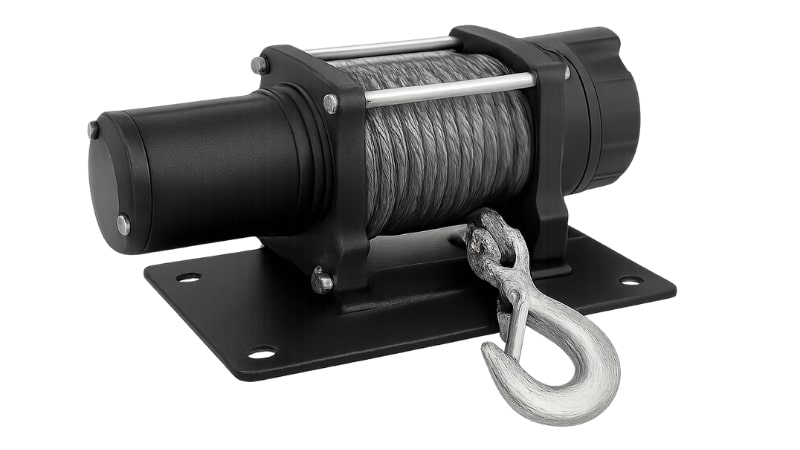
Top 10 ATV Winch Mounts – Quick Comparison
if you’re comparing options quickly, this table distills how each ATV winch mount actually performs—not just how it’s marketed.
| Product | Best For | Key Features | Specifications | Notable Advantage |
| KFI Products 100430 Winch Mount | Best overall structural reliability | 3/16″ heavy-duty steel, powder-coated finish, model-specific design | Fits select Polaris ATVs, standard 4-bolt winch pattern | Exceptional rigidity and frame-integrated load distribution |
| WARN 100380 Winch Mounting Kit | OEM-level fit for Honda ATVs | Precision-engineered steel mount, factory-aligned bolt points | Fits Honda Foreman TRX500, Rancher TRX420, Rubicon TRX500 | Seamless fitment with optimal winch and fairlead alignment |
| GRIPWAY Trailer Hitch Winch Mount Plate | Versatile receiver-based mounting | Fits 2″ receivers, powder-coated steel, cradle design | Multi-vehicle use, heavy-duty construction | Quick install/removal across vehicles |
| JY PERFORMANCE Cradle Winch Mount | Heavy-duty multi-vehicle use | Reinforced steel, integrated handles, high load capacity | Supports 8,000–13,000 lb winches, 2″ receiver fit | Truck-level pulling power in portable form |
| WeiSen Winch Mount Bracket (Polaris Sportsman) | OEM-level Polaris fitment | Precision-cut steel, powder-coated, bolt-on install | Fits 2011–2022 Polaris Sportsman models | Factory-like integration without drilling |
| Extreme Max 5600.3241 | Honda Rancher & Foreman compatibility | Laser-cut steel, corrosion-resistant finish | Model-specific for Rancher 420 & Foreman 500 | Reliable bolt-on solution for Honda ATVs |
| MaxxHaul 50688 | Budget-friendly receiver option | Lightweight steel, cradle-style mount | Fits most 2″ receivers, supports mid-range winches | Affordable, compact, and easy to store |
| ECOTRIC 10″ × 4½” Cradle Mount | Compact multi-vehicle portability | Welded steel construction, powder-coated finish | Standard bolt pattern compatibility | Space-efficient design for flexible use |
| Nilight Universal Trailer Hitch Mount | All-weather durability | Heavy-duty steel, advanced anti-corrosion coating | Fits 2″ receivers, wide compatibility | Superior rust resistance in harsh conditions |
| Guide Gear Universal Hitch Mount | Quick setup and removal | Open-frame design, heavy-duty steel construction | Compatible with most winches and 2″ receivers | Fast mounting without permanent modification |
10 Best ATV/UTV Winch Mounts: Tested & Reviewed
Whether you need a rock-solid mount for tough recoveries or a versatile option to share between vehicles, the right winch mount can make or break your off-road experience. The products below have been handpicked for their durability, fitment, and unique features that give them an edge over the competition.
From model-specific plates to universal receiver cradles, this list covers every style and budget so you can hit the trails with confidence.
1. KFI P100430 Winch Mount — Best Overall for Structural Strength
The KFI Products 100430 sets the benchmark for what a proper ATV winch mount should feel like—rigid, precise, and built with load behavior in mind, not just fitment.
Constructed from 3/16-inch steel, this mount doesn’t just support the winch—it anchors it. Under angled pulls, where weaker plates tend to flex subtly, the KFI holds its shape. That stability translates directly into smoother winching and less long-term stress on your ATV frame.
Fitment is model-specific (primarily Polaris platforms), which allows the mount to integrate cleanly with factory mounting points. Instead of forcing alignment, everything sits where it should—like a well-cut panel in a tailored jacket.
Pros:
- Excellent frame integration with multiple mounting points
- Strong resistance to flex under real recovery load
- Compatible with standard 4-bolt winch patterns
Cons:
- Only fits specific Polaris models
- May require clearance checks with aftermarket bumpers
Bottomline: If it fits your ATV, this is the most structurally reliable winch mount you can buy—balanced, durable, and built for real use.
2. WARN 100380 Winch Mounting Kit — Best OEM Fit for Honda ATVs
The WARN 100380 is less about brute strength and more about precision—engineered specifically for Honda Foreman TRX500, Rancher TRX420, and Rubicon TRX500 models.
What makes this mount stand out is its OEM-level alignment. Every bolt point, every angle, feels intentional. The winch sits exactly where it should, and the fairlead alignment remains clean—reducing cable drag and uneven spooling.
In practice, this translates into a smoother, more controlled winching experience, especially under repeated use.
Pros:
- Exceptional fitment for Honda TRX platforms
- Clean alignment with winch and fairlead
- Consistent performance under repeated load
Cons:
- Limited strictly to compatible Honda models
- Slightly higher cost than generic mounts
Bottomline: If you’re running a Honda ATV, this is one of the most refined and dependable mounting solutions available—built to integrate seamlessly rather than adapt.
3. GRIPWAY Trailer Hitch Winch Mount Plate — Best for Versatile Receiver-Based Mounting
This heavy-duty mount plate fits any standard 2-inch trailer hitch receiver, making it perfect for ATVs, UTVs, and trucks alike. Crafted from thick steel with a black powder-coated finish, it’s designed to resist rust and wear from heavy use.
Its quick-install cradle style lets you swap between vehicles or store the winch when not in use—something many fixed mounts can’t offer.
Pros:
- Fits standard 2-inch receivers
- Durable steel with powder coating
- Easy install and removal
- Works with multiple vehicles
Cons:
- Receiver clearance may be tight on smaller ATVs
- Adds front-end protrusion
Bottom line: A great choice for riders who want one rugged mount to share across multiple machines without compromising strength or durability.
4. JY PERFORMANCE Cradle Winch Mount — Best for Heavy-Duty Multi-Vehicle Use
Designed to handle winches rated from 8,000 to 13,000 lbs, this cradle mount brings truck-level pulling power to your ATV/UTV setup. It features reinforced steel construction, integrated handles for portability, and a universal bolt pattern.
The ability to slide into a standard receiver and be moved between rigs makes it a workhorse for farm, trail, and rescue scenarios—something lighter mounts just can’t match.
Pros:
- Massive load capacity
- Integrated carry handles
- Universal bolt pattern compatibility
- Quick receiver install/removal
Cons:
- Heavier than typical ATV mounts
- Overkill for smaller winches
Bottom line: If you run high-capacity winches and need one mount to rule them all, this cradle handles the toughest loads while staying portable.
5. WeiSen Winch Mount Bracket Plate (Polaris Sportsman) — Best for OEM-Level Fitment
Built specifically for 2011–2022 Polaris Sportsman models, this mount plate offers a perfect bolt-on fit with zero drilling required. Precision laser-cut steel ensures strength, while a corrosion-resistant coating keeps it looking fresh season after season.
The tailored design means no guesswork—just factory-like integration that universal mounts can’t replicate.
Pros:
- Exact model fitment
- No drilling required
- Durable powder-coated steel
- Keeps factory appearance
Cons:
- Only fits listed Sportsman models
- No quick-swap option
Bottom line: Thsi WeiSen Winch Mount Ideal for Polaris Sportsman owners who want a clean, factory-style install that’s as strong as it is seamless.
6. Extreme Max 5600.3241 ATV Winch Mount — Best for Honda Rancher & Foreman Models
Tailored to fit select Honda ATVs – Rancher 420 and Foreman 500 ATVs, this mount plate delivers precision fit and high-strength performance. It’s made from laser-cut steel with a black powder finish to withstand mud, water, and rust. The bolt-on design ensures quick installation, making it a go-to for Honda owners looking for reliability without modification hassles.
Pros:
- Perfect fit for specific Honda models
- Corrosion-resistant coating
- High-strength steel construction
- Easy installation
Cons:
- Limited to certain Honda models
- Not designed for quick removal
Bottom line: A dependable, model-specific solution for Honda Rancher and Foreman riders who want strong, no-fuss winch mounting.
7. MaxxHaul 50688 Universal Hitch Winch Mount — Best Budget-Friendly Receiver Option
This universal winch mount offers solid construction at a wallet-friendly price, making it great for occasional users. It fits 2-inch receivers and supports most winches up to a mid-range capacity.
The removable cradle design allows you to store the winch when not in use—protecting it from weather damage and extending its life.
Pros:
- Affordable price point
- Fits most 2-inch receivers
- Lightweight yet strong steel build
- Easy to store winch off-season
Cons:
- Not for extreme heavy-duty loads
- Receiver tolerance can vary
Bottom line: An excellent entry-level choice for riders who want functional versatility without overspending.
8. ECOTRIC 10″ × 4½” Cradle Winch Mount — Best for Compact, Portable Applications
This one also features a cradle mount, a compact footprint with a standard 10″ × 4½” bolt pattern, making it compatible with most standard winches. Its welded steel frame and black powder coating provide long-term durability, while the portable design makes it easy to transfer between ATVs, UTVs, and trucks.
The size and portability give it an edge for riders tight on space.
Pros:
- Compact and easy to store
- Fits standard winch bolt patterns
- Rugged steel construction
- Multi-vehicle compatibility
Cons:
- Smaller size may limit load capacity
- No integrated fairlead mount in some setups
Bottom line: Perfect for riders who need a strong, space-saving winch mount they can move between machines effortlessly.
9. Nilight Universal Trailer Hitch Winch Mounting Plate — Best for All-Weather Durability
Nilight’s universal winch mount plate fits 2-inch receivers and comes with a reinforced structure for better load handling. The standout feature is its superior anti-corrosion coating, which makes it perfect for wet, salty, or snowy environments.
Combined with a wide compatibility range, it’s a go-to for all-weather, all-terrain riders.
Pros:
- Excellent anti-corrosion finish
- Fits most standard winches and receivers
- Solid welded frame construction
- Works across multiple vehicles
Cons:
- Slightly heavier than comparable mounts
- Receiver fitment can require adjustment
Bottom line:
If you ride year-round through mud, snow, and rain, this corrosion-resistant mount will outlast the elements.
10. Guide Gear Universal Hitch Winch Mount — Best for Quick Setup and Removal
Designed for maximum convenience, this universal mount slides into 2-inch receivers and supports a wide range of winch sizes. It’s made from heavy-duty steel with a durable finish and features an open design that makes bolting on winches a breeze.
The simple and rapid setup process is perfect for riders who swap gear frequently.
Pros:
- Quick install and removal
- Works with most winch sizes
- Heavy-duty steel frame
- Affordable and versatile
Cons:
- No model-specific fitment
- Can add front-end bulk
Bottom line: A smart choice for riders who value fast, flexible winch mounting without permanent modifications.
Universal vs Model-Specific Winch Mounts (What Actually Works)
At first glance, universal and model-specific mounts appear to solve the same problem. In practice, they behave very differently under load—like comparing a tailored leather harness to an adjustable strap. Both hold, but only one distributes tension with precision.
Why Model-Specific Mounts Almost Always Perform Better
Model-specific ATV winch mounts are engineered to match the exact geometry of your frame. That precision matters more than most riders expect.
Because they align with factory mounting points:
- Load is distributed across the chassis instead of isolated bolts
- Fairlead positioning stays consistent
- Installation avoids guesswork
More importantly, they eliminate one of the biggest hidden risks—misalignment. A mount that sits even slightly off-axis introduces uneven stress, which compounds over time.
This is why many manufacturers design mounts around specific ATV models and winch configurations—because true compatibility isn’t universal. And that compatibility goes beyond the mount itself; it’s tied to how winch size and capacity are matched to your machine, which ultimately determines how much load the mounting system has to handle.
Where Universal Mounts Make Sense (and Where They Don’t)
Universal mounts exist for flexibility, not performance.
They work best when:
- You’re using lighter winches (2,000–3,600 lb range)
- Fitment happens to align closely with your frame
- You need a temporary or shared setup
But their limitations show quickly under real stress:
- Bolt patterns may “fit” but not sit perfectly flush
- Load concentrates in fewer mounting points
- Minor flex becomes structural fatigue over time
A universal mount is like using a one-size belt—it can work, but it rarely holds tension exactly where it should. This becomes more noticeable when comparing different machine setups, especially once you understand the practical differences between ATV and UTV winch configurations and how each handles load and mounting stress.
Receiver-Mounted Systems: Flexibility vs Stability
Receiver hitch mounts sit in a category of their own. They’re designed for versatility—allowing you to move a winch between vehicles or mount it only when needed.
That flexibility comes with a trade-off:
- Additional mounting layers reduce rigidity
- Load transfer is less direct than frame-mounted systems
- Stability depends heavily on hitch quality
Receiver mounts excel in convenience, but they are structurally less integrated than dedicated frame mounts. They also tend to pair better with setups where winch sizing and application are chosen with flexibility in mind, rather than maximum recovery performance.
The Practical Takeaway
If you ride regularly in mud, rocks, or recovery-heavy terrain:
→ Choose model-specific mounts
If your use is occasional or multi-vehicle:
→ Universal or receiver mounts can work—but with limits
The key insight is simple: Fitment is not just about whether a mount bolts on—it’s about how it carries force once it does.
Real-World Scenario: What Happens When the Mount Isn’t Strong Enough
A winch mount rarely fails all at once. It fails gradually—quietly—until one pull exposes everything.
Picture this: your ATV is sunk deep in wet clay, wheels spinning without traction. You engage the winch, and everything feels normal—at first.
Then the subtle signs begin.
Phase 1: Micro Flex
Under load, the mount plate begins to flex slightly. You won’t see it immediately, but the stress is already concentrating at the bolt points.
This is where thin steel reveals itself—not by breaking, but by bending just enough to compromise alignment.
Phase 2: Load Misalignment
As the plate flexes:
- The winch drum pulls at a slight angle
- The cable starts feeding unevenly
- The fairlead experiences friction it wasn’t designed for
At this stage, performance drops. The winch works harder, but pulls less efficiently—often the result of small setup errors that build over time, similar to the kinds of issues riders run into when they overlook common winching mistakes that affect recovery performance.
Phase 3: Structural Fatigue
Repeated use compounds the problem:
- Bolt holes widen
- Mounting points weaken
- Plate deformation becomes permanent
Eventually, the mount no longer returns to its original shape. What starts as minor inefficiency gradually turns into a system-level problem that many riders only notice when diagnosing why a winch setup stops working as expected under load.
Phase 4: Failure Under Stress
This is where things go wrong—usually when you need the system most.
A weak or poorly fitted mount can:
- Shift under load
- Tear at mounting points
- Transfer stress into the ATV frame itself
And at that moment, your winch—no matter how powerful—becomes unreliable.
As many off-road scenarios show, failure rarely comes from one big mistake—it’s usually the result of repeated strain, poor alignment, and overlooked warning signs.
The Insight Most Riders Miss
Winch mounts don’t fail because they’re used once.
They fail because they’re slightly inadequate every time they’re used.
Like poorly stitched leather, the weakness isn’t obvious—until tension exposes it.
Installation Reality Check Before You Buy
Installation is where expectations and reality tend to diverge. Most mounts are marketed as “bolt-on,” but the experience varies depending on design precision and ATV model.
Understanding this before buying saves time—and prevents frustration. Even mounts designed for easy fitment can become challenging if you’re not familiar with how a proper winch installation should come together from start to finish.
Fitment vs Actual Installation
A mount labeled as “compatible” doesn’t guarantee a seamless install.
Even with model-specific mounts:
- Tight clearances can complicate alignment
- Access to mounting bolts may be restricted
- Minor adjustments are sometimes required
Universal mounts amplify these challenges. Because they aren’t designed for a specific frame, alignment becomes trial-and-error—especially if you’re working without a clear reference for how mounting, alignment, and wiring are supposed to be handled in a complete setup.
Hidden Friction Points
What slows most installations isn’t complexity—it’s access.
Common issues include:
- Hard-to-reach bolt positions behind skid plates
- Interference with factory components
- Limited space for tools
These small obstacles extend install time far beyond expectations. They also increase the chances of mistakes during routing and connections, particularly when dealing with winch wiring and control setup in tight spaces, where precision matters more than speed.
Bolt Patterns and Compatibility
Most ATV winches use standard mounting patterns (commonly 4-bolt configurations), but spacing can vary.
That means:
- A mount can accept your winch
- But still misalign with your ATV
This dual compatibility—winch to mount, mount to ATV—is where many setups fail. Even small inconsistencies here can affect long-term reliability, especially if the system isn’t installed with the same care you’d apply when properly mounting and aligning a winch on an ATV from the ground up.
Drilling and Modification (When It Happens)
While many mounts are advertised as no-drill, some setups still require:
- Minor drilling into mounting points
- Adjustments to brackets
- Spacer use for alignment
These aren’t deal-breakers—but they matter if you expect a clean install. In cases like this, understanding what a correct installation process looks like before you begin makes the difference between a controlled adjustment and a frustrating trial-and-error process.
The Practical Takeaway
Installation quality often mirrors product quality.
- Precise mounts install with minimal resistance
- Generic mounts require adaptation
A smooth installation isn’t just convenient—it’s usually a sign that the mount will perform correctly under load.
Common Mistakes (And Why Most Buyers Get This Wrong)
Most buying mistakes don’t come from lack of effort—they come from focusing on the wrong details. Riders often prioritize price or convenience, overlooking the structural role the mount actually plays.
Mistake 1: Treating All Mounts as Equal
Not all winch mounts behave the same.
Different ATVs and winches require different mounting systems, and assuming universal compatibility leads to poor fitment and compromised performance—especially when riders don’t fully understand how different setups compare in real-world use, including which winch types and configurations actually perform reliably across different conditions.
Mistake 2: Choosing Universal First
Universal mounts are tempting because they promise flexibility.
But flexibility often comes at the cost of:
- Reduced structural integrity
- Increased alignment issues
- Higher long-term wear
They solve short-term convenience, not long-term reliability. This is the same trade-off many riders face when comparing budget setups, particularly when trying to balance cost with performance in winch options that seem affordable but don’t always hold up under real recovery stress.
Mistake 3: Ignoring Load Direction
Winching isn’t always a straight pull.
When pulling at angles:
- Stress shifts unevenly across the mount
- Weak designs begin to flex
- Mounting points absorb more strain than intended
A mount that performs well in a straight line may struggle under angled loads—something that becomes more obvious when you start comparing how different winch setups handle real trail and mud recovery situations.
Mistake 4: Overvaluing Winch Power Over Mount Strength
Many riders invest in stronger winches without upgrading the mount.
But the system is only as strong as its weakest point.
A high-capacity winch paired with a weak mount:
- Increases stress on the mounting system
- Accelerates failure
- Reduces overall effectiveness
This often happens when buyers focus only on specs or brand reputation, without considering which winch systems are actually built for long-term reliability in demanding conditions.
Mistake 5: Skipping Fitment Verification
Even model-specific mounts require verification.
Checking:
- ATV model year compatibility
- Bolt pattern alignment
- Clearance around key components
Prevents installation issues later. Skipping this step is one of the most common reasons setups fail early—especially when buyers rely on assumptions instead of verifying whether a winch and mounting setup truly matches their machine and use case.
Closing Thought for This Section
The difference between a reliable winch setup and a frustrating one rarely comes down to the winch itself.
It comes down to the mount—how it fits, how it holds, and how it behaves when tension is no longer theoretical.
How to Choose the Right ATV Winch Mount (and Which Ones Actually Hold Up)
Choosing the right ATV winch mount isn’t about picking the strongest option on paper—it’s about matching structure, fitment, and intended use with precision. Like selecting the right leather weight for a specific application, the wrong choice may still function, but it won’t age or perform the way it should.
The decision becomes clearer when broken into three practical filters.
Start With Your ATV Model and Frame Design
Everything begins with compatibility—not just in name, but in geometry.
A proper mount should:
- Align with factory mounting points
- Sit flush against the frame without gaps
- Maintain correct fairlead positioning
Even slight misalignment introduces stress that compounds over time. This is why model-specific winch mounts consistently outperform universal options—they are designed with your ATV’s structure in mind, not adapted to it.
If your ATV model has a dedicated mount available, that is almost always the correct starting point—especially if you’ve already looked at which mounting options actually hold up across different ATV models and riding conditions.
Match the Mount to Your Winch Capacity
Winch mounts and winches must be treated as a system.
A heavier winch (3,500–4,500 lbs and above) generates significantly more force—not just forward, but across mounting points. Pairing a high-capacity winch with a light-duty mount creates imbalance.
What to look for:
- Steel thickness appropriate for your winch rating
- Reinforced mounting points
- Stable fairlead alignment under load
A useful rule:
If your winch is designed for recovery, your mount should be designed for resistance—not just compatibility. This becomes even more important when comparing which winch kits and setups are built for real recovery scenarios rather than light-duty use.
Define Your Use Case Honestly
The right mount depends heavily on how you ride.
- Light trail use: A mid-range model-specific mount is more than sufficient
- Mud, recovery, or heavy terrain: Prioritize thick steel and full frame integration
- Multi-vehicle or occasional use: A receiver-mounted system may justify its compromises
Many riders overestimate flexibility and underestimate load conditions. The result is a mount that works—until it doesn’t. This is why experienced riders often evaluate which winch setups consistently perform in demanding environments like mud, trails, and recovery situations before making a final decision.
Balance Installation vs Long-Term Performance
Ease of installation matters, but it shouldn’t outweigh structural integrity.
- A mount that installs quickly but flexes under load creates long-term issues
- A mount that requires minor effort but fits precisely tends to perform reliably
In practice, a slightly more involved installation often signals better design alignment—especially when paired with winch systems known for long-term reliability rather than short-term convenience.
The Decision Framework
To simplify:
- Find a model-specific mount for your ATV
- Ensure it matches your winch capacity
- Choose based on real riding conditions—not ideal ones
Everything else—brand, finish, price—comes after these fundamentals.
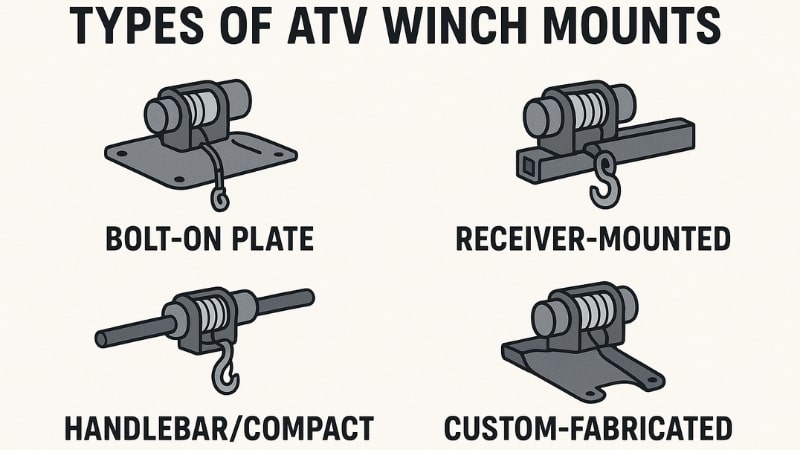
At a Glance: Which Mount Suits You Best?
Choosing a mount feels confusing—so many styles and parts. This simple table helps you zone in on what fits your riding style and needs. Use it as your quick reference before diving into the detailed sections.
| Use Case | Mount Type | Key Benefits | Trade-offs |
| Everyday Utility | Bolt-On Front Plate | Strong connection, stays firmly in place | Permanent (not easy to remove) |
| Winter Plow / Seasonal | Receiver-Mounted | Swappable, flexible, durable for plowing | Adds protrusion and extra weight |
| Sport / Light Use | Handlebar / Compact | Sleek, less weight forward, ideal for small winches | Lower load tolerance |
| Custom Builds / Heavy Duty | Fabricated | Tailored strength, great integration | Requires welding or fabrication skill |
FAQs on ATV Winch Mounts
Will any ATV winch mount fit any ATV?
No, not all ATV winch mounts are universal. Most mounts are designed for specific ATV models to ensure proper alignment and load distribution. While universal mounts exist, they often require adjustments and may not provide the same structural integrity as model-specific options.
Do I need a mounting plate for my ATV winch?
Yes, an ATV winch typically requires a mounting plate or dedicated mount to attach securely to the frame. The mount ensures proper alignment with the fairlead and distributes load evenly during operation, which is essential for both performance and long-term durability.
Can I install a winch mount without drilling?
Many model-specific ATV winch mounts are designed as bolt-on systems and do not require drilling. However, some setups—especially universal mounts—may need minor modifications or drilling to achieve proper fitment and alignment.
Are universal winch mounts reliable?
Universal winch mounts can be reliable for light-duty use, but they often lack the precise fit and structural stability of model-specific mounts. For heavy recovery or frequent use, a dedicated mount designed for your ATV model is the more dependable option.
What size winch mount do I need?
The size of the winch mount depends on both your ATV frame and your winch’s bolt pattern. Most ATV winches use a standard 4-bolt mounting pattern, but spacing and compatibility vary, so it’s important to verify both mount and ATV fitment before purchasing.
Final Verdict and Recommendations
A winch mount is one of those components that rarely gets attention—until it fails. And when it does, it reveals its importance immediately.
The best ATV winch mount isn’t the one with the most features or the lowest price. It’s the one that integrates cleanly with your ATV, holds its structure under load, and maintains alignment when recovery conditions are less than ideal.
Best Choices by Use Case
- Best overall: KFI model-specific winch mount
- Best premium option: Warn winch mount kit
- Best mid-range: SuperATV winch mount
- Best budget: Extreme Max (light-duty only)
- Best for flexibility: Champion receiver mount
Each of these works—but only in the right context. If you’re comparing options more closely, it helps to look at which winch brands and product combinations consistently perform well across different setups, rather than choosing based on name alone.
The Core Insight
Most riders focus on the winch. Experienced riders focus on the mount.
Because in real conditions, power means very little if the structure holding it cannot carry the load. That’s also why riders who’ve tested different setups tend to prioritize winch systems known for reliability under repeated recovery use, not just peak specs on paper.
Final Recommendation
If your ATV supports a model-specific mount, choose it.
If you ride in demanding conditions, prioritize thickness and frame integration.
If you need flexibility, accept the trade-offs consciously.
Everything else is secondary. And if you’re still deciding, reviewing real-world winch performance and comparisons across different price ranges can make it much easier to match the right setup to your riding style.
A well-chosen winch mount doesn’t draw attention to itself.
It simply holds—quietly, consistently, and without compromise—when everything else is under tension.
Continue exploring related topics:
- replacing a worn or faulty winch solenoid
- how to test whether your winch solenoid is working properly
- which winch brands and models are actually worth considering

ATVNotes is an off-road resource focused on ATV and UTV winching, recovery systems, safety gear, tires, batteries, and essential off-road equipment. Content is produced by the ATVNotes Expert Team and written from the perspective of a practical off-road recovery advisor, emphasizing real-world performance, system compatibility, and safety-first practices across trail riding, utility use, and off-road exploration.